
Lieing or lying? The correct spelling is lying. English has no word spelled “lieing,” even though it can look right when you type fast.
This guide explains the simple rule behind it, shows both meanings of lie, and covers lay and lied, so you can use every form with confidence.
Quick Answer
Lying is the only correct spelling. Lieing is a common mistake, not a word.
- Correct: lying
- Incorrect: lieing
In the lieing or lying question, lying wins every time. It works for both meanings: resting flat and not telling the truth.
Example: She is lying on the sofa, and he is lying about why he is late.
Simple Background
Most verbs just add -ing, like walk and walking. Verbs that end in -ie change the -ie to -y first.
Example: One walk becomes walking, but one lie becomes lying.
That one swap explains the whole lieing or lying mix-up. People treat lie like a regular verb and add -ing without changing anything. The y keeps the same “eye” sound and lets -ing attach cleanly.
Other -IE Verbs That Follow the Same Rule
Every common verb ending in -ie follows this rule. Lie, die, tie and vie all change to -y before -ing.
| Verb | -ing form |
| lie | lying |
| die | dying |
| tie | tying |
| vie | vying |
| untie | untying |
| belie | belying |
Once you know the pattern, you don’t need to memorize each word. The lieing or lying rule works for every verb that ends in -ie.
Example: He is untying his shoes while the campfire is dying down.
Where Does “Lying” Come From? A Quick Word History
Lying comes from two different verbs that look the same. One means to rest flat, and the other means to say something untrue.
Merriam-Webster lists them as separate verbs. The resting verb comes from Old English licgan, which is distantly related to the Latin word for bed. The untruth verb comes from Old English lēogan, and the noun lie comes from the Old English lyge.
So the two meanings are not close cousins. They ended up with the same spelling, which is why the lieing or lying question has just one answer: lying.
Example: Licgan gave us “lying down,” while lēogan gave us “lying to a friend.”
Clear Explanation of the Difference
In the lieing or lying debate, lying is a real word with two meanings. Lieing is a spelling error with no meaning at all.
What is “Lying”?
Lying is the -ing form of the verb lie. It means either resting in a flat position or saying something untrue.
- Resting: The dog is lying under the porch.
- Not telling the truth: He is lying about where he was last night.
The spelling never changes between the two meanings. Only the context tells you which one you mean.
What is “Lieing”?
Lieing is not a word. It appears when someone adds -ing to lie without making the y swap.
It has no meaning of its own, and dictionaries don’t list it as a form of lie.
- Wrong: She was lieing on the couch all afternoon.
- Right: She was lying on the couch all afternoon.
Lie vs. Lay vs. Laying: Don’t Mix These Up
Lie means to rest flat and takes no object. Lay means to put something down and always needs an object.
| Verb | Meaning | Present | Past | Past participle | -ing form |
| lie | to rest flat | lie | lay | lain | lying |
| lie | to say something untrue | lie | lied | lied | lying |
| lay | to put something down | lay | laid | laid | laying |
Here’s a quick test. If something is being placed somewhere, use lay or laying. If a person or thing is just resting, use lie or lying.
Example: I lay my keys on the shelf, and then I lie on the sofa.
The two lie verbs share one -ing form, so the table also shows why lieing or lying only has one right answer.
Lie, Lied, Lay: Past Tense of Lie
The past tense depends on the meaning. When you mean resting, the past is lay. When you mean telling an untruth, the past is lied.
Example: Yesterday she lay awake for hours, and her brother lied about the broken window.
The tricky part is that lay is also the present tense of a different verb. “I lay the cards down” is present tense, but “I lay awake last night” is past tense of lie.
None of this changes the lieing or lying answer, because the -ing form is always lying. The past participles are different too. For resting, use lain: she has lain there all morning. For untruths, use lied: he has lied before.
Comparison Table
Only lying is correct here, and lieing never is. Laying is a different word with a different meaning.
| Word | Correct? | Meaning |
| lying | Yes | resting flat, or saying something untrue |
| lieing | No | a spelling mistake |
| laying | Yes | putting something down |
| lied | Yes | past tense of lie (untruth) |
| lain | Yes | past participle of lie (resting) |
Keep this table in mind when you proofread lieing or lying. It covers the forms that cause the most confusion.
Example: He is laying the cards on the table while she is lying on the rug.
Read Also Plural of Chief: Chiefs or Chieves? Rule, Examples & Origin
Which One to Use and When
Use lying every time, in every kind of writing. There is no formal or casual setting where lieing is correct.
If you doubt lieing or lying in a draft, pick lying. Treat lieing like any typo, fix it and move on. Spell checkers often catch it, but quick texts and social posts can slip through.
Pick your other forms by meaning. Use lie or lying for resting, lied for untruths in the past, and lay or laying when you put something down.
Example: In a text, write “I’m lying on the couch, so call me later.”
How to Pronounce “Lying” Correctly
Lying is pronounced “LY-ing,” with two syllables. It rhymes with trying and flying.
The sound is written /ˈlaɪ.ɪŋ/. The first part sounds exactly like the word lie.
Lieing and lying would sound the same if anyone said lieing out loud. So sound can’t settle lieing or lying. It is a writing problem, not a speaking problem, and only your eye can catch it.
Example: Say it with its rhymes: lying, trying, flying.
Simple Tip to Remember
Remember this swap: ie becomes y before -ing. Then think of three words together: lie, die and tie.
Example: lie becomes lying, die becomes dying, and tie becomes tying.
Use this tip whenever lieing or lying slows you down. If you ever type “ieing,” stop and look again. English doesn’t use that ending for these verbs. A quick check for “ie” before “ing” fixes the problem every time.
Dying vs Dyeing: When the E Stays

Dying means losing life, and dyeing means changing a color. Dyeing keeps its e so it doesn’t look like dying.
Example: The plant is dying, and she is dyeing her scarf blue.
This is a close cousin of the lieing or lying rule. Verbs that end in -ie swap to -y, so die becomes dying. But dye ends in -ye, so it keeps the e and becomes dyeing. The word singe works the same way: singeing.
Lieing or Lying Common Mistakes People Make

Most lieing or lying mistakes come from three habits. Writers keep the ie, forget the spelling change, or trust their ears.
1. Keeping the “ie”
The most common mistake is keeping the ie and adding -ing. Change the ie to y instead.
- Wrong: He kept lieing to his manager.
- Right: He kept lying to his manager.
2. Forgetting spelling-change rules
Many writers forget that some verbs change before -ing. This is true for more than lie.
Make loses its e (making), run doubles its n (running), and lie changes its ie (lying). Each has its own small rule.
Example: making, running and lying all change before -ing.
3. Confusing pronunciation and spelling
Lieing and lying sound the same, so the ear can’t tell them apart. Only the eye can.
Some writers assume that two spellings with one sound must both be right. English doesn’t work that way, and this is a clear case.
Example: Both would be said “LY-ing,” but only lying is correct.
Lieing or Lying Everyday Real Life Examples
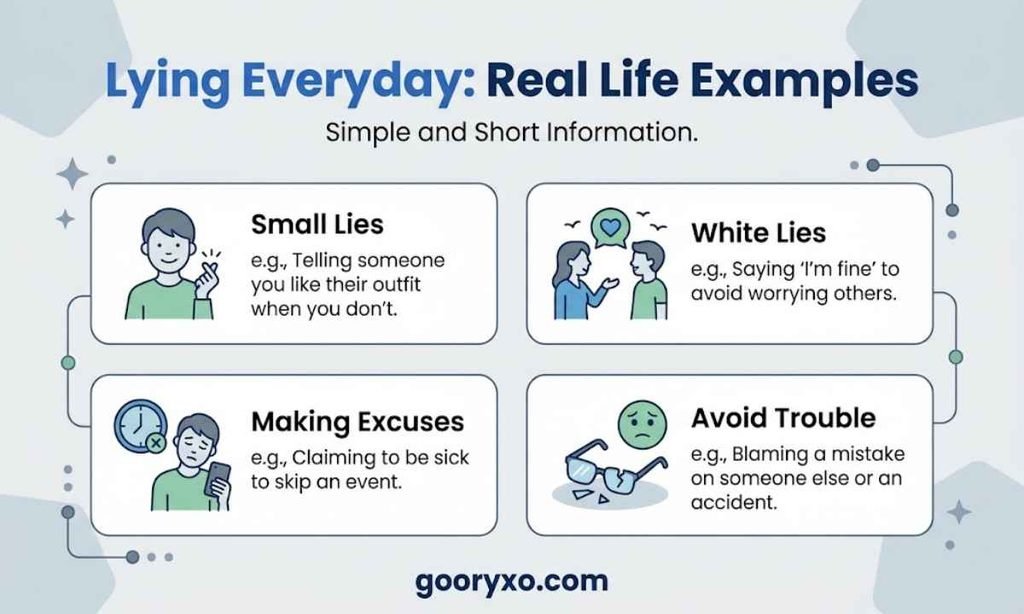
Lying shows up in daily life in two ways: resting and not telling the truth. These examples show both.
In Daily Life
Lying is common in home and family talk. It usually describes resting or a small untruth.
- The cat has been lying on the windowsill all morning.
- He was lying about finishing his homework.
In Messages
In texts, lying is short and quick. It is easy to mistype, so check it before you send.
- Are you lying to me right now?
- Just lying around the house today.
On Social Media
Posts often use lying for both a mood and a complaint.
- Currently lying in bed and avoiding my to-do list.
- Stop lying to your followers about that product.
In School
School writing uses lying for both things in a room and honesty in a story.
- The textbooks were lying open on every desk.
- The essay explained why lying to a friend hurts trust.
Short Learning Section for Students
Students can master the lieing or lying rule in four quick steps. No long grammar notes are needed.
Step 1: Learn the rule
Learn one line: ie becomes y before -ing. That single rule settles the lieing or lying question.
Example: lie to lying.
Step 2: Practice
Write six short sentences. Use lying for resting in two, lying for untruths in two, and lay or lied in the last two.
Practice builds the habit faster than reading rules.
Step 3: Use memory trick
Link lie to its two cousins, die and tie. If dying and tying feel natural, lying will too.
Example: dying, tying, lying.
Step 4: Check spelling carefully
Before you send an essay or email, scan for “ie” followed by “ing.” That quick look catches the error.
Read Also Plural of Chief: Chiefs or Chieves? Rule, Examples & Origin
Lieing or Lying Down
The correct phrase is lying down. Lieing down is never right.
Lie down is the base form. Its past is lay down, and its -ing form is lying down. People often say “lay down” in speech, but careful writing keeps lie for resting.
Example: I’m lying down for ten minutes before dinner.
Lieing or Lying in Bed
The correct phrase is lying in bed. Lieing in bed is not a recognized spelling.
People also write “laying in bed,” but that is a different verb. You only lay something in bed, like a blanket or a baby. A person who rests there is lying.
For the past, say “she lay in bed” or “she has lain in bed.”
Example: She spent the whole morning lying in bed with a book.
Lieing or Lying to Someone
The correct phrase is lying to someone. The past tense is lied, as in “he lied to me.”
Example: Stop lying to me about where you were.
The lieing or lying rule stays the same whether you talk about resting or untruths. Only the meaning changes. You can also say lie about something, as in “he lied about his age.”
Lying as a Noun and Adjective: Lying Low, Lying in Wait
Lying can also work as a noun, as in “Lying is wrong.” It can be an adjective too, as in “a lying witness.”
You’ll also see it in set phrases. Lying low means staying out of sight. Lying in wait means hiding to surprise someone. Low-lying describes land that sits close to sea level.
The lieing or lying rule still applies here. Every one of these keeps the same lying spelling.
Example: The low-lying fields flooded while the fox was lying in wait.
Liar or Lier: A Related Spelling Mix-Up
A person who tells lies is a liar. Lier is a rare real word, but it means one who lies, as in resting or waiting in ambush.
Merriam-Webster lists lier, but most people never use it. For a person who tells untruths, you want liar. Many spell checkers flag lier for that reason.
Example: Nobody trusts a liar for long.
Quick Self-Check: Test Yourself
Choose the right word in each line. Then check your answers.
- The dog is ___ on the porch. (lying / lieing)
- He was caught ___ about his age. (lying / lieing)
- She ___ awake all night yesterday. (lay / laid)
- He ___ to his boss last week. (lay / lied)
- She is ___ her hair red. (dying / dyeing)
- The old tree is slowly ___. (dying / dyeing)
- Please ___ the book on the table. (lie / lay)
- A ___ never admits the truth. (liar / lier)
Answers: 1) lying, 2) lying, 3) lay, 4) lied, 5) dyeing, 6) dying, 7) lay, 8) liar.
Summary
Lieing or lying? Lying is correct every time. Change the ie to y before -ing, and the same rule gives dying and tying.
Remember that lie is really two verbs, with lay and lied as their past forms. Dyeing keeps its e, and a liar is the person who tells lies. Keep that in mind, and the lieing or lying question won’t slow you down again.
Frequently Asked Questions
Is it lieing or lying?
It is lying. Lieing is not a word, and it only appears as a spelling mistake.
Why does lie become lying instead of lieing?
Verbs that end in -ie change to -y before -ing. That is why lie becomes lying, die becomes dying, and tie becomes tying.
What is the past tense of lie?
It depends on the meaning. The past of lie (to rest) is lay, and the past of lie (to say something untrue) is lied.
Is it lying down or laying down?
For a person who is resting, it is lying down. Laying down means placing something down, like laying a book on a table.
Is lieing or lying spelled differently in British English?
No. British and American English both use lying. Neither one accepts lieing.
Is lier a word?
Yes, but it is rare. Lier means one who lies, as in resting or hiding in wait. A person who tells lies is a liar.

My name is Ashfaq, and I am an English teacher with 5 years of teaching experience, specializing in English grammar. My mission is to make grammar easy to understand through simple explanations, practical examples, and helpful learning resources. At Gooryxo, I aim to help learners improve their grammar, strengthen their writing skills, and use English with confidence.

1 thought on “Lieing or Lying? Correct Spelling, Rule & Examples”