
Losing means failing to keep or win something. Loosing means letting something go free. If you’re stuck on loosing vs losing, the word you want is almost always losing.
The two spellings come from different verbs, which is why they can’t trade places. Below you’ll find clear meanings, pronunciation, idioms, and a short quiz, so you can pick the right one without a second thought.
Comparison Overview
Losing deals with defeat, absence, and decline, while loosing deals with release. They grow out of two separate verbs, lose and loose, so neither can stand in for the other.
Example: The rider is losing her balance, and the falconer beside her is loosing a hawk.
Think of them as two different actions that happen to share most of their letters. One describes something slipping away from you. The other describes you letting something go, usually on purpose.
Merriam-Webster, the Oxford English Dictionary, and Cambridge Dictionary all treat the two verbs separately, so neither spelling is a casual variant of the other. Loosing is simply the rarer one, which is why this pair shows up so often on lists of commonly confused words.
Definition of Loosing
Loosing (/ˈluːsɪŋ/) is the present participle of the verb loose, which means to release, let fly, or set free. The loosing meaning is simple: letting something go on purpose. You’ll spot it mostly in archery, falconry, sailing, and older or formal writing.
The verb runs loose, looses, loosed, loosing. In the loosing vs losing pair, this is the rarer word, so don’t expect to need it often. Close synonyms include releasing, unleashing, untying, and unfastening, while its opposites are tightening, securing, and binding.
Example: The archer is loosing her third arrow just as the wind settles.
In archery, the release of an arrow has long been called “the loose,” which shows how closely this meaning is tied to the verb. Outside sport, you may bump into it in religious and literary passages, where “binding and loosing” shows up as a pair.
Definition of Losing
Losing (/ˈluːzɪŋ/) is the present participle of the verb lose, which means to no longer have something, to fail to win, or to misplace it. The losing meaning is wide, and it’s one of the most common verbs in everyday English.
The root verb runs lose, loses, lost, losing, and it has relatives like loss, losses, and loser. It covers keys, matches, money, customers, weight, patience, hope, and even people.
Our shop is losing customers to the new mall, and the owner is losing sleep over it. Example: that single sentence uses the same word for a business problem and a personal one, which is typical of how flexible losing is.
Main Differences Between Loosing vs Losing
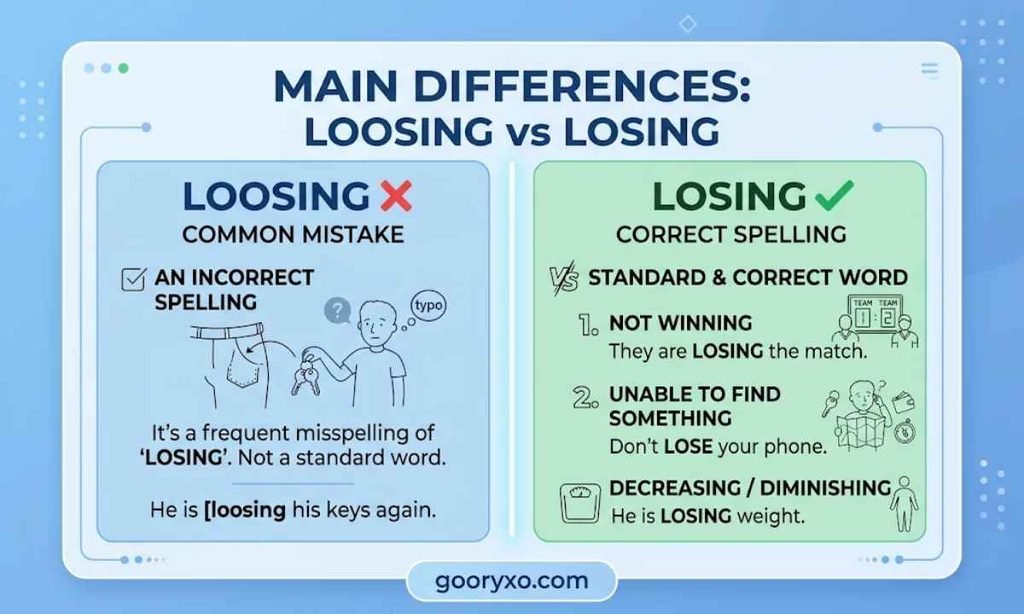
The biggest difference between loosing vs losing is meaning: loosing releases, losing fails or misplaces. Everything else in the table below follows from that.
| Feature | Loosing | Losing |
| Base verb | loose | lose |
| Core meaning | release, set free | fail to keep, win, or find |
| Pronunciation | /ˈluːsɪŋ/ (hissing s) | /ˈluːzɪŋ/ (buzzing z) |
| Past tense | loosed | lost |
| Needs an object (transitive)? | Almost always | Not always |
| How common | Rare, specialist | Everyday |
| Typical settings | Archery, animals, ropes, literary writing | Games, money, keys, emotions |
| Opposite (antonym) | Tightening, binding | Winning, finding, keeping |
The pronunciation row matters more than it looks. The two words are close, but they aren’t twins, and that small s-versus-z gap is covered in detail further down.
Example: The coach is losing patience with the defense, while the kennel manager is loosing the dogs for their afternoon run.
Grammar Guide
Grammar alone can’t separate these two, because both are plain -ing forms. What decides the spelling is the verb underneath.
Example: Lose plus -ing gives losing, and loose plus -ing gives loosing. In both cases the final e drops before the ending.
How each term is used in sentences
Both words work as a present participle in continuous tenses and as a gerund that acts like a noun.
Example: “She’s losing altitude” and “He was loosing the knot” are continuous forms. “Losing a close match hurts” and “Loosing the hounds took three handlers” are gerunds.
One more difference: loosing nearly always needs something to act on, like an arrow, a rope, or a falcon, so it works as a transitive verb. Losing can also stand alone, as in “Our team is losing,” and that sentence would sound wrong with loosing.
Common mistakes learners make
The big one is writing loosing when the meaning is failure or misplacement. It happens to ESL learners and native speakers alike, because “loose” has two o’s and the extra letter pushes people to add it to lose.
- “I’m loosing weight” should be “I’m losing weight.”
- “We kept loosing the lead” should be “We kept losing the lead.”
- “I always loose my charger” should be “I always lose my charger,” since loose is being used as a verb for the wrong meaning.
- “Looses” and “loses” get swapped for the same reason.
- Spellcheck and autocorrect stay quiet, because both loosing and losing are real words.
Example: “He’s loosing his hair” sounds like he’s setting it free. The intended sentence is “He’s losing his hair.”
Simple rules to remember
Match the meaning to the verb first, then add -ing. Here’s the quick version:
- If something fails, vanishes, or gets beaten, use losing.
- If something is let go, freed, or untied on purpose, use loosing.
- If the sentence works without an object (“We’re ___”), it’s losing.
- If you’re still unsure, the odds heavily favor losing.
Example: “We’re ___ badly” can only be losing, and “She’s ___ the ropes” leans toward loosing because something is being untied.
Read Also Knifes or Knives: Which Is Correct? Plural & Verb Rules
Quick tips for writing and speaking
Use sound and spelling together: say the word, then confirm it on the page. A few tricks make that easy.
- Losing rhymes with choosing, and loosing rhymes with juicing.
- Lose, loss, lost, and losing all carry a single o.
- As a memory trick, lose has lost one o, while loose keeps both, and that extra o is extra slack.
- Search your draft for “loosing” before you send it, and make sure each hit involves something being released.
- In speech, listen for the buzz of a z in losing against the hiss of an s in loosing.
Example: If you can swap in “choosing” and the rhythm still fits, you want losing.
When to Use Each One
Use losing for anything slipping away or going wrong, and use loosing for a release on purpose. That one split settles nearly every loosing vs losing choice you’ll face.
Example: “The startup is losing money” and “The trainer is loosing the greyhounds at the start gate” show both sides.
Losing fits competitions, lost items, shrinking numbers, fading abilities like focus or hearing, and people who’ve left your life. Loosing fits arrows, animals, knots, restraints, and the occasional symbolic release, such as a writer loosing a storm of criticism.
When NOT to Use Each One
Don’t use loosing to describe failure, defeat, or misplacement. And don’t use losing when something is being freed or untied.
- Wrong: “The club is loosing its best players.” Right: “The club is losing its best players.”
- Wrong: “The shepherd is losing the gate latch so the sheep can move.” Right: “The shepherd is loosing the gate latch.”
- Wrong: “She’s loosing her belt after dinner.” Right: “She’s loosening her belt.”
That last one trips people up. Loosing means releasing, while loosening means making something less tight, and the two aren’t the same verb.
Example: A jar lid you’ve been twisting is being loosened, not loosed.
Which One to Use (Decision Guide)
Ask one question to settle loosing vs losing: is something slipping away from someone, or is someone setting something free? The first answer points to losing, and the second points to loosing.
| Situation | Pick | Why |
| Failing to win a match | Losing | Defeat |
| Misplacing a phone | Losing | Misplacement |
| Fading patience or focus | Losing | Decline |
| Customers or money draining away | Losing | Reduction |
| Letting a hawk fly | Loosing | Release |
| Releasing an arrow | Loosing | Release |
| Untying a mooring rope | Loosing | Unfastening |
| Making a belt less tight | Neither | Use loosening |
If the table doesn’t settle it, run a quick three-step check. First, ask whether anything is being freed. Second, ask whether a person or animal is deliberately letting it go. If both answers are no, write losing.
Example: “The ferry crew is ___ the lines” gets a yes to both questions, so it’s loosing.
Losing vs Loose vs Loosing (The Third Confusing Word)
Loose is mostly an adjective meaning not tight, but it’s also a rare verb. That’s exactly why the trio is confusing. Losing and loosing are both -ing forms, while loose is the base word.
| Word | Part of speech | Past form | Meaning | Example |
| loose | adjective | n/a | not tight or not secure | The screw is loose. |
| loose | verb | loosed | to release or set free | They loose the hounds at dawn. |
| lose | verb | lost | to misplace, fail, or be deprived of | Don’t lose your passport. |
| losing | present participle | lost | currently failing or misplacing | We’re losing daylight. |
| loosing | present participle | loosed | currently releasing | He’s loosing the reins. |
| loss | noun | n/a | the act or result of losing | The loss stung. |
Example: “My shoelace is loose, so I’m afraid of losing my balance” uses an adjective and a participle in one line, and each word does a different job.
An easy way to sort out this trio is to start from the root verb. If the root is lose, you get losing. If the base is the verb loose, you get loosing. If the word is describing something that isn’t tight, it’s the adjective and no -ing form is involved.
The loose vs lose split is where most of the trouble starts: loose is an adjective with a hissing s, and lose is a verb with a buzzing z. A related pair, lose vs loss, works the same way, because lose is the verb and loss is the noun.
Read Also Knifes or Knives: Which Is Correct? Plural & Verb Rules
Loose, Looses, Loosed, Loosen & Unloose (Word Family)
These words share a root with loosing, and knowing them clears up a lot of the fog. Loosen isn’t a synonym for loose; it means to make something less tight.
| Word | Type | Meaning | Example |
| loose / looses | verb | releases, lets go | The archer looses an arrow. |
| loosed | past form | released | The handler loosed the dogs. |
| loosing | participle | releasing | She’s loosing the hawk. |
| loosen / loosening | verb | make less tight | He’s loosening his tie. |
| unloose / unloosed | verb | set free (same sense as loose) | They unloosed the boat. |
| lose / loses | verb | misplace or fail | He loses his keys weekly. |
| lost | past form | misplaced or beaten | We lost the final. |
| loss / losses | noun | the result of losing | Last season’s losses added up. |
Example: “He loosened the strap” means it became less tight, while “He loosed the strap” would mean he let go of it, which is a different picture.
Unloose is a strange one. Despite the un- prefix, it means the same thing as loose, so don’t read it as a reversal. You’ll mostly see it in literary or older writing.
Pronunciation: Why They Sound So Similar (But Aren’t Identical)
Losing and loosing sound close, but they aren’t the same. In IPA, losing is /ˈluːzɪŋ/ with a buzzing z, while loosing is /ˈluːsɪŋ/ with a hissing s.
Example: Say “choosing” and then “juicing.” The first has the z of losing, and the second has the s of loosing.
So why do people mix up loosing and losing in writing? Strictly speaking, they’re near-homophones, not true homophones, because the middle consonant differs. Both start with the same long “oo,” and in quick speech the difference is easy to miss. Spelling adds to the trouble, because lose breaks the usual pattern. The verb loose ends in an s sound, as in goose, but lose ends in a z sound, as in choose.
English has other pairs where an s/z shift separates two words, such as advice and advise. The lesson is that sound can help, but it’s not a perfect test, since a listener may not catch the s or z. Check the meaning too.
Loosing vs Losing Real-World Practical Examples
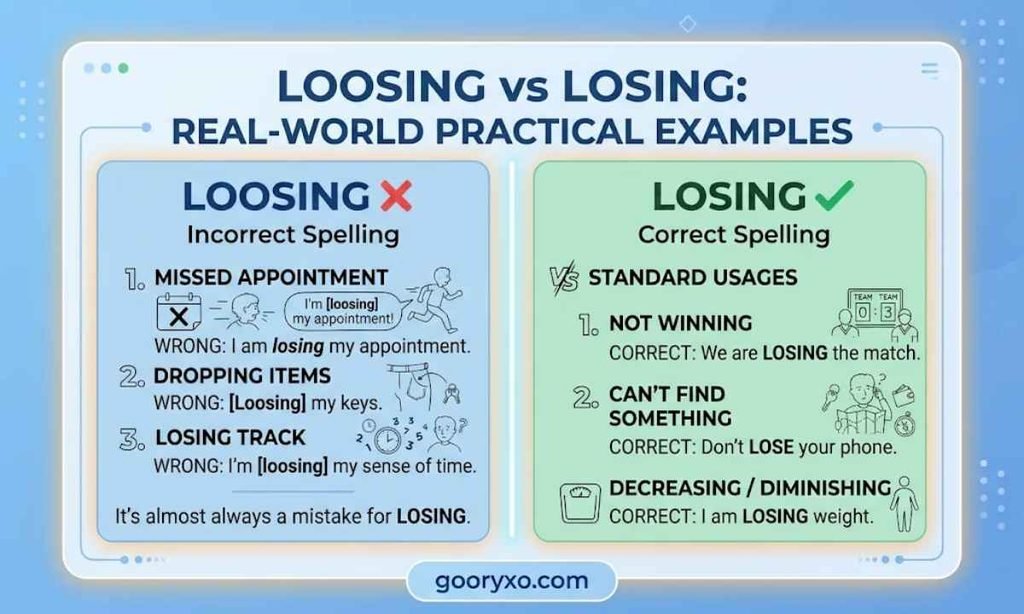
Seeing loosing vs losing in real situations makes the difference stick faster than any rule. Here are examples grouped by word, with a few settings you’ll actually meet.
Loosing Examples
- At the competition, the archer is loosing arrows every few seconds. (sport)
- The deckhand is loosing the sail ties before leaving the harbor. (sailing)
- The wildlife team is loosing a rehabilitated owl back into the forest. (animals)
- The gatekeeper is loosing the chain so the cart can pass. (restraints)
- She’s loosing the balloon’s rope so it can drift upward. (everyday action)
- The novelist describes a general loosing his army across the plain. (literary)
Example: “The falconer is loosing the hawk at dusk” works because someone is deliberately letting an animal go.
Losing Examples
- She’s losing her voice after the long concert. (health)
- The team is losing ground in the final minutes. (sports)
- I keep losing my train of thought during meetings. (focus)
- His phone is losing battery faster than before. (technology)
- The cafe is losing customers to the new place across the street. (business)
- Losing a close friend changed how he sees time. (emotion)
- We’re losing daylight, so let’s head back. (time)
- They’re losing patience with the endless delays. (emotion)
Example: “Our flight is losing altitude” would be alarming, and it uses losing because something is slipping away, not being released.
Common Idioms with Losing and Loosing

Almost every idiom in this area uses losing, while loosing appears in a small handful of formal or literary phrases. Idioms are a quick way to see how differently loosing or losing behaves in real speech.
Example: “I’m losing my mind over this puzzle” is a normal, casual idiom. “I’m loosing my mind” isn’t.
Common losing phrases include losing my mind, losing touch, losing track, losing ground, losing face, losing heart, losing my temper, and losing sleep over something. In British English you’ll also hear losing the plot, meaning going off course or becoming irrational.
Loosing shows up in phrases like loosing an arrow, loosing the hounds, and loosing the dogs of war, which is a dramatic image for starting a conflict. The pair “binding and loosing” is a fixed expression in older religious writing. These are rare today, but they’re real.
Self-Assessment (Fill in the Blanks)
Pick losing or loosing for each blank. Answers and short reasons follow right after.
- The tour guide kept ______ her group in the crowded market.
- After the storm, the crew spent an hour ______ the knotted mooring lines.
- I’m ______ interest in this show because the plot barely moves.
- The archer is ______ her fifth arrow of the round.
- Prices are climbing, and small shops are ______ customers to online stores.
- He’s been ______ sleep over the deadline.
- The kennel owner is ______ the dogs into the yard for their morning run.
- She worries about ______ her grip on the project.
- Our laptop is ______ charge faster than it used to.
- Some old texts talk about binding and ______.
Answers
- losing, since the guide keeps misplacing people.
- loosing, since the crew is untying lines.
- losing, since interest is fading.
- loosing, since the archer is releasing an arrow.
- losing, since customers are draining away.
- losing, since he isn’t getting enough sleep.
- loosing, since the dogs are being let out on purpose.
- losing, since control is slipping away.
- losing, since the charge is draining.
- loosing, since it’s the fixed phrase about release.
Summary About Loosing or Losing
Losing is the spelling you’ll use for failure, misplacement, and decline. Loosing is the rarer word and only fits when something is being released or set free.
The choice between loosing or losing comes down to the verb underneath: lose gives losing, and loose gives loosing. Once you tie each spelling to its action, the mix-up mostly disappears.
Frequently Asked Questions
Is it loosing or losing weight?
It’s losing weight. “Loosing weight” would describe letting a physical weight go, like freeing a counterweight, which isn’t what people mean when they talk about their health.
Is it loosed or lost?
It depends on the verb, because each one has its own past tense. Lost is the past form of lose, as in “We lost the game,” while loosed is the past form of loose, as in “The handler loosed the dogs.”
What is the difference between loosing and loosening?
Loosing means releasing or setting free, while loosening means making something less tight. You loosen a belt, but you loose a hawk.
What does loosing vs losing my mind mean?
The correct phrase is “losing my mind,” meaning you feel overwhelmed or stressed. The loosing vs losing question doesn’t have a tricky answer here, since nothing is being released.
Is it losing or loosing a person?
It’s losing a person. That covers misplacing someone in a crowd as well as losing them through separation or death. Loosing would only apply if you were literally letting someone go free from restraints.
Is loosing ever grammatically correct?
Yes. Loosing is correct when it means releasing, untying, or setting free, such as in archery, animal handling, or older literary writing.
Is there a difference between UK and US spelling for these words?
No. Both words are spelled the same way in British and American English. The loosing vs losing question is about meaning, not region.

My name is Ashfaq, and I am an English teacher with 5 years of teaching experience, specializing in English grammar. My mission is to make grammar easy to understand through simple explanations, practical examples, and helpful learning resources. At Gooryxo, I aim to help learners improve their grammar, strengthen their writing skills, and use English with confidence.

1 thought on “Loosing vs Losing: Correct Spelling, Difference & Examples”