
31st is correct. Full stop. The whole 31st or 31th debate ends right there, because “31th” is not a word in standard English at all. Yet people type it every day, in birthday posts, office emails, and deadline reminders, usually because the wrong ending just feels right.
This guide shows why 31st wins, walks you through the one rule that decides every ordinal ending, and points out where writers slip. You also get the full 1 to 100 table, the superscript question settled, and examples for every month that actually reaches a 31st day.
31st or 31th: Quick Answer
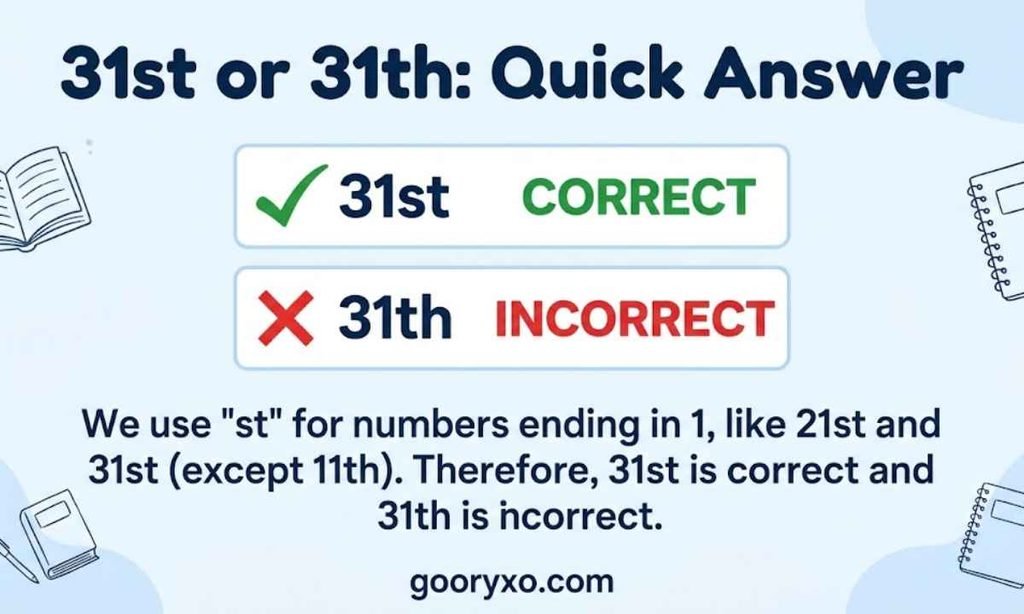
31st is the only correct form: it is the ordinal number for 31, the form used for dates, positions, and rankings. 31th is wrong in every context: dates, rankings, birthdays, anniversaries, formal reports, and casual texts. No dictionary and no style guide accepts it.
Example: Her birthday party is on the 31st. (correct)
Example: He finished 31st in the race. (correct)
Example: Her birthday party is on the 31th. (incorrect)
If you only remember one thing from this page, make it this: thirty-one is spoken as “thirty-first,” and the written ending copies the spoken one. First ends in -st, so 31 takes -st.
Ordinal Suffix Rule at a Glance
The last digit of a number picks its suffix. That is the entire rule, and it works for every ordinal you will ever write. These two-letter endings have a name, by the way: ordinal indicators. They mark a number as an ordinal, a position, rather than a cardinal, a plain count like one, two, three.
· A number ending in 1 takes -st: 1st, 21st, 31st, 41st
· A number ending in 2 takes -nd: 2nd, 22nd, 32nd, 42nd
· A number ending in 3 takes -rd: 3rd, 23rd, 33rd, 43rd
· Every other number takes -th: 4th, 10th, 20th, 30th, 100th
One exception matters. The numbers 11, 12, and 13 ignore their last digit and always take -th: 11th, 12th, 13th. The same applies to 111th, 112th, and 113th further up the line.
Two smaller details are worth filing away. In spelled-out ordinals, only the final part changes, so 421 becomes “four hundred and twenty-first.” And words ending in -ty swap the y for ie before -th, which is why 30 is “thirtieth,” not “thirtyth.”
Example: She came 21st in the exam, her brother placed 22nd, and their cousin finished 23rd.
Ordinal Numbers 1 to 100: Full Table
Here is every ordinal from 1st to 100th in one place, numeral and word side by side. Find 31 in the fourth column: it reads “thirty-first,” which is the whole 31st or 31th question answered by the table itself.
| 1–10 | 11–20 | 21–30 | 31–40 | 41–50 |
| 1st – first | 11th – eleventh | 21st – twenty-first | 31st – thirty-first | 41st – forty-first |
| 2nd – second | 12th – twelfth | 22nd – twenty-second | 32nd – thirty-second | 42nd – forty-second |
| 3rd – third | 13th – thirteenth | 23rd – twenty-third | 33rd – thirty-third | 43rd – forty-third |
| 4th – fourth | 14th – fourteenth | 24th – twenty-fourth | 34th – thirty-fourth | 44th – forty-fourth |
| 5th – fifth | 15th – fifteenth | 25th – twenty-fifth | 35th – thirty-fifth | 45th – forty-fifth |
| 6th – sixth | 16th – sixteenth | 26th – twenty-sixth | 36th – thirty-sixth | 46th – forty-sixth |
| 7th – seventh | 17th – seventeenth | 27th – twenty-seventh | 37th – thirty-seventh | 47th – forty-seventh |
| 8th – eighth | 18th – eighteenth | 28th – twenty-eighth | 38th – thirty-eighth | 48th – forty-eighth |
| 9th – ninth | 19th – nineteenth | 29th – twenty-ninth | 39th – thirty-ninth | 49th – forty-ninth |
| 10th – tenth | 20th – twentieth | 30th – thirtieth | 40th – fortieth | 50th – fiftieth |
| 51–60 | 61–70 | 71–80 | 81–90 | 91–100 |
| 51st – fifty-first | 61st – sixty-first | 71st – seventy-first | 81st – eighty-first | 91st – ninety-first |
| 52nd – fifty-second | 62nd – sixty-second | 72nd – seventy-second | 82nd – eighty-second | 92nd – ninety-second |
| 53rd – fifty-third | 63rd – sixty-third | 73rd – seventy-third | 83rd – eighty-third | 93rd – ninety-third |
| 54th – fifty-fourth | 64th – sixty-fourth | 74th – seventy-fourth | 84th – eighty-fourth | 94th – ninety-fourth |
| 55th – fifty-fifth | 65th – sixty-fifth | 75th – seventy-fifth | 85th – eighty-fifth | 95th – ninety-fifth |
| 56th – fifty-sixth | 66th – sixty-sixth | 76th – seventy-sixth | 86th – eighty-sixth | 96th – ninety-sixth |
| 57th – fifty-seventh | 67th – sixty-seventh | 77th – seventy-seventh | 87th – eighty-seventh | 97th – ninety-seventh |
| 58th – fifty-eighth | 68th – sixty-eighth | 78th – seventy-eighth | 88th – eighty-eighth | 98th – ninety-eighth |
| 59th – fifty-ninth | 69th – sixty-ninth | 79th – seventy-ninth | 89th – eighty-ninth | 99th – ninety-ninth |
| 60th – sixtieth | 70th – seventieth | 80th – eightieth | 90th – ninetieth | 100th – one hundredth |
Notice the pattern repeating every ten numbers. The endings cycle st, nd, rd, th in the same order, broken only by the three teen exceptions in the second column.
31st or 31th in Dates: Correct Usage Examples
In dates, the answer never changes: it is always 31st, whatever the month. Seven months have a 31st day (January, March, May, July, August, October, and December), and each one takes the same spelling.
Example: January 31st is the last day of the month.
Example: The lease ends on March 31st.
Example: The shop’s sale runs until May 31st.
Example: Rent on the new flat is due from July 31st.
Example: The office reopens after the break on August 31st.
Example: Halloween falls on October 31st.
Example: The year ends on December 31st.
One formatting slip to avoid: never leave a gap before the ending. “31 st” is just as wrong as “31th,” because the suffix is part of the number, not a separate word.
When NOT to Use a Suffix After a Date
Here is the flip side most guides skip. In a full date written in American news style, the AP Stylebook drops the suffix entirely: “May 31,” not “May 31st.”
Neither version changes the spelling question. When a suffix is used, it is -st; when AP style leaves it off, nothing replaces it. The suffix earns its place when the day stands alone. It also appears with “of,” as in “the 31st of May” or “rent is paid on the 31st.”
Read Also Lieing or Lying? Correct Spelling, Rule & Examples
The Origin of 31st or 31th

Ordinal endings are copied from speech. An ordinal number shows position: first, second, third. It takes the last two letters of its spoken form, and those letters become the suffix you write. “First” gives 1st its -st, “second” gives 2nd its -nd, and “third” gives 3rd its -rd.
Thirty-one is pronounced “thirty-first.” The final spoken word is “first,” so the abbreviation is 31st. Merriam-Webster lists the word form as “thirty-first,” and the Cambridge Dictionary records it the same way. “31th” would need the number to be spoken “thirty-oneth,” which no English speaker has ever said. That is why 31th never became a real form: it fights the pronunciation instead of following it.
The teen exception has an older story. Eleven and twelve do not grow out of “one” and “two” at all. They descend from Old English endleofan (“one left after ten”) and twelf, so they never carried -st or -nd in the first place. Thirteen joined them by pattern, and all three settled on -th.
Example: Say “forty-first” out loud and the spelling of 41st writes itself. The same trick settles 51st, 61st, 71st, 81st, and 91st.
British English vs American English Spelling
There is no spelling difference at all. British and American English both write 31st, and neither variety has ever used 31th.
What changes is the shape of the date around it. American writing usually puts the month first: “December 31st.” British writing typically puts the day first: “31st December.” British style also likes the word “of” in the middle (“the 31st of December”), while American style usually leaves it out.
Example: A London invitation reads “31st December,” while a New York one reads “December 31st.” Different order, identical ordinal.
Comparison Table
Side by side, the difference between the two varieties is word order, not spelling: the 31st or 31th ending itself never changes. Here is the full picture:
| Feature | American English | British English |
| Ordinal spelling | 31st | 31st |
| Typical date order | Month, day, year | Day, month, year |
| Example | December 31st, 2026 | 31st December 2026 |
| Use of “of” | Usually dropped | Common: “the 31st of December” |
| Suffix in full dates | Often dropped in news style (AP) | Usually kept |
| Regional variant of 31st | None | None |
Which Form Should You Use?
Use 31st everywhere, without exception. Dates, rankings, birthdays, anniversaries, floors of a building, chapters of a book: the form never changes, because the pronunciation behind it never changes.
· Calendar dates: “the 31st of any month that has one”
· Rankings: “she placed 31st out of 200 runners”
· Birthdays: “his 31st birthday party”
· Anniversaries: “their 31st year together”
The only real choice is numerals versus words. “31st” suits everyday writing, data, and anything with several numbers in it. “Thirty-first” reads better spelled out when a formal sentence opens with the number.
Example: Thirty-first place went to a first-time runner. (Sentence openings look cleaner with the word form.)
Should the 31st Suffix Be Superscript?
No, not in modern writing. Keep the suffix on the baseline, the same size as the number: 31st, not 31ˢᵗ. The Chicago Manual of Style is explicit on this point: the letters in ordinal numbers should not appear as superscripts.
The raised style is a leftover from older typesetting, and it survives mainly because Microsoft Word adds it automatically. If Word keeps shrinking your suffixes, switch the habit off. Go to File, then Options, then Proofing, then AutoCorrect Options, and untick “Ordinals (1st) with superscript” on the AutoFormat As You Type tab.
Example: Type “the 31st” in a plain email and nobody expects raised letters. Baseline text is the professional default everywhere online.
Common Mistakes with 31st or 31th

Almost everyone who writes 31th knows the 31st or 31th rule in the back of their mind. The error sneaks in through habit, not ignorance, and it tends to arrive by one of four routes.
1. Assuming Every Ordinal Ends in “-th”
This is the biggest cause, because the assumption is nearly true. Most ordinals do end in -th: 4th, 15th, 20th, 30th, hundreds of them. The brain files -th as the default and stamps it onto 31 without checking the last digit.
Example: “The meeting is on the 31th” looks plausible at a glance, because -th endings surround us. It is still wrong.
2. Typing “31th” from Muscle Memory
Fast typing has a rhythm, and number-plus-th is a movement your fingers have practised thousands of times. The wrong ending lands on the page before your eyes have read the number.
Example: You write “the 21th, 31th, and 41th” in one hurried list, even though you would say “twenty-first” without thinking.
The fix is a two-second habit: read the number aloud in your head before sending. Your ears catch what your fingers missed.
3. Confusing 31st with 30th
Thirty genuinely takes -th. Its word form is “thirtieth,” so 30th is perfectly correct, and that correctness bleeds onto its next-door neighbour. But the rule restarts with every new final digit: the moment the number ends in 1 again, -st takes over.
Example: “the 30th and 31st of the month.” Two dates a day apart, two different endings, both correct.
4. Adding a Space Before the Suffix
A quieter slip, and an easy one to miss in proofreading. Writers type “31 st” or “31 th” as if the ending were a separate word. It never is. The suffix glues directly to the number with no space at all.
Example: “31 st January” is wrong twice over: the space is incorrect, and with January 31 the ending should be -st attached, as in “31st January.”
Two cousins of these mistakes deserve a mention. Some writers overcorrect into “31rd,” guessing that any fix must swap one wrong ending for another, but -rd belongs only to numbers ending in 3. Others silently pronounce the number as “thirty-oneth,” and that invented pronunciation drags the wrong letters onto the page.
Read Also Lieing or Lying? Correct Spelling, Rule & Examples
31st or 31th in Everyday Examples
Rules stick better with real dates attached to them. Here is the 31st or 31th question worked through the situations people actually write about, one by one.
October 31st or 31th
October 31st is Halloween, the most-written 31st of the year. Party invitations, event listings, and countdown posts all carry the date, and all of them spell it 31st.
Example: “Our Halloween party is on October 31st, and costumes are required.”
August 31st or 31th
August 31st turns up in history writing more than almost any other end-of-month date. Princess Diana died on August 31st, 1997, and the date appears in that form in every serious account of the event.
Example: “News of the crash broke in the early hours of August 31st.”
31st or 31th Years Old
Neither form belongs next to “years old.” A person turns 31, plain and simple; the ordinal attaches to the milestone, not to the age itself. So it is “turning 31” or “her 31st birthday,” never “turning 31st years old.”
Example: “She turns 31 in June, and the family is planning her 31st birthday dinner.”
Anniversaries follow the same logic: “their 31st year of marriage” is correct, because here the ordinal counts the year, not a person’s age.
31st or 31th March
March 31st carries real weight in the business world. The fiscal year ends on March 31st in countries such as India and Japan. The date fills tax forms, annual reports, and audit letters, always spelled with -st.
Example: “Accounts for the year ending March 31st must be filed by June.”
In British order, the same date is written “31st March.” The order flips; the ordinal does not.
31st or 31th of July
“The 31st of July” is the British-style phrasing, common in formal writing. It also happens to be a famous birthday: in J.K. Rowling’s books, Harry Potter was born on July 31st, a detail fans write out in full every summer.
Example: “The 31st of July marked the last day of term.”
American writing would usually render the same date as “July 31st,” with the month leading.
31st or 31th May
May 31st is World No Tobacco Day, observed by the World Health Organization every year. Health campaigns, news reports, and posters worldwide print the date as May 31st.
Example: “The hospital’s quit-smoking drive launches on May 31st.”
32nd or 31th
These two get tangled simply because they sit side by side. Thirty-two is spoken as “thirty-second,” so it takes -nd and becomes 32nd. Thirty-one is “thirty-first,” so it takes -st. One digit changes, and the ending changes with it: 31st and 32nd are both correct, while 31th and 32th are both wrong.
Example: “He finished 31st on Saturday and 32nd on Sunday.”
31st Pronunciation
31st is pronounced “thirty-first,” written phonetically as /ˌθɜːrti ˈfɜːrst/. Reading the number aloud is the fastest spelling check there is, because the ending you hear is the ending you write.
American speakers usually sound the r in “first” clearly. British speakers often soften it or drop it altogether. The accent changes; the spelling never does, and both sides of the Atlantic write 31st.
Summary
31st is correct; 31th is not a word. The ending follows the last digit and the spoken form. Thirty-one is “thirty-first,” so the written form ends in -st, just like 1st and 21st before it.
Keep the suffix attached, skip the superscript, and say the number aloud whenever you hesitate. That five-second habit settles the 31st or 31th question every single time.
Frequently Asked Questions
Is 31th a word?
No. “31th” appears in no standard dictionary and follows no grammar rule. It is simply a misspelling of 31st, created by attaching the most common ordinal ending to the wrong number.
How do you write 31st in words?
Thirty-first. The word form keeps a hyphen between “thirty” and “first,” and it is the better choice when an ordinal opens a formal sentence.
Which is correct for a birthday: 31st or 31th?
31st, always. Write “her 31st birthday” or “his 31st birthday party.” When you talk about the age itself rather than the celebration, drop the ordinal and write “turning 31.”
Why does 31 take “-st” instead of “-th”?
Because the suffix copies the spoken word. Thirty-one ends in the word “first,” and first supplies -st. The -th ending belongs to numbers whose spoken forms end in “th,” like fourth (4th) and thirtieth (30th).
Is “31rd” ever correct?
No. The -rd ending is reserved for numbers ending in 3, such as 3rd, 23rd, and 33rd. “31rd” mixes two rules and is wrong for the same reason 31th is.
Does the month change how 31st is spelled?
No. January 31st, August 31st, and December 31st all take the same form. Only seven months reach a 31st day, but the spelling rule is identical in each of them.
Do style guides accept “31th” in formal writing?
No. Neither AP nor Chicago nor any other major guide lists 31th as an acceptable variant. Style guides disagree about when to spell ordinals out as words, never about whether 31th exists. It does not.

My name is Ashfaq, and I am an English teacher with 5 years of teaching experience, specializing in English grammar. My mission is to make grammar easy to understand through simple explanations, practical examples, and helpful learning resources. At Gooryxo, I aim to help learners improve their grammar, strengthen their writing skills, and use English with confidence.

1 thought on “31st or 31th: Which One Is Correct? Rules, Examples & Pronunciation”