
Focusses or focuses? Go with focuses. It’s the standard spelling in American, British, Canadian, Australian and New Zealand English, and it’s the one dictionaries list first.
Focusses isn’t a typo, though. It’s a British variant of the same verb, and it still shows up in some UK print. Here’s when each one fits, and why that extra s ever appeared.
Focusses
Focusses is a real spelling of the verb, used mostly in British English. It has the same meaning as focuses. It just has a second s.
Example: The committee focusses on housing costs this year.
That sentence is not wrong. WordReference marks the double-s verb form “mainly UK,” and Oxford Learner’s Dictionary lists focusses, focussing and focussed as other forms in its verb table.
Neither one calls it an error, so the focusses or focuses debate isn’t really about right and wrong.
Focuses
Focuses is the standard spelling of the verb in “he focuses,” and it is also a common plural of the noun. That is why focuses wins the focusses or focuses choice in most places.
As a verb, it follows the same rule as buses and gases: a word that ends in s takes -es. As a noun, Merriam-Webster lists foci first and focuses as the other accepted plural.
Example: Maya focuses on food safety. Her audit names three focuses for next year.
Focusses or Focuses: Quick Answer
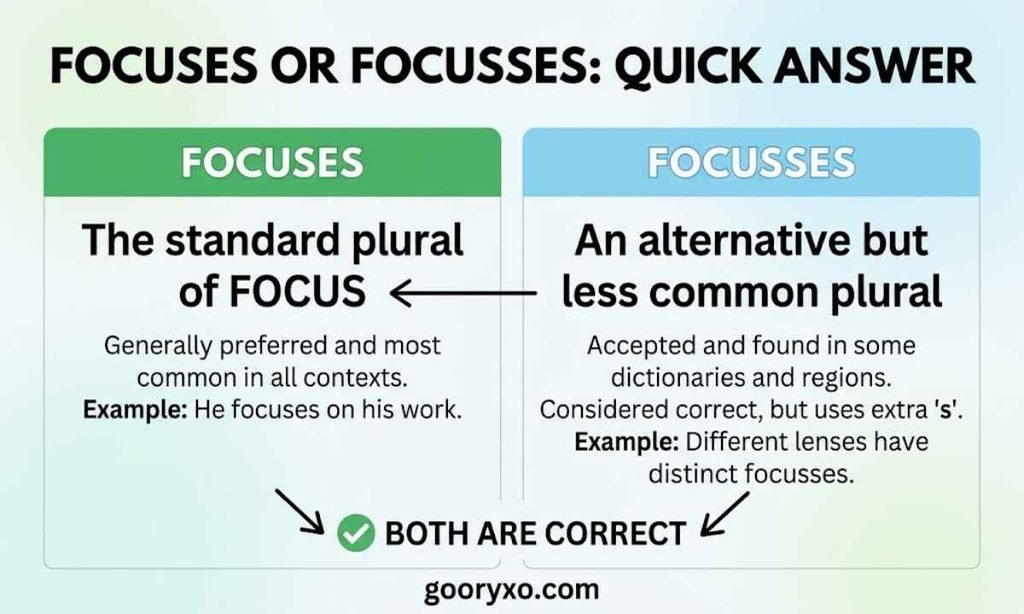
Write focuses. It is right in every major English-speaking country, and dictionaries list it first. Focusses is an accepted British variant, so it isn’t an error, but no editor will question focuses.
Example: “The lens focuses sunlight onto one point” works in a Texas lab report and a London textbook alike.
Use this table when you can’t decide:
| Your situation | Pick |
| Website, email, report or essay | focuses |
| US or Canadian audience | focuses |
| UK audience, no house style | focuses |
| UK publisher whose style sheet wants a double s | focusses (plus focussing, focussed) |
| Document with several editors | either one, used the same way throughout |
The Origin of Focusses or Focuses
Focus is a Latin word for hearth or fireplace, and English borrowed it in the 1600s. Oxford Learner’s Dictionary dates it to the mid-17th century, when it was a term in geometry and physics.
The jump from fireplace to optics makes sense. A hearth is where heat and light gather. A lens gathers light rays in one spot, and that spot took the old name.
Merriam-Webster traces the word through New Latin back to Latin for hearth. Its earliest recorded use is 1664 for the noun and 1776 for the verb. Wiktionary even lists the word fuel as a close relative, which fits the fire link.
The verb is what created the focusses or focuses puzzle. Once English used focus as an action word, it needed a form for he, she and it. Most writers simply added -es.
Example: The magnifying glass focuses the sun’s rays until the paper starts to smoke.
Why Does British English Double the “S”?
Mostly it doesn’t, and by the usual rules it shouldn’t. The double s is an odd habit, not a British spelling rule.
Example: Stop becomes stopped. Travel becomes travelling. Focus becomes focused. Only the first two follow a doubling rule.
British spelling has a double consonant rule that works in two main cases. One is after a stressed short vowel (commit, committed). The other is a final l, which doubles even when the stress is elsewhere (travelling, cancelled).
Focus fits neither case. The stress falls on the first syllable, and the word ends in s, so nothing asks for a second s. Wiktionary’s usage notes add that the Oxford English Dictionary calls focussed irregular.
So why does the focusses or focuses split survive? Writers see pairs like gases and gasses, or buses and busses, and a double s starts to feel normal.
Which Spelling Should You Use?
Use focuses unless a style guide or an editor tells you otherwise. Three quick checks settle the focusses or focuses choice.
First, does your employer, publisher or client have a style sheet? Follow it. Second, who is reading? A global audience points to the single s. Third, what will your text sit next to? Match the text around it.
Then set your spell checker to US or UK English so it matches your choice.
Example: A UK university’s web team writes “focusing” because its house style says so. A freelancer sending that team a blog post should match it.
Read Also 31st or 31th: Which One Is Correct? Rules, Examples & Pronunciation
Easy Way to Remember
If you can spell buses and gases, you can spell focuses. Add -es to a word that ends in s, and stop there.
Example: bus, buses. gas, gases. focus, focuses.
The focusses or focuses decision only gets tricky when a UK style sheet asks for the double s. If that is not your case, there is nothing extra to memorize.
Focusses or Focuses: UK vs US vs Canada vs Australia vs NZ
On the focusses or focuses question, single-s forms lead in all five countries. The double s is mainly a British and Commonwealth option, and Canada is the place where official guidance openly allows both.
| Region | Standard choice | What the double s looks like there |
| United States | focuses | Valid but rare. WordReference calls double-s forms correct in US English, just uncommon. |
| United Kingdom | focuses | Marked “mainly UK” by WordReference. The University of Reading and the University of Leeds ask for the single s. |
| Canada | focuses | The federal Writing Tips Plus tool lists both single and double s. |
| Australia | focuses | Wiktionary’s usage notes say single-s forms are more common here too. |
| New Zealand | focuses | Same note as Australia. |
Some explainers say focusses is almost never used in Canada. The Government of Canada’s Writing Tips Plus says otherwise. In Canadian usage, the verb can take a single or double s before a suffix.
Example: A Toronto editor can write “focuses” or “focusses” in a federal briefing. Either fits the guidance, if the whole document uses the same one.
What Do Oxford and Cambridge Dictionaries Say?
Oxford shows focuses as the main third-person form and lists focusses as another option. It does not call the double s wrong. That is the pattern across the big dictionaries on focusses or focuses.
Example: Merriam-Webster writes “focused also focussed.” The word “also” marks the second spelling as the variant.
Oxford Learner’s Dictionary gives he/she/it focuses first, then shows focusses, focussing and focussed as other forms. Merriam-Webster treats the single s as the main form and the double s as the second choice.
Dictionary.com, which uses Collins, even lists focusses among the noun plurals. WordReference marks the double-s verb form as mainly UK.
Cambridge Dictionary is worth a look too. Its entries are updated from time to time, so read the live listing for focus before you build a style sheet around it.
Style Guide Recommendations (Guardian, BBC, AP, Chicago)
On focusses or focuses, the UK style guides we checked all say the same thing: use the single s. That matches the dictionaries, which treat it as the main form.
The University of Reading style guide lists “focusing (not focussing)” among its spelling examples. The University of Leeds style guide asks for focusing and focused with a single s. The law firm Taylor Wessing marks focused as correct and focussed as wrong in its style guide.
Newsroom and publishing guides, such as the Guardian, the BBC, AP and Chicago, are updated often. Check the current edition if your project follows one. Reading and Leeds both send staff to the Guardian and BBC guides for anything they do not cover.
Example: A British university’s web team gets a draft that says “focussing.” House style sends it back as “focusing.”
Focuses vs Focusses and Related Forms (Complete Usage Guide)
Settle focusses or focuses first, then use the same pattern for every form of the word. If you write focuses, write focusing and focused. If you choose focusses, write focussing and focussed.
| Form | Single s | Double s variant |
| He/she/it (third-person singular) | focuses | focusses |
| Present participle | focusing | focussing |
| Past tense and past participle | focused | focussed |
| Noun plural | focuses or foci | focusses (listed by some dictionaries) |
| Adjective | focused | focussed |
Example: Single-s version: she focuses, she’s focusing, she focused. Double-s version: she focusses, she’s focussing, she focussed.
The short sections below cover each pair.
Focusing vs Focussing
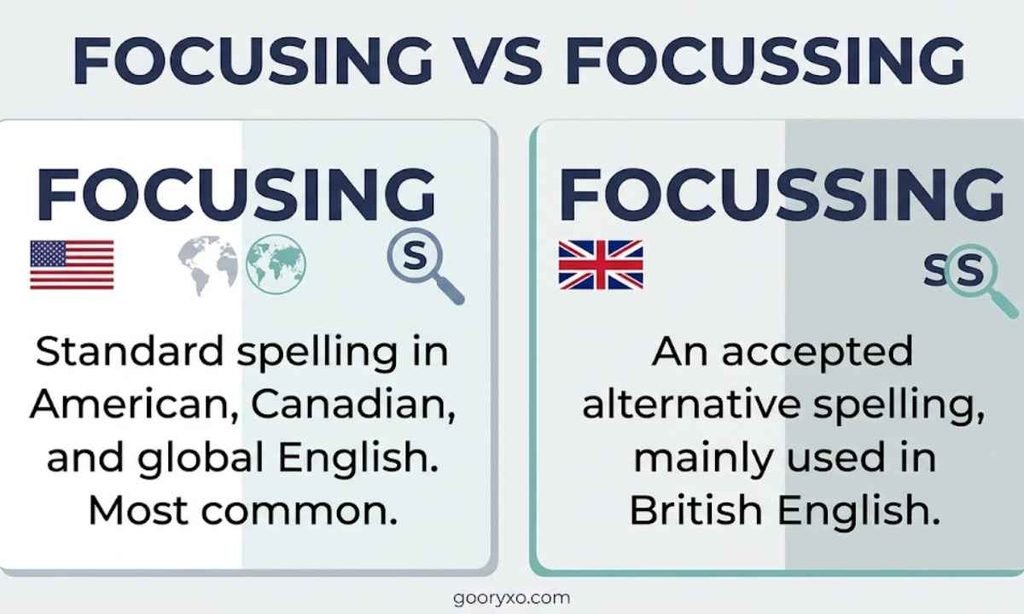
Focusing is the standard form, and focussing is the British variant. Oxford Learner’s Dictionary lists both as -ing forms of the verb, so neither is a mistake.
Example: He’s focusing on his driving test, and his sister is focussing her camera.
Match it to your choice in the focusses or focuses decision. A text that says “focuses” in one paragraph and “focussing” in the next looks messy.
Focused vs Focussed
Focused is standard for both the verb and the adjective. Focussed is the same word with the British double s.
Example: a focused plan, a focussed plan.
Wiktionary’s usage notes call focussed a widely seen UK spelling, but say focused is more common in respected publications. In plain terms, the single s is what most editors expect.
Focuses vs Foci
Use focuses in everyday writing and foci in technical writing. Both are accepted plurals of the noun focus.
Merriam-Webster lists foci first, and Canada’s Writing Tips Plus says foci mostly appears in the sciences. In business writing, foci can sound stiff.
Example: An ellipse has two foci. The review has three focuses.
Focus On vs Focus Around
Write focus on, or focus upon. Canada’s Writing Tips Plus calls “focus around” illogical, because a single point can’t have an “around.”
Example: The audit focused on pricing.
Oxford Learner’s Dictionary’s own sample sentences use on and upon with focus. It’s a small slip, but editors do notice it.
Read Also Lieing or Lying? Correct Spelling, Rule & Examples
Common Mistakes with Focusses or Focuses
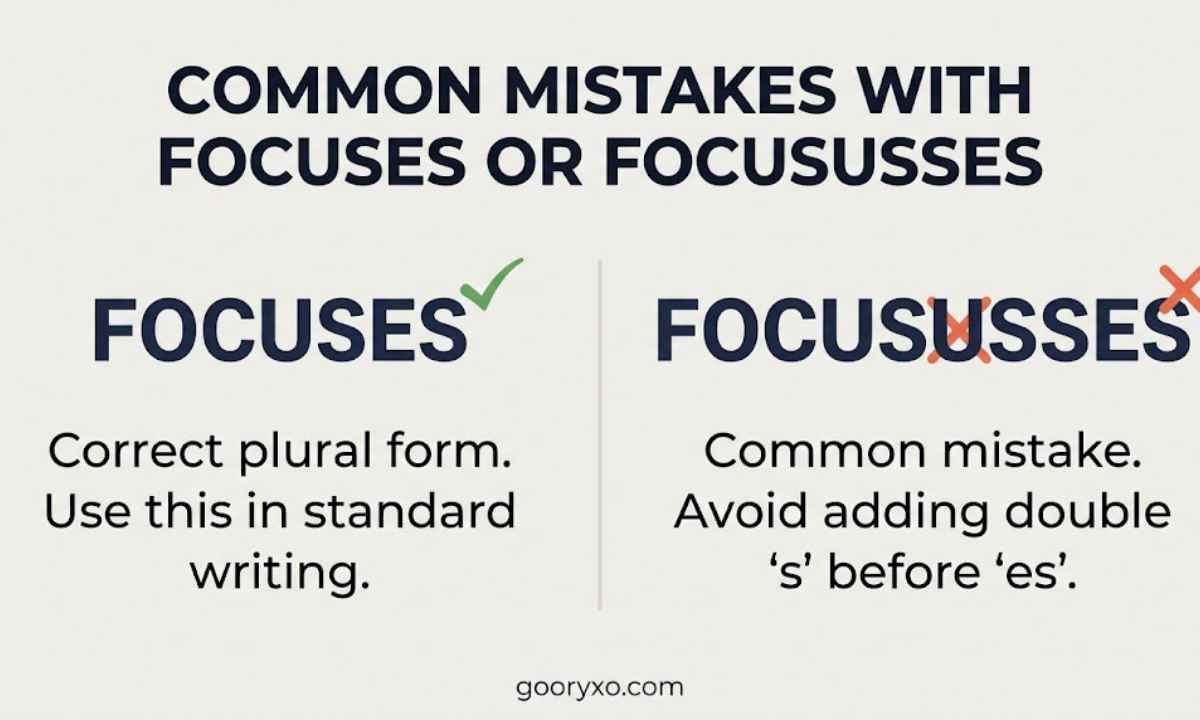
With focusses or focuses, the biggest slip isn’t choosing the “wrong” spelling. It’s mixing the two. These are the mistakes that show up most:
- Using focuses in one paragraph and focusses in another.
- Half-switching: focusses with focusing, or focuses with focussed.
- Typing focuss or focusess by accident.
- Dropping the verb ending (“she focus on sales”).
- Writing “focus around” instead of “focus on.”
- Leaving the spell checker on the wrong language, so it flags the spelling you chose on purpose.
- Using foci in casual business writing, where focuses reads more naturally.
Example: Wrong: “Our team focusses on sales, and it’s focusing on retention.” Right: “Our team focuses on sales, and it’s focusing on retention.”
Common Search Confusions About Focuses and Focusses
Most focusses or focuses searches come down to three doubts: is it a word, which spelling is correct, and which one goes with he or she. The answers are yes, focuses, and focuses.
Example: Someone types “he focus or he focuses” at 11 p.m. before sending an email. The answer is he focuses.
- Is focusses a word? Yes. It’s a recognized British variant, just a less common one.
- Focuss or focusess? Both are typos. The correct spelling is focuses.
- Focus or focused? Focus is the base verb and the noun. Focused is the past form and the adjective.
- Focuses meaning? As a verb, it means to direct attention or effort at something. As a noun, it means central points of interest.
Focusses or Focuses in Everyday Examples
In everyday writing, focusses or focuses changes only the spelling, never the sentence. Here’s how it looks in the places people actually write.
Example:
- Work email: Our team focuses on client retention this quarter.
- News headline: The new report focuses on rural broadband.
- Academic abstract: This study focuses on sleep and memory in teenagers.
- Optics lesson: A convex lens focuses parallel rays at a single point.
- UK house style: The trust focusses its funding on community projects.
- Canadian government memo: The unit focuses (or focusses) on translation quality.
Only the UK house-style line uses the double s, and a global editor would likely rewrite it first.
Focusses or Focuses: Google Trends & Usage Data
Dictionary usage notes and style guides settle focusses or focuses the same way: single-s forms are more common nearly everywhere. Wiktionary’s notes say focused is much more common in the US, and also more common in the UK, Australia and New Zealand.
You can check this yourself with two free tools:
- Google Books Ngram Viewer: enter “focuses,focusses,” pick the British English corpus, then switch to the American English one and compare the lines.
- Google Trends: compare “focusses” and “focuses,” then filter by country.
Don’t read Trends as a vote, though. People search a spelling question when they’re unsure, so a spike mostly shows doubt, not preference. Ngram counts words in published books, which is closer to real usage.
Both tools update their data, so save a screenshot with the date if you plan to publish your result.
Example: Type “focuses,focusses” into Ngram, set the corpus to British English, and see which line sits higher.
Comparison Table: Focusses vs Focuses
In the focusses or focuses comparison, focuses wins on reach and low risk. Focusses wins only when a UK house style asks for the double s.
| Feature | Focuses | Focusses |
| Standing | Standard everywhere | Accepted variant, mainly British |
| Dictionaries | Listed first (Merriam-Webster, Oxford Learner’s) | Listed as another form (“also”) |
| Related forms | focusing, focused | focussing, focussed |
| UK style guides checked | Recommended (Reading, Leeds, Taylor Wessing) | Not recommended in those guides |
| Chance an editor changes it | Very low | Higher outside UK house styles |
| Best for | Any audience, any country | UK style sheets that ask for it |
Example: The team focuses on retention (standard). The team focusses on retention (UK variant).
Final Thoughts
Focuses is the spelling to use by default. Dictionaries list it first, UK style guides prefer it, and readers in every region take it in without a second look.
Focusses is a real, accepted variant, and it earns its place only when a British house style asks for it. Choose one form for the whole document, and the focusses or focuses question is settled.
Frequently Asked Questions
Focusses or focuses: which one should a UK writer use?
Focuses. It’s standard in the UK too, and the university and law-firm style guides we checked recommend it. Use focusses only if your publisher’s style sheet asks for the double s.
Is “focusses” wrong in British English?
No. Dictionaries record it as a valid British variant, just a less common one. WordReference marks it “mainly UK,” and Oxford Learner’s Dictionary lists it as another form.
For a global website, is it focusses or focuses?
Focuses. It reads as standard in the US, UK, Canada, Australia and New Zealand, so no reader will stumble over it.
Is focusses used in Canada, Australia or New Zealand?
Sometimes. Canada’s federal Writing Tips Plus allows a single or double s. For Australia and New Zealand, Wiktionary’s usage notes say the single-s forms are more common.
What is the plural of focus?
Foci or focuses. Foci is typical in science and math, while focuses suits everyday and business writing.
Should I write focusing or focussing?
Focusing is the safer choice and the standard form. Focussing is the British variant, and it should only appear alongside focusses and focussed in the same document.
Can I mix focuses and focusses in one document?
No. Pick one pattern for focuses, focusing and focused, and keep it all the way through. Switching halfway looks like an error, not a style choice.

My name is Ashfaq, and I am an English teacher with 5 years of teaching experience, specializing in English grammar. My mission is to make grammar easy to understand through simple explanations, practical examples, and helpful learning resources. At Gooryxo, I aim to help learners improve their grammar, strengthen their writing skills, and use English with confidence.

1 thought on “Focusses or Focuses: Which Spelling Is Correct? (UK vs US)”