
Messege or message? The correct spelling is message. Messege is a common typo, not a real word, and the major dictionaries list only message.
This guide explains the messege or message mix-up, how message differs from massage, and a simple rule that makes the spelling stick.
Quick Answer
Message is the only correct spelling. Messege is a misspelling, and dictionaries such as Merriam-Webster and Oxford Learner’s Dictionary list only message.
Example: Wrong: “Please check your messege.” Right: “Please check your message.”
That answer holds in texts, emails, reports and school essays. The messege or message question has one answer in every context and in every English-speaking country.
To settle messege or message for good, spell it letter by letter: m-e-s-s-a-g-e. Double s in the middle, then a-g-e.
Meaning of “Message”
A message is a piece of information sent from one person to another, in speech, writing or signals. Merriam-Webster lists two more senses: a messenger’s errand, and an underlying theme or idea.
Today the word also covers text messages, voicemail, direct messages (DMs) and SMS. Oxford Learner’s Dictionary shows that people convey, give or pass a message, and that a message can be urgent or vital.
Example: She left a message before her flight. The film’s message is that patience pays off.
None of these senses uses the spelling messege, so the messege or message answer never changes.
Message in Common Phrases (Get the Message, Mixed Message, On Message)
Three common phrases use message in a way that isn’t literal. “Get the message” means to understand something nobody said directly, and “mixed messages” are signals that don’t match.
Example: When he kept checking his watch, she got the message and ended the call.
- Get the message: to understand a hint or an unspoken meaning.
- Mixed messages: signals or feelings that clash with each other.
- On message or off message: following, or not following, a party’s official position.
- Send the wrong message: to give people the wrong idea about what you mean.
Why People Write “Messege” Instead of “Message”
People write messege because they spell by ear. The messege or message confusion starts with sound: the last syllable of message sounds like “ij,” and English spells that sound in many ways.
A second reason is look-alike words. College, knowledge and privilege all end in -ege and share that same “ij” sound, so messege can feel right.
Learners may also carry over spellings from other languages. French uses message, Spanish uses mensaje and Portuguese uses mensagem, which can lead to typos like messaje.
Fast typing on a phone does the rest. One wrong tap, and the word looks almost right.
Example: A writer who knows “college” and “knowledge” may type “messege” because the ending sounds the same.
Messege vs Message Comparison Table
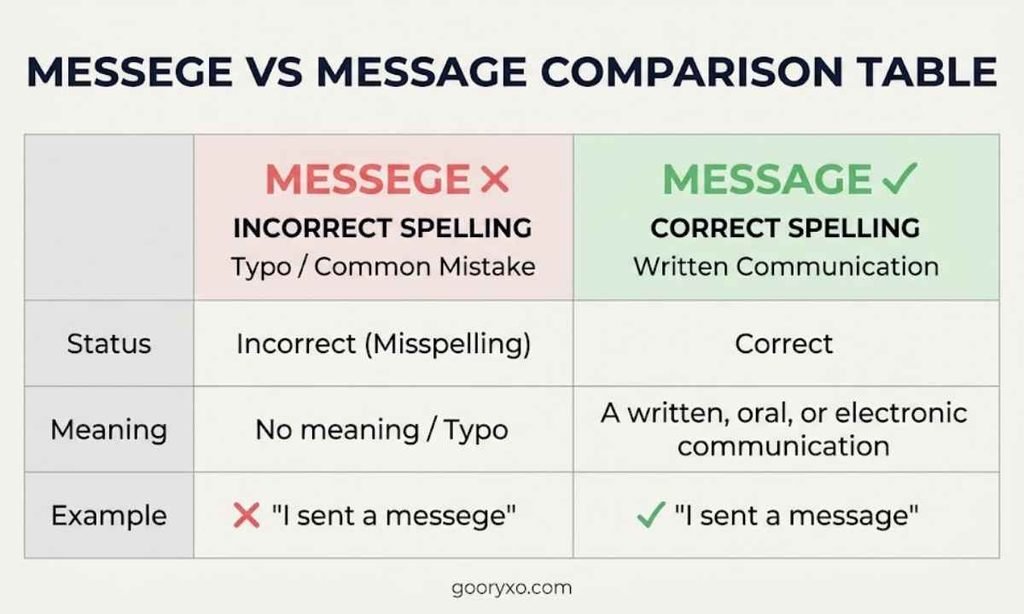
In the messege or message comparison, message is correct every time. Messege and the other near-misses below are typos with no meaning.
Example: “I sent you a messsage” should be “I sent you a message.”
| Spelling | Correct? | What’s wrong | Fix |
| message | Yes | Nothing. It is the standard noun and verb. | Use it |
| messege | No | The -ege ending is wrong. | message |
| mesage | No | One s is missing. | message |
| messsage | No | One s too many. | message |
| messge | No | The a is missing. | message |
| messaje | No | A j replaces ge, like Spanish “mensaje.” | message |
| massage | Yes, but different | A real word for rubbing the body. | Use only for that meaning |
On the messege or message question, only the first row is right. The massage row is a real word, but it means something else.
Messege or Message or Massage
Of the three, only message and massage are real words. Messege is a typo, and massage is a different word with a different meaning.
| Word | Real word? | Meaning | Sample sentence |
| Messege | No | None | Not used |
| Message | Yes | Information sent to someone | “Did you get my message?” |
| Massage | Yes | Rubbing or pressing the body to relax muscles | “He booked a massage.” |
A message is information that is sent. A massage is the rubbing or pressing of the body to relax muscles or ease pain, which is the meaning the Britannica Dictionary gives.
Massage also has a second use. People say they massage figures or a draft when they adjust it until it looks better. The related person words are masseur and masseuse.
The two words only meet in fast typing and fast speech. In the messege or message or massage trio, no word can stand in for another.
Example: She sent a message to the spa. Then she booked a massage.
Message vs Massage: Pronunciation Difference
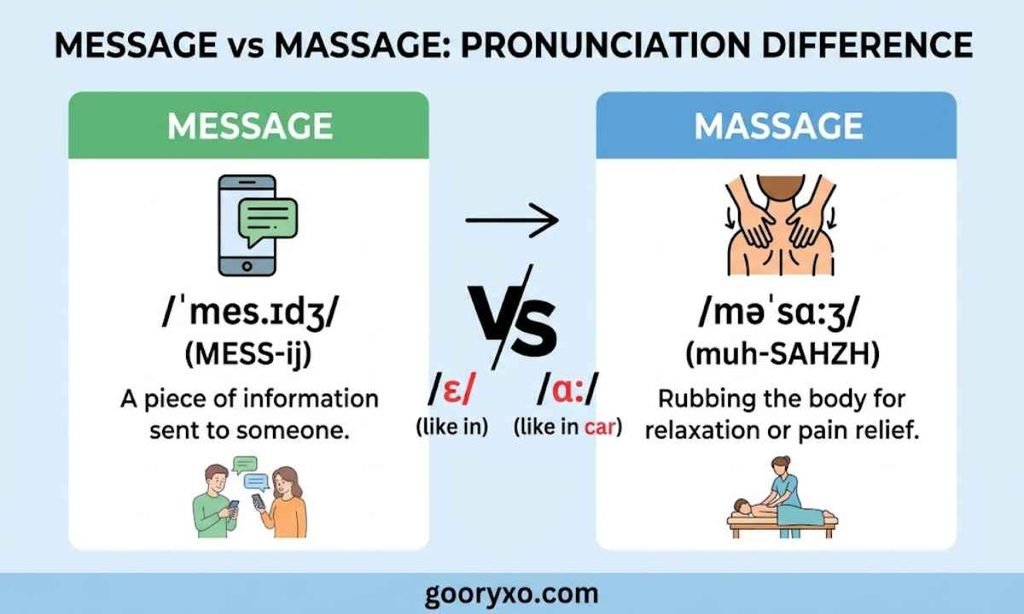
Message is said MESS-ij, with the stress on the first syllable and a j sound at the end, like the end of “judge.” Massage ends in a soft “zh” sound, like the end of “beige.”
Merriam-Webster shows message as ˈme-sij, and Oxford Learner’s Dictionary gives /ˈmesɪdʒ/. Both the US and the UK say it the same way. Because sound can’t show the spelling, the messege or message doubt is common.
Example: MESS-ij is message. MASS-ahzh or muh-SAHZH is massage.
If your last sound is a j, you are saying message. If it is a zh, you are saying massage.
US vs UK Pronunciation of Massage
In the US, massage is usually said muh-SAHZH, with the stress on the second syllable. In the UK, the stress usually falls on the first syllable, as in MASS-ahzh.
Example: She booked a massage (US: muh-SAHZH, UK: MASS-ahzh).
Britannica Dictionary and WordReference both show this split. Some dictionaries also list a version that ends in a j sound, but the zh ending is the one they show first.
Neither version sounds like message. That is why the two words are easy to tell apart when you listen for the last sound.
Read Also Focusses or Focuses: Which Spelling Is Correct? (UK vs US)
Correct Usage of “Message” in Sentences
Message works as a noun in almost every setting. It fits personal, formal and digital writing equally well.
Example:
- Everyday: Did you get my message? He left a voice message this morning.
- Work: The chairman’s message opens the annual report. Please take a message if the manager is out.
- Digital: The app shows when your message has been read. She sent the shop a direct message.
- Theme or idea: The ad’s message is simple: slow down.
For more than one, add an s: “I have three new messages.” The spelling stays the same in a casual chat and in a formal memo, so the messege or message slip should never appear in either.
Message as a Verb (To Message Someone)
Yes, message is also a verb. To message someone means to send them a message, as in “Message me when you get home.”
Merriam-Webster lists the verb forms messaged and messaging. It can take an object (message the team) or stand alone (they message every day).
Example: She messaged the team, and now everyone is messaging back.
The base word never changes, so the messege or message rule covers every form. Only the endings change: messages, messaged and messaging, which drops the final e before -ing.
How the Verb Came Back in the Digital Age
The verb is old, but it nearly disappeared before email and chat brought it back. Merriam-Webster records it as early as 1582.
Etymonline, the Online Etymology Dictionary, says the Century Dictionary of 1895 marked it as obsolete. The sense of sending an electronic message shows up by 1992.
Example: A century ago, a dictionary called this verb obsolete. Today people say “message me” without a second thought.
Common Mistakes Related to “Message”

The most common mistakes around messege or message are missing or extra letters, the -ege ending, and mixing message with massage. Here are the ones that show up most:
- messege instead of message
- mesage (one s is missing)
- messsage (one s too many)
- messge (the a is missing)
- messaje or mesaje (a j ending, like the Spanish word)
- messegeing instead of messaging
- messanger instead of messenger
- massage when you mean message, or the other way around
Example: Wrong: “I messsaged you a mesage.” Right: “I messaged you a message.”
Set your spell checker to English, then read the word aloud once. The messege or message error is easy to catch when you check the last four letters: s-a-g-e.
Spelling Rule Behind “Message”
Message ends in -age because it came into English from Old French message, which came from Medieval Latin missaticum. The double s and the -age ending are both part of that word history.
Merriam-Webster traces the word through Anglo-French and Medieval Latin back to Latin missus, the past participle of mittere, “to send.” Etymonline dates the noun to around 1300.
Example: Mission and message both come from the Latin verb mittere, “to send.” Both have a double s.
Merriam-Webster also links message to emit, mission and promise. That family is why the messege or message question has a firm answer: the spelling follows the history, not the sound.
Why “-age” Sounds Different in Message and Massage
Most English words that end in -age say “ij,” such as village, package, damage and message. Words borrowed later from French usually keep the French “zh” sound, such as massage, garage and mirage.
French turned an old Latin ending into -age. Words that entered English early settled into the “ij” sound, while later loanwords kept the French sound.
Example: Village says ij. Garage says zh. Message says ij. Massage says zh.
So the -age spelling alone can’t tell you the sound. A simple rule helps: message ends in ij, and massage ends in zh.
American vs British English Differences
There is no spelling difference. American and British English both spell it message, and both reject messege.
| Item | American English | British English |
| Spelling of message | message | message |
| Messege | Not valid | Not valid |
| Saying message | MESS-ij | MESS-ij |
| Saying massage | muh-SAHZH | MASS-ahzh |
| Verb forms | messaged, messaging | messaged, messaging |
Example: An American and a British writer both type “Message me,” but they say “massage” differently.
Unlike color and colour, this word has no regional spelling pair. The messege or message answer is the same on both sides of the Atlantic.
Related Words and Variations
Messages, messaging and messaged all keep the same root spelling. Messenger is related too, but it ends differently.
- Messages: the plural of the noun.
- Messaged: the past tense of the verb.
- Messaging: the -ing form, also used for apps and services, as in a messaging app.
- Messenger: a person or app that delivers messages.
- Text message, voice message, direct message and voicemail: common digital terms built on the same word.
Example: Three messages came in while the messenger app was updating.
The messege or message error does not carry into these forms. If you spell message right, the whole family follows.
Read Also 31st or 31th: Which One Is Correct? Rules, Examples & Pronunciation
Messenger: The Word That Breaks the Pattern
Messenger does not end in -age. It ends in -enger.
Etymonline explains that messenger comes from Old French messagier, and that English added an extra n along the way. That is why people sometimes write messager or messanger by mistake.
Example: The messenger carried the message. Both words share a root, but only one ends in -age.
Easy Memory Tricks
The easiest fix for messege or message is the word family: message belongs with mission, so it has a double s. Here are four quick ways to lock it in:
- Link it to mission. Both words are about something being sent, and both have a double s.
- Split it into two real words: mess + age.
- Check the vowels. Message goes e, a, e. Messege goes e, e, e. The middle a is the one people drop.
- Tell it apart from massage. Massage has two a’s, like the “aah” of relief.
Example: Write it in chunks: mess + age = message.
Pick the one trick that feels natural and use it every time a doubt shows up. One trick is enough.
When “Messege” Might Appear
The messege or message typo shows up mostly in quick typing, chat apps, social media comments and in the writing of people who spell by sound. It is a typo wherever it appears.
Example: An email subject that reads “New messege from support” should read “New message from support.”
Seeing a typo often doesn’t make it correct. Dictionaries list message and nothing else.
Spell checkers usually underline messege, so fix it when it is flagged. Also proofread subject lines, form fields and usernames, where spell checkers often stay quiet.
Why Correct Spelling Matters
Getting the messege or message choice right makes writing easier to read and easier to trust. A typo in a common word like message can pull the reader away from your point.
- It shows care in emails, job applications and client notes.
- It prevents mix-ups, since “I need a massage” and “I need a message” mean very different things.
- It helps people find your text when they search an inbox or a file for the word message.
Example: A subject line that says “Messege received” looks careless in a client email. “Message received” does not.
The messege or message choice is small, but readers notice it. Getting it right costs nothing.
Summary
The messege or message question has one answer: message. It has a double s and ends in -age, and messege is only a typo.
Message and massage are different words with different sounds and meanings. Remember mess + age and the link to mission, and the spelling will stick.
Frequently Asked Questions
Is it messege or message?
Message. It is the only correct spelling, and messege is a typo. Remember the double s in the middle and the a-g-e ending.
Is “messege” ever correct?
No. Messege is not a word in standard English, and the dictionaries list only message. In the messege or message debate, it stays a misspelling in every context.
What is the difference between a message and a massage?
A message is information sent to someone, such as a text or an email. A massage is the rubbing or pressing of the body to relax muscles or ease pain.
Is messege or message spelled differently in British English?
No. Message is the spelling in both American and British English. Only the stress on massage differs: MASS-ahzh in the UK and muh-SAHZH in the US.
How do you pronounce message and massage?
Message is MESS-ij and ends in a j sound. Massage ends in a soft zh sound, said muh-SAHZH in the US and usually MASS-ahzh in the UK.
Is “message” a verb?
Yes. To message someone means to send them a message. The forms are message, messages, messaged and messaging.
How do you spell messenger?
M-e-s-s-e-n-g-e-r. It ends in -enger, not -age, because it comes from Old French messagier, and English added an extra n.

My name is Ashfaq, and I am an English teacher with 5 years of teaching experience, specializing in English grammar. My mission is to make grammar easy to understand through simple explanations, practical examples, and helpful learning resources. At Gooryxo, I aim to help learners improve their grammar, strengthen their writing skills, and use English with confidence.

1 thought on “Messege or Message: Which Spelling Is Correct? (+ Massage)”