
Baton is the correct spelling; batton is a typo, an old spelling, or a surname. That’s the short answer to batton or baton, so you can stop here if you only needed a quick check.
Want the full picture? Below you’ll find meanings, word history, pronunciation, grammar rules, the batten mix-up, and ten practice questions.
Comparison Overview
Baton is the standard word for a short stick or rod used in music, sports, policing, and ceremonies. Batton is a surname, an old spelling, or a spelling mistake.
The table shows batton or baton side by side. Batten has its own column because it’s the third word that often gets mixed in.
| Feature | Batton | Baton | Batten |
| Standard modern spelling | No | Yes | Yes |
| Usual role | Surname; old spelling | Noun; sometimes a verb | Noun; verb |
| Core meaning | A family name, or an old form of baton | A short stick: conductor’s, relay, police, ceremonial | A strip of wood or metal that holds or strengthens something |
| Safe in formal writing | Only as a name | Yes | Yes |
| Where you’ll see it | Surnames, street names, old texts | Orchestras, tracks, parades, policing | Carpentry, sails, stage rigging |
Quick facts:
- Baton means a short stick used by conductors, relay runners, police officers, and drum majors.
- Batton is a surname and an old spelling of baton, not a standard word today.
- Batten is a different word: a strip of wood or metal that holds something in place.
- Baton comes from the French word bâton and, before that, Latin bastum.
Example: A sprinter hands over a baton, a roofer nails down a batten, and the neighbor named Batton waves from the porch. Three words, three jobs.
Definition of Batton
Batton has no standard meaning in modern English. In the batton or baton question, it’s the side that survives only as a surname, an old spelling of baton, and, in some dictionaries, a variant of batten.
Example: “Dr. Ruth Batton will review the file” is correct because it’s a name. “The runner lost the batton” is wrong, and any proofreader would circle it.
Wiktionary lists it as an old-fashioned spelling of baton and as a surname. Some dictionary sites also list it as a variant of batten, the strip that holds things in place. In everyday writing today, readers will see it as a spelling mistake.
Definition of Baton
A baton is a short stick or rod that a person carries or hands over for a reason: to conduct music, run a relay, keep order, or show rank. In the batton or baton choice, this is the word with the real meaning.
Example: She tucked the baton under her arm and walked to the podium.
It can also be a verb, though that’s rare. To baton someone means to hit them with a baton, and the forms batons, batoned, and batoning are all regular.
Common Uses of Baton
Baton covers five jobs, and in the batton or baton debate none of them ever takes the double t:
- Conducting an orchestra or choir
- Passing between runners in a relay race
- Policing, as a tool for defense and control
- Ceremonies, from marshals to drum majors
- Baton twirling in parades and competitions
The word has also gained a non-literal meaning. When someone “passes the baton,” they hand a task or a leadership role to the next person.
Example: “After two decades running the lab, she passed the baton to her deputy” has no stick in it at all, and the spelling is still baton.
Main Differences Between Batton and Baton

The gap between batton and baton comes down to three things: meaning, usage, and context. A fourth worry, batten, gets its own short section below.
Meaning
Baton names a real object, while batton names nothing in standard English today. Its only meanings are a family name and an old spelling that few readers recognize.
Example: If someone says “pass me the baton,” you can picture a stick. If they say “pass me the batton,” you picture a typo.
Usage
Baton works in every kind of writing, from a text message to a textbook. Batton works in one narrow case: a name that’s spelled that way on purpose.
Example: “Batton & Sons Plumbing” is a fine business name. “The relay batton” is not fine.
Anywhere else in a formal document, readers will think you made a mistake, not that you chose an old spelling.
Context
Context settles it fast. If the thing is a stick, rod, or sign of authority, it’s baton; if it’s a person, street, or business, it’s Batton.
Look at the words nearby. Conductor, runner, officer, marshal, and parade all point to baton, while Mr., Mrs., Lane, and Hardware point to Batton.
Example: “The marshal raised his baton” is the object. “Turn left on Batton Lane” is a place name.
Batton vs Batten vs Button
Baton is the stick, batten is a strip that holds things in place, and button is what keeps your shirt closed. All three are short and look alike, so they get swapped easily.
Example: He nailed a batten over the gap in the fence, then handed his daughter the baton for her twirling lesson.
A batten is a thin strip of wood or metal that holds, stiffens, or covers something. You’ll find battens on sails, stage curtains, and fences. The phrase “batten down the hatches” means to close up a ship, or get ready, before bad weather.
Some dictionary sites list batton as a variant of batten, which is why a few pages call it a strip of wood. In real writing, you’ll almost always see batten.
Two more look-alikes keep the single t. Batonnet is the French word for vegetables cut into thin sticks. Baton Rouge is a Louisiana city whose name is French for “red stick.”
Common Contexts Where Baton Is Used
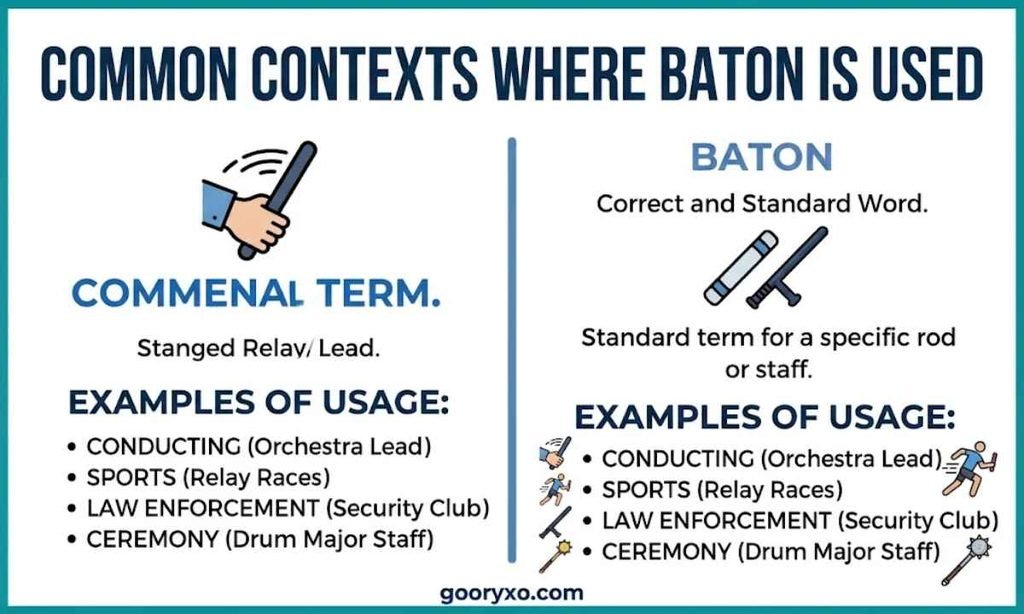
Baton shows up in four main places: music, sports, law enforcement, and ceremonies. The object looks different in each one, but the spelling stays the same.
In Music
In music, a baton is the thin stick a conductor uses to set the tempo and cue the musicians in an orchestra or choir.
Example: The symphony opened under the baton of a young guest conductor from Vienna.
The phrase “under the baton of” is common in concert programs and reviews. The tool even has a dramatic story. The French composer Jean-Baptiste Lully reportedly hit his own foot with the heavy staff he used to keep time in 1687, and the injury later killed him.
In Sports
In sports, the baton is the smooth, hollow tube that relay runners pass to each other. Under World Athletics rules, it’s about 28 to 30 centimeters long and weighs at least 50 grams.
Runners must pass it inside a marked takeover zone, or the team is disqualified. The zone is 20 meters long in the 4×400 relay and, since 2018, 30 meters in the 4×100. Baton twirling is a separate sport judged on skill and routine.
Example: Their anchor was the fastest runner in the heat, but the exchange before her happened past the end of the zone, so the team was disqualified.
In Law Enforcement
In policing, a baton is a stick that officers carry for defense and control. The usual types are the straight baton, the side-handle baton (sometimes called a tonfa), and the expandable baton, which folds down for carrying.
Names change by region. Truncheon is the usual British word, while Americans also say nightstick or billy club. Each department and country sets its own rules on when one can be used.
Example: Recruits spent a morning learning how to carry and handle an expandable baton safely.
In Ceremonies
In ceremonies, a baton shows command or leadership. The best-known type is the marshal’s baton, which appeared in France as a sign of high command in the late Middle Ages.
Example: The museum’s marshal’s baton, topped with gold stars, sits behind glass in the entrance hall.
A ceremonial baton is thicker than a swagger stick and mostly for show. Unlike a staff of office, it isn’t rested on the ground. Drum majors still lead marching bands with a baton or a mace.
Etymology & Origin of Baton
Baton comes from the French word bâton, which came from Old French baston and, earlier, Late Latin bastum, meaning stick or staff.
Example: Compare English baton, French bâton, and Spanish bastón. The Spanish word still has the s that French dropped, and the little hat on the French â marks where that s used to be.
English borrowed the word early, and the spelling kept changing. Old dictionary records show batton in use from the 1500s, including a mid-1500s Scottish text and Edmund Spenser’s The Faerie Queene in 1596. Baton appears from the 1600s onward, and Walter Scott used it in 1829.
That’s where the extra t behind batton or baton comes from. It isn’t random; it’s left over from a time when spelling wasn’t fixed yet.
Read Also Address or Adress? Correct Spelling, Memory Trick & Examples
Pronunciation of Baton – US vs UK
Americans usually say baton as buh-TAHN, while British speakers say BAT-on. Dictionaries show /bəˈtɑːn/ for the US sound and /ˈbæt.ɒn/ for the UK sound.
Example: A radio host in Chicago says buh-TAHN, a commentator in Manchester says BAT-on, and both write baton.
The French original sounds close to /batɔ̃/ and ends in a nasal sound that English never kept.
The UK sound also feeds the batton or baton mix-up. A short “a” followed by a t looks like batter, button, and batten, so a double t feels natural when you spell by ear.
Grammar Guide
Baton follows normal noun rules and can also act as a verb, while batton isn’t part of standard grammar. The sections below show how each word behaves in real sentences.
How Each Term Is Used in Sentences
Baton is a countable noun with the plural batons, and it can be a verb. Batton appears only as a proper noun, so its plural is the Battons.
Three phrases are worth knowing: pass the baton, under the baton of, and take up the baton. The possessive is baton’s, as in “the baton’s weight.”
Example: The Battons cheered as both teams’ batons crossed the finish line.
Common Mistakes Learners Make
The most common mistake in the batton or baton choice is doubling the t because the first syllable sounds short. A few other slips show up often:
- Trusting spellcheck, which may accept batton because it’s a surname and appears in some dictionaries
- Writing batten when you mean the stick, or the other way around
- Typing button when you’re moving fast
- Spelling the city as Batton Rouge
- Thinking batonnet is just a fancy baton, when it’s a way of cutting vegetables
Example: Her résumé said she “passed the batton” on three projects, and the recruiter spotted the typo before reading anything else.
Simple Rules to Remember
If it’s a stick someone carries, waves, or hands over, spell it with one t. Treat Batton as a name and copy it exactly as the person writes it.
Here’s a trick that works: a baton is passed on, a batten is nailed down. The word “on” ends baton, and the double t belongs to batten, the strip you fix in place.
Example: “Pass it on” gives you baton. “Nail it down” gives you batten. “Mr. Batton” gets copied as written.
Quick Tips for Writing and Speaking
Before you hit send, search your draft for batton; if it isn’t a name, change it. That one check catches most errors.
- Add baton to your custom dictionary if you write about sports or music often
- Say the word aloud, then check the spelling in a dictionary instead of trusting the sound
- Keep batton exactly as written when you’re quoting older text
- Check how a person spells their own name before you write to them
Example: After you finish a sports recap, press Ctrl+F, type “batton,” and fix every hit that isn’t a person’s name.
Is Batton Ever Correct?

Yes, but only in three cases: a surname, a place or business name, and a quotation from older writing.
Batton is a real surname in English and French, and a surname database counts roughly 3,500 people who carry it, mostly in the United States. One known bearer was the French composer Désiré-Alexandre Batton (1798 to 1855). Names keep their spelling, even when the word looks like a mistake.
Example: A conductor named Batton could lift a baton at any concert. The name keeps both t’s, and the stick keeps one.
Read Also Address or Adress? Correct Spelling, Memory Trick & Examples
When to Use Each One
Use baton for the object and Batton for the name. Nearly every real case fits one of those two.
Use Baton When:
Use baton any time you mean the physical stick or the idea of handing something over.
- Describing a conductor’s wand
- Writing about a relay handoff
- Referring to police or security equipment
- Mentioning a marshal’s or drum major’s ceremonial staff
- Using the idiom “pass the baton”
Example: The new coach inherited a team, a playbook, and the baton from a retiring legend.
Use Batton When:
Use Batton only when it’s part of a person’s name, a business name, or a quotation you’re keeping as written.
- Writing to someone whose surname is Batton
- Writing a street or business name
- Quoting older text without changing it
Example: A paper on Spenser can keep his spelling inside quotation marks, though your own sentences should say baton.
When NOT to Use Each One
Avoid batton in anything meant to look polished, and don’t “fix” Batton when it’s a name. Both errors are small, and both are easy to prevent.
Do Not Use Batton
Don’t use batton in essays, résumés, emails, captions, or news writing. Readers see it as a mistake, and it can hurt an otherwise careful piece.
Example: “Experienced in passing the batton between project teams” on a résumé looks careless, even if the experience is real.
Do Not Use Baton
Don’t change Batton to baton when it’s someone’s name or a business listing. The change can cause mix-ups with bookings, forms, and records.
Example: Writing “Dr. Alan Baton” on an invitation to Dr. Alan Batton is a small slip, but he’ll notice it.
Which One to Use (Decision Guide)
Ask one question: is it a stick, or is it a name? Your answer settles the batton or baton choice almost every time.
- A stick, rod, or sign of authority that someone carries or hands over: baton.
- A strip that’s nailed or fixed in place: batten.
- A person, street, or business: Batton, copied exactly.
- Still unsure: go with baton, then check the sentence in a dictionary.
Example: “Pass the ___ to the next runner” needs baton. “Nail a ___ across the door” needs batten. “Ask for Ms. ___ at reception” needs Batton.
Baton in Relay Races and Police Use
In both relay racing and policing, the spelling is baton. If you searched for batton or baton relay, there’s no race where the double t is right.
In relays, the sprint to the line gets the attention, but the handoff decides plenty of races. In many programs the incoming runner calls a short cue like “stick” or “hand.”
Many sprint teams also switch hands from leg to leg. The pass still has to finish inside the takeover zone.
Example: A team that practices exchanges with chalk marks on the track will often beat a faster team that doesn’t.
On the police side, the baton is a tool that comes with training. Departments set their own rules on when it can be used, and officers practice how to carry and handle it. The word is baton there too, whether it’s straight, side-handle, or expandable.
Real-World Practical Examples
The examples below show where each spelling belongs in the batton or baton question, so you can copy the pattern in your own sentences.
Batton Examples
Batton is correct only when it’s a name.
Examples:
- Batton Lane is closed for resurfacing until Friday.
- Please send the invoice to Ms. Batton in accounts.
- The Batton Hardware sign has hung on Elm Street since 1962.
- A scholar quoting Spenser would keep his spelling, batton, inside the quotation marks.
Baton Examples
Baton is correct in every sentence about the object or the idiom.
Examples:
- The conductor lifted the baton, and the room went quiet.
- Our anchor leg started early and almost missed the baton.
- Recruits trained with a collapsible baton during week three.
- The color guard followed a drum major spinning a silver baton.
- He retired last spring and passed the baton to his deputy.
- Three batons were tangled in the equipment bag.
Self-Assessment (Fill in the Blanks)
Here are ten quick questions. Fill each blank with baton, batton, batten, or the missing word. The answers follow the list.
- The conductor raised her ______ and the strings fell silent.
- A hollow ______ is passed between runners inside the takeover zone.
- Please address the letter to Mrs. ______, whose surname has two t’s.
- The crew used a wooden ______ to fix the loose sail panel.
- “Pass the ______” is an idiom for handing responsibility to someone else.
- Most Americans say baton as buh-______.
- The French word ______ is the source of the English spelling.
- The Louisiana city is spelled ______ Rouge.
- Before the storm hit, the crew had to ______ down the hatches.
- The plural of baton is ______.
Answers:
- baton
- baton
- Batton
- batten
- baton
- TAHN
- bâton
- Baton
- batten
- batons
Summary About Batton or Baton
Baton is the spelling you want for the stick. Batton belongs only to surnames, quoted older texts, and slips of the keyboard.
Next time you’re torn between batton or baton, ask whether you mean an object or a name. Keep batten for the strip you nail down.
Frequently Asked Questions
Is it batton or baton?
Baton is the correct spelling. Batton is valid only as a surname, an old spelling inside a quotation, or a typo. When you mean the stick, use baton.
Is batton a real word?
Barely. It exists as a surname and as an old spelling of baton, and some dictionaries list it as a variant of batten. It isn’t standard in modern English.
How do you pronounce baton?
Americans usually say buh-TAHN, and British speakers say BAT-on. The spelling stays baton either way.
Is it batton or baton in a relay race?
It’s baton. The relay baton is a smooth, hollow tube passed inside a marked takeover zone, and the double t is only a mistake there.
What is the difference between baton and batten?
A baton is a stick that’s carried or passed along, while a batten is a strip of wood or metal that holds or strengthens something. The memory trick: a baton is passed on, a batten is nailed down.
Can baton be a verb?
Yes, though it’s rare. To baton means to hit with a baton, and the forms are batons, batoned, and batoning.
Why do people write batton?
The short “a” sound invites a double t, the way it does in batter and button. The surname Batton and the old spelling in historical texts add to the confusion.

My name is Ashfaq, and I am an English teacher with 5 years of teaching experience, specializing in English grammar. My mission is to make grammar easy to understand through simple explanations, practical examples, and helpful learning resources. At Gooryxo, I aim to help learners improve their grammar, strengthen their writing skills, and use English with confidence.

1 thought on “Batton or Baton: Which Is Correct? Meaning, Spelling & Examples”