
Carries or carrys? Use carries. The y in carry turns into ies when the verb follows he, she, it, or any single subject, so carrys is a spelling error in both American and British English.
This guide shows why the rule works, how each meaning of carries looks in real sentences, and which look-alikes (carry’s, carries’, caries) trip up careful writers too.
Quick Answer:
Carries is correct. It is the third-person singular, simple present form of the verb carry, and Merriam-Webster, Oxford Learner’s Dictionaries, and Dictionary.com all list it for he, she, and it.
For the carries or carrys question, only one check matters. Carry ends in a consonant plus y (r + y), so the y turns into i before -es. Cry, study, and reply do the same thing.
The night-shift nurse carries a small flashlight in her coat.
- Right: he carries, she carries, it carries.
- Wrong: carrys.
- Rule: consonant + y becomes -ies. Vowel + y just adds -s.
That single check settles carries or carrys every time. The sections below cover meanings, exceptions, and look-alike words.
Carries Meaning
Carries is the he/she/it form of the verb carry. It has five main jobs: holding something, moving it, supporting it, stocking it, and delivering it. Knowing all five helps you settle carries or carrys in your own writing.
The verb comes from Latin carrus, a wheeled wagon, through Old North French, so it is a distant relative of the word car. Dictionaries list many senses of carry. The sections below cover the ones you will meet most.
A bus carries schoolchildren across the river bridge every morning.
Carries Means Holds or Transports
At its simplest, carries means a person has something with them, in hand, in a bag, or on their body, while they move.
Rafay carries his pencils in a small tin box that rattles on every bus ride.
This also covers things you wear or keep on you, like a watch, a house key, or a phone. You can even carry yourself. In “she carries herself with confidence,” the verb describes posture, not luggage.
Carries Means Transports
Carries also works for things that move cargo without hands: a truck, a pipe, a cable, an animal, or a river. Nobody has to hold the cargo.
Think of a river. The current does the moving, and the silt simply travels along. Cables carry power or data in the same way, and airlines carry passengers.
The river carries fine silt down to the delta every spring.
Carries Means Supports Weight
Carries can mean holds up weight. A beam, pillar, shelf, or bridge carries a load so that the structure stays standing.
The old viaduct carries the railway line over the valley.
Engineers say a bridge carries a road or a rail line. The road or rail is the load, and the bridge holds it up. Floors, axles, and load-bearing walls work the same way.
Carries Means Offers or Stocks a Product
Stores use carries to say a product is on their shelves. It is a stock word, and nobody has to lift anything.
That hardware store carries left-handed scissors.
The object can be a brand, a size, or a whole category. A pharmacy might carry sugar-free syrups. If a shop does not stock an item, you say it doesn’t carry it.
Carries as a Noun (Plural of Carry)
Carries is also the plural of the noun carry, and sports, travel, and math all use it. The plural changes y to ies, like story and stories, so even the noun answers the carries or carrys question the same way.
In American football, carries are rushing attempts. In golf, a carry is how far the ball flies before it lands. Canoeists use the word for a portage, where you carry the boat over land. Dictionary.com also lists the range of a gun, and “concealed carry” is a common phrase in the news.
In school math, you “carry the one” when a column adds up to more than nine. Adding 58 and 67 by hand gives you two carries.
How to Pronounce Carries
Carries is pronounced KAR-eez, written /ˈkæriz/ in IPA. The stress is on the first syllable, and the word ends in a z sound, not an s. It rhymes with marries.
The -ies spelling is what signals that z sound. The word also sounds the same as Carrie’s, the possessive of the name Carrie, which can cause mix-ups later in this guide.
Say it slowly: carries (KAR-eez), marries (MAR-eez).
Synonyms of Carries
The closest synonyms of carries are transports, conveys, bears, and hauls, but each one fits only certain situations. Choose the word that matches the meaning, and remember that the carries or carrys spelling question only affects carries itself.
The ferry carries forty cars, so you could also say it transports forty cars.
| If carries means… | Try… | Example |
| holds on the person | bears, has with them | She carries a notebook / She has a notebook with her |
| moves from place to place | transports, ferries, hauls | The truck carries gravel / The truck hauls gravel |
| passes along information | conveys, delivers, broadcasts | The paper carries the story / The paper runs the story |
| supports weight | bears, holds up | The pier carries the deck / The pier holds up the deck |
| keeps in stock | stocks, sells | The shop carries tea / The shop stocks tea |
Carrys Meaning
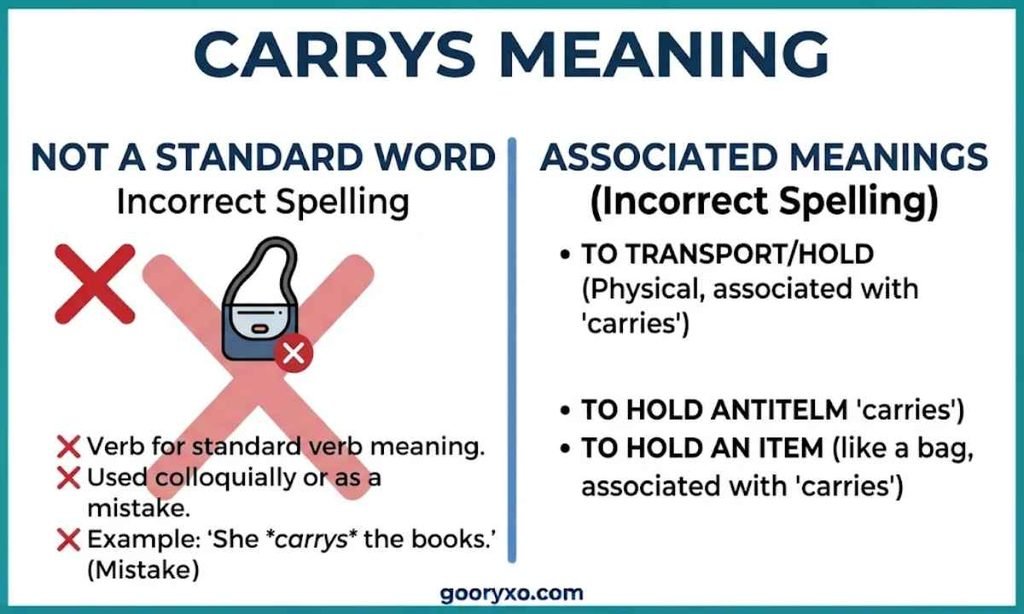
Is carrys a word? Not in standard English. As a verb it means nothing at all. It is a misspelling of carries, made by adding a plain -s where English wants -ies, and it is the heart of the carries or carrys confusion.
Two narrow exceptions exist in the carries or carrys debate, and both are nouns. “The Carrys” can mean a family named Carry. In French, carry is a curry dish from Réunion and Mauritius, and its plural is carrys. Neither is the English verb.
Wrong: The mechanic carrys his tools in a crate. Right: The mechanic carries his tools in a crate.
Why Does Carrys Look Correct?
Carrys looks fine at first glance because nearly every other verb just adds -s. You have seen walks and plays countless times, so your eye accepts the pattern. That habit is the root of the carries or carrys mix-up.
Line up plays, stays, and carrys, and the last one blends right in.
Verbs ending in -ys also look normal, which hides the error even more. Fast typing and autocorrect let it slide too, and English learners and native speakers both make this slip. Only the letter before the y shows the difference.
Why Is It Carries, Not Carrys?
Because a consonant stands before the y, English swaps the y for i and adds -es. The carries spelling follows a general convention, not a rule made just for carry.
Nouns follow it too: baby becomes babies, party becomes parties, and berry becomes berries. Once you see that, carries or carrys stops being a coin flip, because carrys looks as wrong as babys. The -ies ending also matches the z sound at the end of the word.
The camel carries enough water for a week-long crossing.
The Consonant + Y Rule
Every carries or carrys decision starts with one check: look at the letter before the final y. If it is a consonant, replace the y with -ies. In carry, that letter is r, so you get carries.
| Base verb | He / she / it form |
| carry | carries |
| hurry | hurries |
| worry | worries |
| try | tries |
| copy | copies |
| reply | replies |
| bury | buries |
| multiply | multiplies |
The y stays before -ing, so you get carrying, studying, and copying. It changes to i before -ed (carried) and -er (carrier).
The printer copies each page in seconds, and the clerk carries the stack to the front desk.
What Happens With a Vowel + Y?
If a vowel comes before the final y, the y stays and the verb just takes -s. There is no swap and no -ies. That is why the carries or carrys problem only exists for consonant endings.
He buys fruit on Fridays and enjoys every bite.
So play becomes plays, stay becomes stays, and obey becomes obeys. Says is a small oddity: it sounds like “sez” but is spelled says. To test any verb, look at the letter before the y. A vowel means keep it. A consonant means change it.
Other Verbs That Follow the Same Pattern (and the Proper Noun Exception)
Many verbs work like carry, such as marry, bury, vary, deny, reply, and multiply. Proper nouns are the main exception, because they keep their y in the plural.
Names don’t follow the verb rule. You write the Murphys, two Terrys, or the Henrys, never the Murphies. That is the one corner of the carries or carrys question where carrys survives in everyday English, and it is a noun, not a verb.
The Carrys next door host a street party every August.
Read Also Batton or Baton: Which Is Correct? Meaning, Spelling & Examples
Carries vs. Carry: Understanding the Verb Forms
Use carry with I, you, we, they, and plural subjects. Use carries with he, she, it, and any one person or thing. The -es is an inflection, a small ending that marks person and number.
My aunt carries the keys, but my cousins carry the bags.
Choosing carry or carries depends only on the subject. Spelling is half of the carries or carrys puzzle, and subject-verb agreement is the other half.
| Subject | Verb form | Sample sentence |
| I / you | carry | You carry the tray. |
| he / she / it | carries | It carries a heavy battery. |
| we / they | carry | They carry the banners. |
| one clerk | carries | The clerk carries the files. |
| two clerks | carry | The clerks carry the files. |
| who / everyone | carries | Who carries the cooler? |
Words like everyone, each, and who count as singular, so they take carries.
When to Use Carries in a Sentence
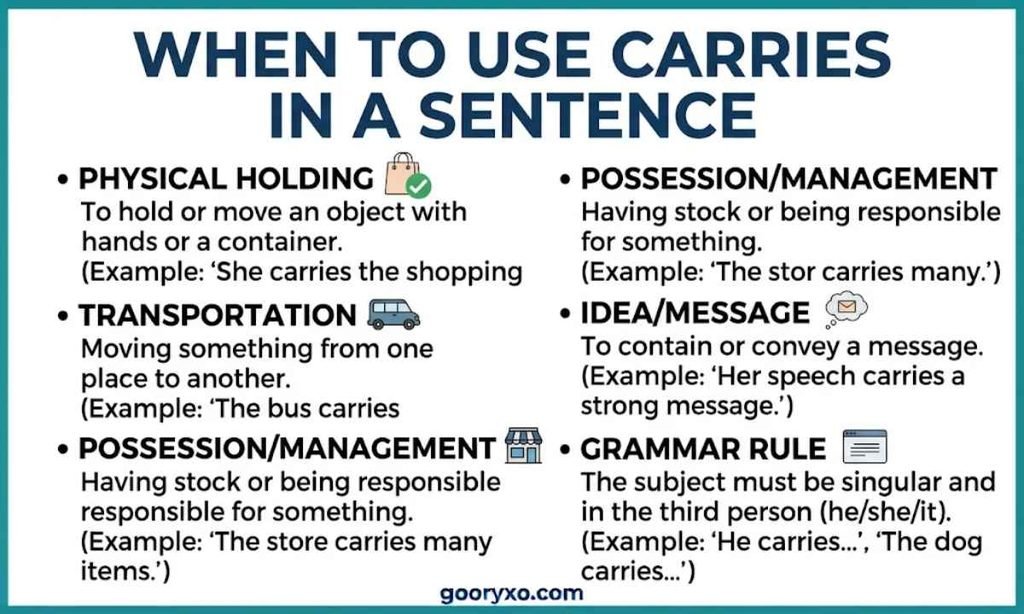
Use carries when a single third-person subject is carrying something, now or as a habit. A quick check: if he, she, or it could replace the subject, carries works.
The security guard carries a radio and a heavy ring of keys.
Once the spelling is settled in the carries or carrys debate, the next question is meaning. The five sections below sort the common uses. The simple present covers habits and facts, which is why carries appears in so many everyday sentences.
Physical Carrying
Use carries when a person has something in their hands, bag, or pocket while moving. The usual order is subject, carries, object, then where or how.
The lifeguard carries a whistle and a first-aid pouch on her belt.
This is the plain, hands-on meaning, and it is where most carries or carrys slips happen.
Transportation
Use carries when a vehicle, pipe, or service moves people or goods. A company or a system is one subject, so it still takes carries.
The subject is the mover, and the cargo is the object. The carries or carrys rule does not change for machines, so you can say a ferry carries trucks, a cable carries electricity, or an airline carries thousands of passengers a day.
The overnight ferry carries trucks and foot passengers across the strait.
Supporting a Load
Use carries when part of a structure holds up weight, such as a beam, shelf, pier, or bridge.
This oak shelf carries a full set of encyclopedias without bending.
The wording sounds technical, but it is easy to use. Floors carry furniture, columns carry roofs, and axles carry the weight of the cart.
Stocking Products
Use carries when a shop or seller has a product available to buy.
The corner pharmacy carries three brands of baby formula.
Customers often ask this as a question, and the question takes the base form: Do you carry this in a larger size? The same switch happens with does and doesn’t. Product pages are where the carries or carrys slip appears most.
Communicating or Containing Something
Use carries when a source delivers information, a sound travels, or an action brings a result with it. This is the most flexible group.
- The evening paper carries a weather warning for the coast.
- The sports channel carries the final live.
- A missed deadline carries a late fee.
- Her voice carries to the back of the playground.
Once you read carries as “has or delivers,” the range makes sense. The carries or carrys spelling stays the same across all of it.
Carries On, Carries Out, Carries Over: Phrasal Verbs and Idioms
Carries changes meaning when a small word follows it, but the spelling stays the same. Carries on means continues, carries out means performs, carries over means moves to the next period, and carries off means manages something well.
Her objection carries weight because she wrote the original contract.
- carries on: The bakery carries on despite the flood.
- carries out: The inspector carries out every check herself.
- carries over: Unused leave carries over into January.
- carries off: He carries off a bold tie better than most.
- carries forward: In accounting, a loss carries forward to next year.
The carries or carrys rule holds here too, so it is carries out, never carrys out. A few idioms use the same form. A strong proposal carries the day, someone who carries a torch for an old friend still has feelings, and a person who can’t carry a tune sings out of key. With plural subjects, drop the -es: the auditors carry out the review.
Common Mistakes
Writers make five main mistakes around carries or carrys: writing carrys, dropping the -s after he or she, adding -s to a plural subject, adding -s after does, and adding a stray apostrophe. A sixth, carryes, shows up in fast typing.
| Mistake | Fix | What went wrong |
| The driver carrys the post. | The driver carries the post. | The y never changed to i. |
| She carry the box. | She carries the box. | The third-person -s is missing. |
| The cooks carries trays. | The cooks carry trays. | A plural subject takes the base form. |
| Does he carries cash? | Does he carry cash? | Does already holds the -s. |
| The crane carry’s steel. | The crane carries steel. | A verb never takes an apostrophe. |
| The van carryes parcels. | The van carries parcels. | Only the y changes, with no extra e. |
Carries is not always right. The subject decides, so a plural subject needs carry.
The cooks carry the trays, but the head cook carries the soup.
A Simple Case Study
Four small slips can hide in one quick message, and one of them is the carries or carrys error itself. Try to spot them before you read the fix.
Hi parents, Mr. Qureshi carrys the first-aid kit, the volunteers carries the snacks, and our bus company carry full insurance. Does he carries a spare key for the hall?
Here is the clean version:
Hi parents, Mr. Qureshi carries the first-aid kit, the volunteers carry the snacks, and our bus company carries full insurance. Does he carry a spare key for the hall?
- Mr. Qureshi is singular, but carrys is misspelled.
- Volunteers is plural, so it needs the base form carry.
- Company is singular, so it takes carries.
- Does already marks the third person, so carry stays plain.
Carries in Different Tenses
Carries only appears in the simple present, and only with a third-person singular subject. Other tenses use carry, carried, or carrying, so carrys has no place anywhere. The carries or carrys question only comes up in the simple present.
| Form | Example |
| Simple present (he/she/it) | She carries the bag. |
| Simple present (I/you/we/they) | They carry the bag. |
| Simple past | She carried the bag. |
| Present continuous | She is carrying the bag. |
| Present perfect | She has carried the bag. |
| Future | She will carry the bag. |
The ending matters: -ed turns the y into i (carried), but -ing leaves it alone (carrying).
By the time the rain started, the porters had carried every bag inside.
Carries or Carrys in Questions and Negative Sentences
Use plain carry after does, doesn’t, do, and don’t. The helping (auxiliary) verb already shows the third person, so the main verb needs no ending.
This is where writers who have already settled the carries or carrys question still slip, because the habit of adding -s kicks in on its own.
Does the courier carry cash?
Negatives work the same way: the shop doesn’t carry that brand. Modal verbs follow the rule, so you say she can carry it and he will carry it, never she can carries it. Plural subjects take do or don’t with carry: “Do they carry cash?”
One exception catches people. When who, what, or which is the subject, there is no helping verb, so the -s stays: Who carries the keys?
Carries vs. Carries’ vs. Carry’s
Carries without an apostrophe is the one you want for the verb and for plural nouns. Carry’s and carries’ are possessive forms and need a special reason. So the carries or carrys decision sometimes arrives with an apostrophe question attached.
The porter carries the bag, but the carry’s length decided the golf hole.
Carries
Carries has no apostrophe, whether it works as a verb or a plural noun. Use it for he, she, it, single subjects, and for more than one carry in sport or travel.
The new lid carries a child-safety lock.
Two carries is correct. Two carry’s is a common apostrophe mistake with plurals.
Carry’s
Carry’s shows that one carry owns something, as in the carry’s distance. It can also be a short form of “Carry is” when someone is named Carry.
The carry’s length over the lake was 212 yards.
For a person, Carrie’s is the more common spelling. It sounds exactly like carries, so check it twice before you publish.
Read Also Batton or Baton: Which Is Correct? Meaning, Spelling & Examples
Carries’
Carries’ shows that several carries own something, and it appears mostly in sports stats.
Those three carries’ combined yardage was 61.
It reads a little awkwardly, so many editors rewrite it as “the combined yardage of those three carries.” Both versions are correct, but the rewrite is smoother.
Carries vs. Caries

Carries belongs to the verb carry. Caries is a dental word for tooth decay, and the two share nothing except their look. Caries comes from a Latin word for decay.
The school screening found early caries in six pupils, and the nurse carries the records to the clinic.
In some accents the two sound alike, so the typo is easy to make. It also gives you a third spelling to keep apart from carries or carrys. In other accents, caries has a longer “air” vowel (KAIR-eez). Caries is an uncountable noun, so it stays the same in singular and plural. You will mostly see it in the phrase “dental caries.”
A related look-alike is carrier, where the y also becomes i before -er.
How to Remember
Look at the letter in front of the y. Consonant: use -ies. Vowel: keep the y and add -s. That one check ends every carries or carrys doubt.
If berries looks right to you, then carries does too.
Three habits make this automatic:
- The berry test. Put carry next to berry. Nobody writes berrys, so nobody should write carrys.
- The cry test. Swap in a verb you are sure about. “He crys” looks wrong, so “he carrys” is wrong too.
- The z test. Say the word aloud. If it ends in a z sound after a consonant, the spelling wants -ies.
Quick Comparison:
Carries is the only correct third-person form in this carries or carrys comparison. Carry, carried, and carrying are valid too, while carrys is not.
| Form | Correct? | Where it fits |
| carries | Yes | Verb for he, she, it; plural noun |
| carry | Yes | Base form; I, you, we, they; after does |
| carried | Yes | Past tense and past participle |
| carrying | Yes | Present participle |
| carrys | No | Only as a plural name or the French dish |
| carry’s | Limited | Possessive of the noun carry, or short for “Carry is” |
| carries’ | Limited | Possessive of the plural noun |
| caries | Different word | Tooth decay |
My brother carries his lunch, but the other drivers carry theirs.
Examples
These sentences show carries in each of its main senses, so the carries or carrys choice looks obvious in context. Read a few aloud and listen for the z at the end.
Holding or wearing
- Maryam carries a folding stool to every cricket match.
- The hiker carries two liters of water and a spare map.
Transporting
- The night train carries newspapers to the coast.
- A narrow pipe carries rainwater to the garden drain.
Supporting
- This steel beam carries the floor above it.
Stocking
- The market stall carries fresh mint all year.
Information and consequences
- The bulletin carries a warning about heavy rain.
- A speeding ticket carries a fine of 150 pounds.
Phrasal verbs and nouns
- The committee carries out its review every June.
- The quarterback finished with 14 carries.
Carries or carrys in a sentence
Test yourself on carries or carrys: fill each gap with carries or carry. Carrys is never the answer, so you can cross it off before you start.
- The tour guide ____ a small megaphone.
- Does your sister ____ her own lunch?
- Both lifeguards ____ rescue tubes.
- This bridge ____ six lanes of traffic.
- Who ____ the cooler?
- A missed deadline ____ a penalty.
Answers: (1) carries, since guide is singular. (2) carry, because does already marks the third person. (3) carry, because two lifeguards make a plural subject. (4) carries, for one bridge. (5) carries, because who is singular and has no helping verb. (6) carries, since deadline is singular.
Final Thoughts
The carries or carrys question has one answer: carries. The y becomes i before -es whenever a consonant sits right before it, which is the same move that gives you studies, tries, and replies.
Keep carry after does, doesn’t, and plural subjects, and save the apostrophe forms for rare cases. Next time carries or carrys slows you down, check the letter before the y.
Frequently Asked Questions
Is it carries or carrys?
It’s carries. For the carries or carrys question, pick carries whenever he, she, it, or a single noun is doing the carrying, since carry ends in a consonant plus y.
The conductor carries a leather ticket bag.
Is carrys ever correct?
Not as a verb. In the carries or carrys question, carrys only works as a plural noun, such as a family called the Carrys or the French dish carry.
The Carrys moved into the house on the corner.
What is the plural of carry?
The plural of carry is carries, the same change that turns story into stories. So the carries or carrys rule covers nouns as well. You will see it in sports, like a golfer’s carries over water, and on canoe routes with long carries.
The guide marked three carries on the canoe route map.
Do I say “does she carry” or “does she carries”?
Say “does she carry.” Does already marks the third person, so carry stays in its basic form. The same goes for doesn’t.
Does she carry a spare charger?
Is carries spelled differently in British and American English?
No. British and American English both use carries, so the carries or carrys answer never changes by region. Dictionaries from both sides, such as Oxford and Merriam-Webster, give the same form.
The London bus carries commuters, and so does the New York subway.
What is the past tense of carry?
The past tense of carry is carried. The y becomes i before -ed, and the same form works as the past participle. Carrying, the -ing form, keeps its y. That is why the carries or carrys question never comes up in the past tense.
The porter carried every bag up the stairs.
How do you pronounce carries?
Carries is pronounced KAR-eez, or /ˈkæriz/, with the stress on the first syllable and a z sound at the end. It rhymes with marries and sounds like the possessive Carrie’s. Carrys would sound the same, which is why the carries or carrys error only shows up in writing.
Say carries out loud: KAR-eez.

My name is Ashfaq, and I am an English teacher with 5 years of teaching experience, specializing in English grammar. My mission is to make grammar easy to understand through simple explanations, practical examples, and helpful learning resources. At Gooryxo, I aim to help learners improve their grammar, strengthen their writing skills, and use English with confidence.

1 thought on “Carries or Carrys? Correct Spelling, Meaning & Usage (2026)”