
Quick Answer: In the moment vs momment question, the rule is simple: moment is the correct spelling, and momment is a mistake. Write moment with one m in the middle: M-O-M-E-N-T. If you mean a short time, a point in time, or an important occasion, the word is always moment.
Moment is the correct spelling, and momment is a mistake. That single line settles the moment vs momment question, yet the two spellings look so alike that even native speakers type the wrong one. This guide gives you the rule, the meaning, and plenty of examples.
I have seen this typo in job applications, school work, and business emails, and the fix is always the same: learn the word as one picture, not as a rule. By the end of this guide, you will know exactly which spelling to use in the moment vs momment choice, and you will never need to guess again.
What Is a Moment?
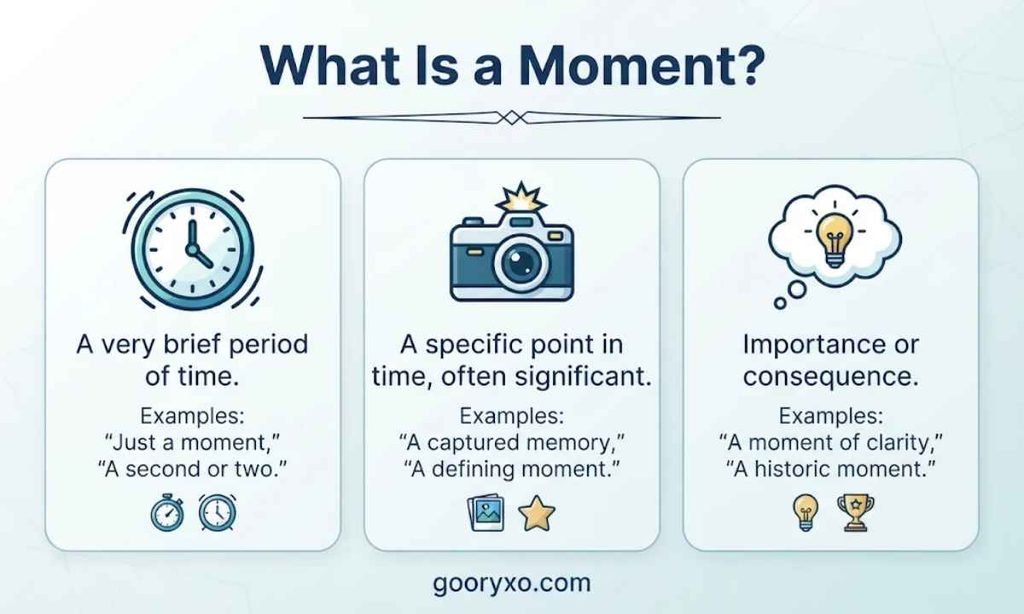
Moment is a noun. It names a short period of time, a particular point in time, the present time in certain phrases, or an important occasion.
In everyday English, a moment commonly means a short amount of time. It can also identify a particular point when something happens, or an important occasion worth remembering. Dictionaries also record specialized meanings in subjects such as physics and statistics.
The moment definition in standard dictionaries starts with a short period of time, then adds a particular point, an important occasion, and the present time.
Momment, by contrast, is simply the wrong spelling in the moment vs momment pair, when the word you want is moment.
Example: “Give me a moment to check.” That line asks for a short amount of time. “At that moment, the lights went out.” That line points to a particular point in time.
Moment vs Momment: Origin and Word History
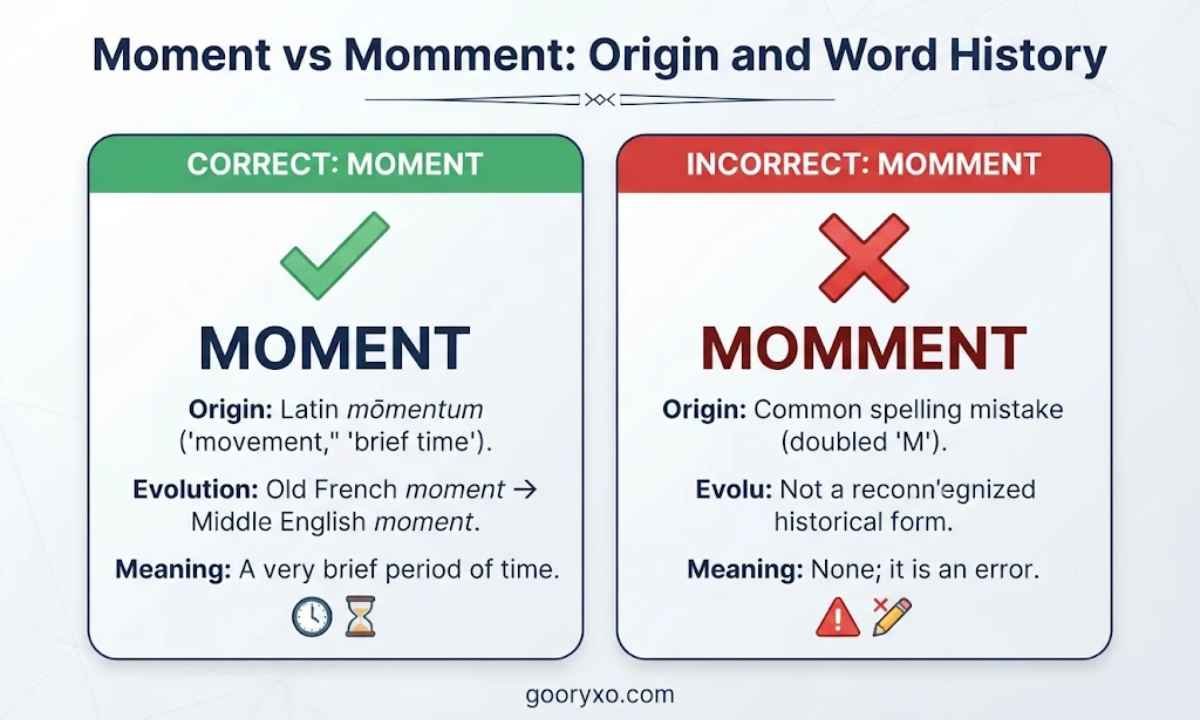
Moment comes from Latin momentum, meaning movement or a moment of time, which traces back to the verb movere, meaning to move.
That root explains the moment vs momment connection: moment, momentum, and movement look related because they share one family tree. But they grew into different words. Moment kept the time meaning, momentum kept force and progress, and movement kept motion. Middle English took the word from Latin, and modern English spells it with one m in the middle.
Dictionaries such as Merriam-Webster, the Cambridge Dictionary, and the Oxford English Dictionary trace moment to that Latin root.
Example: The Latin root movere gave us moment for time, momentum for force, and movement for motion.
Why the Correct Spelling Matters
One extra letter may look like a small mistake, but spelling shapes how readers judge your writing.
Example: A resume with momment in the first line looks rushed, even if the rest of it is perfect.
Writing momment instead of moment stands out most in job applications and resumes, business emails, school assignments, reports, website copy, social media graphics, presentations, academic papers, advertisements, and professional messages.
A typo in a casual text may cause little trouble. The same typo in an email subject line, a headline, an application, or a client proposal can make the writing look less carefully reviewed.
The meaning is usually still clear in the moment vs momment mix, but correct spelling protects your credibility.
The Core Rule for Moment vs Momment

The moment vs momment spelling rule could hardly be simpler: always write moment, never momment, when you mean a short period, a point in time, or an important occasion.
The moment spelling is M-O-M-E-N-T. Notice that there are two m’s in the whole word, one at the beginning and one later in the word, but there is no double mm.
That distinction matters, because saying moment has only one m would itself be wrong. It has two m letters in total. What it does not have is a doubled mm.
Example: Correct: moment. Incorrect: momment.
Is Momment Ever Correct?
Not as the standard English spelling of moment in the moment vs momment question.
If you are describing time, an occasion, an important point, or one of the word’s technical meanings, use moment. A brand name, username, fictional name, or intentionally altered spelling could contain Momment, but that would not make it the normal English word.
Example: A game character named Momment would be a made-up name, not the English word.
Moment vs Momment Pronunciation
The moment pronunciation is MO-ment, with the stress on the first part. Momment has no standard pronunciation, because it is not a word.
Example: Say MO-ment out loud. Two parts, and the first one takes the stress.
| Word | Pronunciation | How to Say It |
| moment | /ˈmoʊ.mənt/ (American) or /ˈməʊ.mənt/ (British) | MO-ment, two parts, stress on the first |
| momment | No standard pronunciation | People say it like moment, but the spelling is wrong |
The two spellings sound the same when spoken in the moment vs momment pair, and that is part of the trap. Your ear cannot tell them apart, so your eye has to learn the spelling. Remember MO-ment, and the single m in the middle will follow.
How to Use Moment Correctly
Use moment when you mean a short period, a particular point in time, an opportunity, or an important occasion.
Dictionaries also record specialized and less common meanings beyond ordinary time expressions. The most useful patterns for the moment vs momment choice are listed below, and each one changes the meaning slightly.
- a moment, a short amount of time: “Could you wait a moment?”
- the moment, a particular or identifiable point in time: “I remember the moment we met.”
- at the moment, now or currently: “I am busy at the moment.”
- in a moment, very soon: “I will be with you in a moment.”
- for a moment, for a short period: “He paused for a moment before answering.”
- in the moment, focused on or fully experiencing the present situation: “Try to stay in the moment.”
- a defining/important/critical moment, an important point or occasion: “That choice was a defining moment for the team.”
- moments, the normal plural: “We shared many memorable moments that summer.”
“A Moment,” “The Moment,” and “Moments”
The article before moment can change the meaning slightly.
A Moment
Use a moment in the moment vs momment choice when the exact point or duration is not specifically identified.
Example: “Can I speak to you for a moment?”
The speaker means a short amount of time, not one previously identified moment.
The Moment
Use the moment when you mean a specific point in time that the listener can identify from context.
Example: “That was the moment I changed my mind.”
The moment can also mean as soon as, in constructions such as “The moment the meeting ended, she called me.” This use is established in standard English.
Moments
The regular plural is moments.
The moments plural is simple: add s to moment and you get moments, and that is the moment vs momment plural rule. Momment does not become momments, because momment is not a word.
Example: “We shared several memorable moments.”
Correct Examples of Moment
These moment vs momment examples show the correct spelling at work in real situations.
- Conversation: “Give me a moment to find my keys.”
- Customer service: “One moment, please. Let me check your account.”
- Email: “Could I have a moment of your time to go over the new proposal?”
- Workplace: “Now may be the right moment to bring up the budget.”
- Meeting: “At that moment, everyone in the room understood the problem.”
- School: “Our teacher paused for a moment so we could check our answers.”
- Academic writing: “The reform marked a significant moment in the history of the school.”
- Social media: “What a proud moment for the whole team!”
- Text message: “Busy at the moment. I will call you later.”
- Interview: “The moment that shaped my career was my first big project.”
- Storytelling: “For a moment, the whole room went quiet.”
- Presentation: “This is a critical moment for us, because the next choice will shape our growth.”
Notice how each sentence in this moment vs momment set uses moment for time, a point, or an occasion. None of them needs a double m, and none of them would work with momment.
Incorrect vs. Correct: Moment or Momment
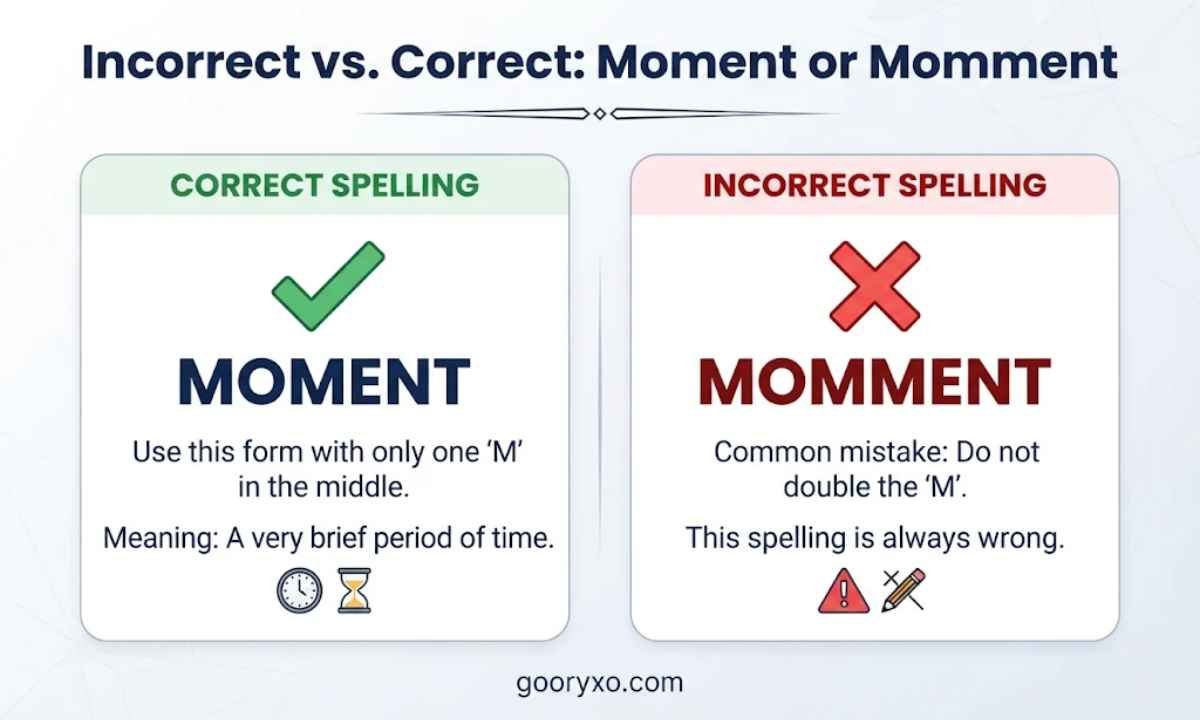
The fastest way to learn the moment vs momment difference is to see the mistake next to the fix.
| Incorrect | Correct | Why |
| Please wait a momment. | Please wait a moment. | The standard spelling has no doubled mm. |
| I need a momment to think. | I need a moment to think. | Moment is the right noun for a short period of time. |
| At that momment, I understood. | At that moment, I understood. | A particular point in time is a moment. |
| I am busy at the momment. | I am busy at the moment. | The established phrase is at the moment, meaning currently. |
| I will be ready in a momment. | I will be ready in a moment. | In a moment means very soon. |
| It was a proud momment for us. | It was a proud moment for us. | A proud occasion can also be called a moment. |
| Take a momment to read the instructions. | Take a moment to read the instructions. | The word for a brief amount of time is spelled moment. |
| This is a critical momment in the project. | This is a critical moment in the project. | Moment can also name an important stage in a process. |
| We shared several memorable momments. | We shared several memorable moments. | The plural of moment is moments. |
| Stay in the momment and focus. | Stay in the moment and focus. | In the moment is the usual phrase for focusing on the present. |
Why Do People Spell Moment as Momment?
The moment vs momment error is understandable, because English spelling contains many doubled consonants, but moment is not one of the words that doubles its middle m.
Double-Letter Pattern Confusion
Writers see many familiar English words with a double letter, such as mm, so a doubled consonant can look visually plausible.
That does not mean every similar-looking word in the moment vs momment mix follows the same pattern. Moment must simply be learned with its established spelling.
Example: Words like summer and hammer have a double m, so momment can look right at first glance.
The Word Contains Two M Sounds and Letters
The word begins with m and contains another m later: mo-ment.
Example: Say mo-ment slowly. Two m sounds, but only one m in the middle.
When writers remember the rough visual shape in the moment vs momment pair rather than the exact sequence of letters, they may accidentally turn the second m into mm. The pronunciation itself does not require a doubled consonant.
Fast Typing
Sometimes momment is not a spelling misunderstanding at all. A writer may simply strike the m key twice.
This is especially easy to miss when typing quickly on a phone. In the moment vs momment slip, the extra m hides in a long word, and the eye skips past it.
Example: Type fast on your phone, and moment can easily come out as momment.
Overgeneralising English Spelling Patterns
Learners often look for rules that can be applied to many words. That strategy is useful, but English spelling contains many individual word patterns.
Example: A double consonant in one word does not prove that a similar-looking word should also have one.
The rule that works for summer does not work for moment, and that is the moment vs momment lesson. Some spellings just have to be learned one word at a time.
Autocomplete and Spellcheck Are Helpful, Not Perfect
Most modern spelling tools can flag many obvious misspellings, but no proofreading system should replace careful reading.
Settings, custom dictionaries, formatting, application behavior, and user choices can affect whether a moment vs momment mistake is caught or corrected. A tool can help, but it cannot read your mind.
Example: Spellcheck may fix momment in a document, but it can miss it in a graphic, a heading, or a caption.
Translation Interference
Translation interference is not a major explanation that should automatically be blamed for this particular error.
Example: An ESL learner’s first language may shape spelling habits, but momment is more simply explained by visual memory, double-letter confusion, or a typing slip.
Unless there is evidence of a specific language-based pattern, the simpler moment vs momment explanations fit better. This is a case where the honest answer is: the spelling just looks that way.
Common Mistakes Checklist
Run through this moment vs momment checklist before you hit send. Eight mistakes, one quick read.
- Writing momment because it looks balanced: English words do not need to look balanced. Learn moment as one whole word instead of guessing from its shape.
- Thinking moment has only one m in total: It actually has two, m-o-m-e-n-t. The rule is that there is no double mm.
- Writing momments as the plural: The correct plural is moments.
- Confusing “at the moment” with “in a moment”: At the moment usually means now, while in a moment points to the near future.
- Using moment only for a few seconds: The word can also name a particular or important point in time, not just a short stretch you can measure.
- Assuming every occurrence has the same meaning: “Wait a moment,” “a defining moment,” and “at the moment” use the same noun in different ways.
- Trusting autocorrect without proofreading: A tool can help, but headings, graphics, captions, and client-facing documents deserve a manual check.
- Confusing moment with momentum: The words share a history, but they mean different things in modern everyday English.
What Moment Does NOT Mean
The moment vs momment pair gets clearer when you see what moment does not cover.
- Moment does not always mean a few seconds. It can also name a particular point, an important occasion, or the present time.
- Moment does not mean momentum. Momentum is the force or progress that keeps something moving.
- Moment does not mean movement. Movement is an act of moving, a change of position, or an organized group.
- Momment does not mean anything. It is not a word, so it has no meaning, no part of speech, and no place in a dictionary.
- Moment does not change its spelling by region. American and British English both use moment.
Example: A defining moment is not a few seconds, and gaining momentum is not a moment.
See Also Comment vs Coment: Which Spelling Is Correct?
Moment in Real English
Spelling and natural usage are two different skills in the moment vs momment question. These three patterns show how moment works in real English.
Grammatically Correct and Natural
Moment appears naturally in both everyday speech and more careful writing.
Common expressions in the moment vs momment set include wait a moment, at the moment, for a moment, in a moment, and a memorable moment. Native speakers do not normally notice these expressions as formal or unusual, because they are ordinary parts of English. The exact phrase matters, however, because changing the preposition can change the meaning.
Example: “Wait a moment, please. I am busy at the moment, but I will call you in a moment.”
Grammatically Possible but Unnatural
A sentence can contain the correctly spelled word moment and still sound awkward.
Example: “I will perform the task after one moment.” That is understandable, but in ordinary conversation “I will do it in a moment” is more natural when the speaker means very soon.
Correct spelling in the moment vs momment question does not guarantee natural phrasing. Common combinations of words, called collocations, also matter.
Incorrect English
Momment should not be used as an alternative spelling simply because the text is casual, conversational, or online.
Informal English allows contractions, slang, fragments, emojis, and many relaxed constructions, but ordinary informality does not turn a moment vs momment spelling error into a standard variant. If the intended word is the English noun referring to time, an occasion, or significance, the normal spelling remains moment.
Example: A casual text with momment is still a typo. The standard spelling does not change with the setting.
Moment vs Momment Comparison Table
This moment vs momment table puts the whole difference on one page.
| Feature | Moment | Momment |
| Standard English spelling | Yes | No |
| Correct for a short period of time | Yes | No |
| Correct for a particular point in time | Yes | No |
| Can refer to an important occasion | Yes | No |
| Part of speech | Noun | No standard role |
| Plural | Moments | Not the standard form |
| Used in “at the moment” | Yes | No |
| Used in “in a moment” | Yes | No |
| Suitable for formal writing | Yes | No |
| Suitable for casual writing | Yes | No, still a misspelling |
| American English | Moment | Incorrect |
| British English | Moment | Incorrect |
Example: Moment works in every row of the moment vs momment table. Momment works in none of them.
Moment, Momentum, and Movement
These words look related enough to create additional confusion, but they are not interchangeable.
| Word | Basic Meaning | Example |
| moment | a short period, particular point, or important occasion | “It was a special moment.” |
| momentum | force or progress that keeps something moving or developing | “The campaign gained momentum.” |
| movement | an act of moving, a change of position, or an organized group or campaign | “The camera detected movement.” |
Example: “Winning the award was a special moment. The team gained momentum after its first victory.”
Do not choose the word based only on visual similarity in the moment vs momment mix. The moment vs movement choice is the same: choose the word according to meaning.
Memory Trick for Moment
Split the word into MO and MENT, and you get MOMENT, with no extra M. That is the whole moment vs momment trick.
Picture the word as two visual chunks: MO and MENT. Put them together and you get MOMENT. Put an extra m in and you get MOMMENT, which is not a word. Another useful reminder is the familiar phrase one moment please, which everyone uses to ask for a short wait. When you picture that sentence, picture MOMENT as six letters.
Example: MO + MENT = MOMENT. Say it once, and the spelling sticks.
Real-Life Situations
These short scenes show the moment vs momment choice working in the places you actually use the word.
In an Interview
You need a second to organize your answer.
Example: “That is a good question. Give me a moment to think.”
Writing the same sentence in an interview task or a follow-up document needs moment, not momment.
In a Meeting
The team reaches an important stage.
Example: “This is a critical moment for the project.”
Here, moment means an important point in the project’s development, not necessarily a period lasting only a few seconds.
In an Email
You are currently unavailable.
Example: “I am tied up at the moment, but I can review the document this afternoon.”
At the moment means currently or now.
In a Text Message
A friend asks when you will be ready.
Example: “I will be there in a moment.”
Here, in a moment points forward: the action will happen very soon.
In an Exam
The question asks you to correct a sentence.
Example: “It was the happiest momment of her life.” The correction is: “It was the happiest moment of her life.”
The correction is spelling, not grammar or meaning.
Expert Tips for Remembering and Using Moment
Five habits from the moment vs momment rulebook will keep you right every time.
Learn the Whole Word Instead of Inventing a Rule
Not every English spelling needs a complicated grammar rule. Some words are best remembered as complete letter patterns.
For moment, memorize M-O-M-E-N-T. One picture, six letters, and the spelling is done.
Example: Write M-O-M-E-N-T on a card, and look at it once a day for a week.
Proofread the Most Visible Text Twice
Typos in body paragraphs can be missed. Typos in titles, headings, advertisements, thumbnails, email subject lines, and presentation slides are much more noticeable.
Example: Check high-visibility text separately, because that is where a typo costs the most.
A mistake in the middle of a long page may slip past. A mistake in a headline will not.
See Also Comment vs Coment: Which Spelling Is Correct?
Search for Your Personal Misspelling
If you know you often type momment, use your document’s search function to look specifically for it.
This is faster than hoping your eyes catch every occurrence. One search finds every momment in the file.
Example: Press Ctrl + F, type momment, and fix every match.
Learn Phrases, Not Just Individual Words
Learning moment inside common phrases improves both spelling and natural usage.
Example: Practice a moment, for a moment, at the moment, in a moment, at that moment, the right moment, a defining moment, and memorable moments.
Phrases carry the moment vs momment spelling with them. When you know the phrase, you know the word.
Pay Attention to Prepositions
The spelling stays the same, but the phrase can change meaning.
At the moment means now. In a moment means very soon. For a moment means for a short time. In the moment means focused on the present experience. This distinction is more useful to learners than simply memorizing that moment means a short time.
Example: At the moment means now, in a moment means soon. Same word, different preposition, different meaning.
Mini Quiz: Moment vs Momment
Test yourself with this quick moment vs momment quiz. Ten questions, answers included.
| # | Question | Answer | Why |
| 1 | Which is correct: moment or momment? | Moment | The standard spelling contains no doubled mm. |
| 2 | Fill in the blank: “Please give me a ___ to finish this.” | moment | A brief period of time is a moment. |
| 3 | Correct the sentence: “This is an important momment for our company.” | “This is an important moment for our company.” | Momment contains an unnecessary extra m. |
| 4 | Which phrase means “currently”: at the moment or in a moment? | At the moment | At the moment commonly means now. |
| 5 | Fill in the blank: “I will be with you in a ___.” | moment | In a moment means very soon. |
| 6 | What is the plural of moment? | Moments | Add s to form the regular plural. |
| 7 | Correct the sentence: “We enjoyed several unforgettable momments.” | “We enjoyed several unforgettable moments.” | The plural follows moment → moments. |
| 8 | Which is natural: “I need a moment to think” or “I need a momment to think”? | I need a moment to think. | The first sentence uses the standard spelling. |
| 9 | In “That was a defining moment,” does moment have to mean only a few seconds? | No | It can refer to an important point or occasion. |
| 10 | True or false: Momment becomes acceptable in informal messages. | False | Informal register does not make it the standard spelling of moment. |
Expert Tips
When the moment vs momment error appears repeatedly in your writing, do more than correct it once. Build a visual memory of MOMENT.
A practical method is: see it, say it, type it, use it in a phrase. For example: MOMENT, then “Give me a moment.” This approach connects spelling with real language rather than an isolated list of letters.
Example: See MOMENT, say MOMENT, type MOMENT, then use it: “Give me a moment.”
Also remember that spelling and usage are separate skills. Once you can spell moment, learn its common phrases. A learner who writes at the moment and in a moment correctly has gained more useful English than someone who only knows that momment is wrong.
Frequently Asked Questions
Is “momment” a word?
Is momment a word? No. In the moment vs momment pair, momment is not the standard English spelling of moment.
How do you spell moment correctly?
How to spell moment is simple: M-O-M-E-N-T. There are two m letters in the complete word, but they are separated. There is no mm.
What is the plural of moment?
The plural is moments. One moment, two moments. You simply add s.
What is the difference between “at the moment” and “in a moment”?
At the moment generally means now or currently. In a moment generally means very soon. Standard learner dictionaries record these established patterns.
What is the difference between moment and momentum?
Moment commonly refers to time or a particular occasion. Momentum commonly refers to the force or progress that keeps an object, activity, or process moving. The moment vs momment question is about spelling; the moment vs momentum question is about meaning.
Is the spelling different in American and British English?
No. The standard spelling is moment in both American and British English. There is no standard moment/momment regional spelling contrast.
Can I use “momment” in a casual text message?
If you intend the normal English word moment, it is still a spelling error. Casual communication may tolerate more typos, but the standard spelling does not change.
Summary
The answer is one word: moment. Momment is a mistake, not a variant. Moment covers a short stretch of time, a particular point, an important occasion, and the present time in phrases such as at the moment.
The moment vs momment rule is simple: one m in the middle, never two. Remember that at the moment means now, while in a moment usually means very soon. The plural is moments, and the memory trick is MO + MENT = MOMENT. Whether you write casually, academically, or professionally, use moment.

My name is Ashfaq, and I am an English teacher with 5 years of teaching experience, specializing in English grammar. My mission is to make grammar easy to understand through simple explanations, practical examples, and helpful learning resources. At Gooryxo, I aim to help learners improve their grammar, strengthen their writing skills, and use English with confidence.

1 thought on “Moment vs Momment Meaning: Spelling, Examples & Quiz”