
Comment vs coment has a short answer: comment is correct, and it takes two m’s. Coment is a typo that happens when a quick typist skips the second m, and the double m stays put in comments, commented, and commenting.
Below you’ll find the rule, the history behind it, and the spots where the slip sneaks in, from code files to spelling by ear. There are examples, a pronunciation guide, and a short quiz at the end.
What Is Comment?

A comment is a remark, opinion, or note about something, and the same word works as a verb meaning to make such a remark. Either way, it’s spelled with two m’s.
The comment meaning is simple: a remark or opinion. Merriam-Webster, Oxford, and Collins all list both the noun and verb uses, and the verb forms are comments, commented, and commenting. The noun can mean a quick reaction, a critical remark, or an explanatory note attached to a text, like the margin notes in a student edition.
Example: The editor’s one-line comment saved me an hour of rewriting.
Why Correct Spelling Matters
In the comment vs coment debate, one missing letter rarely blocks meaning, but it changes how careful you look. A reader who spots coment in an email may start doubting the rest of it.
Say you’re closing a client message with: “I’d love your coment on the proposal.” Nobody will misunderstand you, yet the slip sits right where the eye lands.
The correct spelling of comment counts most where someone is judging your care: job applications, reports, exam answers, product pages, and customer replies. A typo in a heading or a subject line is hard to miss.
The Core Rule
Write comment with two m’s, every time, in every form. The comment vs coment question never has a second answer, and comments, commented, and commenting all keep the pair.
Here’s how to spell comment: C-O-M-M-E-N-T. Don’t trim it because the word sounds like it has one m. Sound is the wrong guide here, and the pronunciation sections below show why.
In a sentence: She commented on every slide, then commented again in the follow-up thread.
Why Does Comment Have Two M’s? (Etymology)
The double m comes from Latin. The prefix com- met a root that starts with m, and English kept both letters when the word arrived in the late 1300s.
That history settles comment vs coment before it starts. Same pattern, different words: commit, command, commotion, committee.
Merriam-Webster says the word came into Middle English from Late Latin commentum. That Latin word comes from comminisci, “to invent,” which is built from com- plus a root linked to mens, the Latin word for “mind.”
Etymonline adds that commentum first meant an invention, and later Christian writers used it to mean “interpretation, annotation.” It dates the English noun to the late 14th century and the verb to the early 15th.
How to Use Comment Correctly

Use comment as a noun when you mean the remark itself, and as a verb when you mean the act of making one. The spelling doesn’t move in either role.
Comment as a Noun
As a noun, a comment is a remark, reaction, or note, and the plural is comments. Common frames include “leave a comment,” “no comment,” and “request for comment.”
Quick sample: Her comment about the deadline changed the whole meeting.
News stories lean on the last frame when a source stays quiet, which is why you’ll see “did not respond to a request for comment” so often.
Comment as a Verb
As a verb, comment means to say something about a topic, most often with on: comment on the report. It can also take a that-clause, or stand alone when the topic is obvious.
Reported speech works too: she commented that the traffic had eased. And when someone stays quiet, you get the familiar “he wouldn’t comment.”
Comment, Comments, Commented, and Commenting
All four forms keep both m’s: comment, comments, commented, commenting. Build each one on the finished base word and leave the base alone.
| Form | Job | Sample sentence |
| comment | noun or base verb | One comment is enough. |
| comments | plural noun, or verb with he/she/it | She comments on every draft. |
| commented | past tense | He commented an hour ago. |
| commenting | -ing form | I’m commenting from my phone. |
A related word, commenter, names the person leaving the remark. Same double m there too.
Correct Examples of Comment
These twelve sentences show comment in six everyday settings, each with the spelling intact. The word shifts between noun and verb without changing shape.
Conversation
In speech and chat, comment covers any passing remark.
- I wasn’t offended by his comment; I just didn’t get the joke.
- Can I comment on something before we move on?
In email, comments usually mean feedback on an attachment, so the plural shows up a lot.
- Send me your comments on the budget sheet before Thursday noon.
- Thanks for the comments; I’ve fixed the first three.
School
Teachers write comments in margins, and students comment on texts in class discussion.
- Her comment on my thesis statement made me rewrite the whole paragraph.
- The class commented on how the poem keeps repeating the word “home.”
Workplace
At work, the word lives in reviews, approvals, and meetings.
- Legal has one comment on clause four.
- Nobody commented during the demo, which worried me.
Social Media
Here comment is both the thing you post and the action of posting it.
- Her reel picked up four hundred comments in an hour.
- Please keep it kind when you comment.
Academic Writing
Scholars use comment for a brief remark on a source, method, or result.
- The reviewer comments that the sample size is too small.
- A short comment in the footnote explains why the outliers were trimmed.
Incorrect vs. Correct
Every wrong form below drops an m, and every fix simply puts it back. The table gives you eight pairs you can scan in under a minute.
| Incorrect | Correct | What went wrong |
| Her coment was kind. | Her comment was kind. | The noun needs both m’s. |
| Thanks for all the coments! | Thanks for all the comments! | Plural -s goes on the full word. |
| She comented twice. | She commented twice. | Past tense is built on comment. |
| I’m comenting from my phone. | I’m commenting from my phone. | The -ing ending doesn’t remove an m. |
| No coment from the company. | No comment from the company. | The set phrase keeps the spelling. |
| Can I coment here? | Can I comment here? | The verb has the same two m’s. |
| The comenter was polite. | The commenter was polite. | Related words keep the pair. |
| Uncoment line 12. | Uncomment line 12. | Code terms follow the same spelling. |
Why People Write Coment Instead of Comment
Most comment vs coment mistakes happen because the double m is easy to skip when you type fast or spell by ear. A few other habits feed the slip, and knowing them makes it easier to catch.
See Also Pentoxide vs Pentaoxide: Which Is Correct? IUPAC Rule & Examples
The Double Letter Is Easy to Miss
Your finger taps m once and your brain fills in the second one. A doubled consonant is usually the first thing to go when you type fast.
The trouble is proofreading. Your eyes read what you meant to write, so coment can sit on the screen looking perfectly fine until someone else spots it.
Pronunciation Does Not Clearly Reveal Two M’s
Say comment out loud and you hear a single m sound at the join, not two. Doubled letters in English rarely mean a doubled sound.
This is why comment vs coment is so hard to settle by listening. Test it: summer has two m’s and comet has one, yet you hear one m in both. Your ear can’t count the letters for you.
Spelling by Sound
Writing a word the way it sounds works in many languages, but English learners soon find that English breaks that rule. Comment sounds like “COM-ent,” and that’s how a single-m version gets written.
Roman Urdu and Hindi texting, where spelling follows sound, can produce the same result. So do other double-letter words: recommend and accommodate both get misspelled by dropping a letter.
Spelling Overlap With Other Words
Coment sits next to several real words, which is part of why it hides well. Comet, cement, commend, and command all share chunks of its shape.
The sneakiest one is comet. Drop the n and one m from comment and you land on a real word, so a sentence like “Please leave a comet below” passes spellcheck with no warning.
Autocomplete and Spellcheck Have Limits
Spellcheck catches coment most of the time, but it stays silent when a typo happens to be a real word, and autocorrect or autocomplete can swap your word without asking. Many code editors don’t check spelling at all unless you add a plugin.
That’s how the typo reaches real software. In 2022, a patch to the IPFire firewall project fixed a message shown to users that read “Coment the above line and uncoment the next line.”
Tools like Grammarly or the checker in Google Docs help with the comment vs coment slip, but a final read-through is still your best safety net.
Translation Interference
Spanish and Portuguese write the matching verb as comentar, with one m, so speakers of those languages can carry the single m into English. French and Italian use a double m, which is why the problem isn’t universal.
For a learner, comment vs coment can start in another language. Example: a learner who knows the Spanish noun comentario may write “coment” in English, because the stem they remember has one m. The English word doesn’t follow it.
Common Misspellings of Comment
Beyond the plain comment vs coment mix-up, the common spelling mistakes either drop an m, add an extra one, or swap letters. The first kind gets the most attention, but the others are worth knowing too.
| Misspelling | What happened | Fix |
| coment | one m dropped | comment |
| commment | a sticky key added a third m | comment |
| commnet | letters swapped | comment |
| comet | real word typed by accident | comment |
The same patterns hit the other forms. People ask comments or coments, commented or comented, and commenting or comenting, and the answer is always the version with both m’s.
Is “Coment” Ever Correct? Code, Names, and Old Records
Not in modern English, so the comment vs coment answer stays the same. As a spelling of the noun or verb, coment is a typo, and you should fix it.
There’s one fun exception for word lovers. Etymonline says English comment came either from Old French coment, meaning “commentary,” or straight from Late Latin. So the one-m spelling is a real ancestor form, but it belongs to another language and another age.
A username, brand, or quoted passage can also keep coment exactly as written. If you quote a source that has the typo, add [sic] after it and move on.
Example: a handle like coment_club is a name, not a spelling lesson. In your own sentences, it’s still comment.
Common Mistakes Checklist
Run through these eight slips before you hit send, starting with comment vs coment. Most of them take five seconds to catch.
- Dropping an m: coment, coments, comented, or comenting. Put the second m back.
- Adding a third m: commment. Two is the limit.
- Spelling by ear and trusting the sound.
- Trusting spellcheck when the typo is a real word, like comet.
- Mixing up comment and commend. One is a remark, the other is praise.
- Leaving out the preposition. “Commented on the report” reads more naturally than “commented the report.”
- Fixing the typo in your text but missing it in code comments or filenames.
- Skipping the last read-through on anything that goes to a client or teacher.
Before and after: “Please coment on the draft” becomes “Please comment on the draft.”
Comment vs Coment in Real English
In real English there’s only comment. Coment isn’t a regional form or an acceptable variant; it’s a slip.
Writers and editors sort sentences into three groups: correct and natural, correct but stiff, and wrong. The three short sections below show how comment fits each.
Grammatically Correct
A sentence works when comment sits in the right slot: a noun after an article or adjective, a verb after a subject. Coment never works, because it isn’t a word.
Example: “She made one sharp comment, then commented again later.” Both slots are filled correctly, and the spelling is identical.
Possible but Unnatural
These sentences spell comment right but sound like a form letter. They’re grammatical, and nobody speaks that way.
Stiff: “Kindly be advised that I have a comment pertaining to the meeting time.” Natural: “I have a comment about the meeting time.” The shorter one sounds like a person.
Natural Everyday English
Natural English uses comment in short, plain frames: “any comments?”, “drop a comment,” “I’ll comment later.”
- Any comments before we wrap up?
- Drop a comment if this helped.
- The spokesperson wouldn’t comment.
American vs. British English
There’s no difference, so comment vs coment has no regional angle. Both American and British English write comment, and only the first vowel changes when you say it.
Unlike color and colour, this word has no split spelling to remember. If you write it with two m’s, you’re right in both countries.
How to Pronounce Comment (IPA, UK & US)
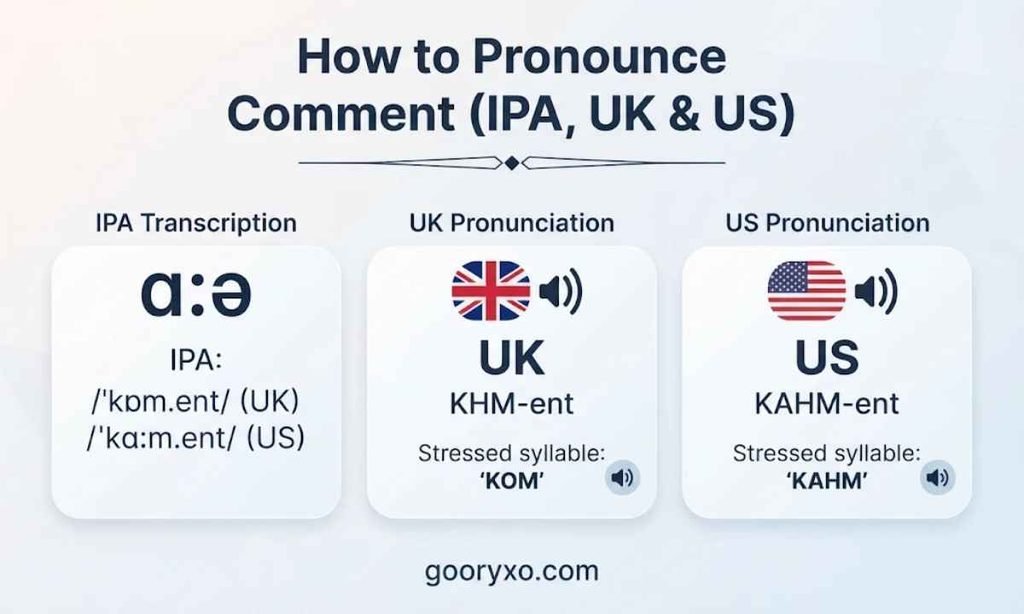
Say COM-ent, with the stress on the first syllable. Dictionaries typically show UK /ˈkɒm.ent/ and US /ˈkɑː.ment/.
The noun and verb share the same stress, unlike record or present, which shift. The double m is just one m sound where the two syllables meet.
Try it slowly: com, then ment. Saying it this way makes comment vs coment easier to hear and see. That split matters again in the memory trick below.
Formal vs. Informal Usage
The spelling never changes between casual and formal writing. What changes is the words around it.
Informal
Informal comment is short and punchy, the kind of thing you’d type under a friend’s post.
- Leave a comment and tell me what you think!
- Thanks for commenting, that made my day.
Formal and Professional
Formal writing ties comment to a clear target and often a deadline.
- People can send written comments on the draft policy until 5 March.
- The council opened a public comment period on the new zoning plan.
Comment vs Coment Comparison Table
Comment is the only correct spelling, and coment is a typo in every form. The table puts the two side by side.
| Feature | Comment | Coment |
| Real English word | Yes | No, it’s a typo |
| Number of letters | 7 | 6 |
| Works as a noun | Yes | No |
| Works as a verb | Yes | No |
| Plural | comments | coments (wrong) |
| Past tense | commented | comented (wrong) |
| -ing form | commenting | comenting (wrong) |
| US spelling | comment | not accepted |
| UK spelling | comment | not accepted |
| Fix | keep it | add the second m |
Example: “Add a comment” is right; “Add a coment” gets corrected.
Comment vs Commend
Comment means to make a remark, and commend means to praise or recommend. They sit one letter apart but do very different jobs.
Merriam-Webster also lists an older sense of commend, “to entrust,” as in commending someone to another’s care. You’ll rarely need it today.
Example: The judge commented on the evidence, then commended the jury for its patience.
See Also Pentoxide vs Pentaoxide: Which Is Correct? IUPAC Rule & Examples
Comment vs Commentary
A comment is a single remark, while commentary is a running series of remarks or analysis. Sports broadcasts and director’s tracks on films are good examples of commentary.
Etymonline dates commentary to the early 15th century, in the sense of a “series or collection of comments.” Someone who delivers it is a commentator.
Picture this: a one-line reply under a post is a comment. A voice explaining every play of a cricket match is commentary.
Synonyms of Comment
Remark, observation, and note cover most noun uses, while mention, say, and point out work for the verb. Each one has a slightly different flavor.
- Remark is a casual, spoken-style comment.
- Observation suggests something noticed carefully.
- Feedback is a comment meant to improve something.
- Annotation is a note written on a text.
Instead of repeating the same word, she wrote: “Her remark drew a laugh, and his observation drew a pause.”
Memory Trick
To settle comment vs coment for good, split the word into com and ment. The first chunk ends with m and the second one starts with m, so the two meet in the middle.
Write it in two beats and your hand won’t skip one. If you jump from com straight to ent, you’ve dropped a letter.
Here’s the picture: com + ment = comment.
Real-Life Situations
Here are five moments where people most often type this word, along with how it looks when it’s right.
Interview
In interviews, recruiters love “comment on” as a way to invite longer answers.
Recruiter: “Can you comment on the gap in your resume?” Candidate: “Sure. I used that year to finish a certification.”
Meeting
In meetings, a comment is a short point raised before a decision.
“I have a quick comment on the timeline before we vote.”
Reviewers use comments when feedback sits in the margins of a shared document.
“I’ve left a few comments in the margins, mostly about formatting.”
Text Message
Texting doesn’t change the spelling, even when the tone is loose.
“Saw your comment under Zain’s post, you’re brutal, haha”
Exam
Exam prompts often use comment as a command word, asking for your view with reasons.
“Comment on the narrator’s tone in the final paragraph.” A spelling slip in that first line can distract the examiner before you’ve said anything.
Expert Tips
Six habits make the double m automatic and end the comment vs coment doubt. Pick two or three and use them for a week.
1. Learn the Whole Word, Not Just the Rule
Treat comment as one picture, not a puzzle to rebuild each time. Copy it into a sentence you’ll actually reuse, like the closing line of your emails.
Try this: end your messages with “Comments welcome,” and your hand learns the word.
2. Check the Base Word Before Adding Endings
Write comment first, then attach -s, -ed, or -ing without touching the base. The ending never changes the m count.
That’s how comment becomes comments, commented, and commenting with no surprises.
3. Learn Common Word Partnerships
Words that travel together are easier to spell because you see them as a unit. Learn these: comment section, comment thread, comment box, request for comment, public comment period.
In code, you’ll also meet “comment out,” which means turning a line into a note the computer ignores, and “uncomment” for the reverse.
4. Do Not Treat Every Search Result as Proof of Correctness
Search engines rank popularity, not spelling. If coment returns thousands of pages, that shows how common the typo is, not that it’s acceptable.
Check Merriam-Webster, Cambridge, or Oxford when a spelling matters.
5. Be Careful With Names and Historical Forms
A name, handle, or quoted source can keep coment untouched. Your own sentences shouldn’t.
Old French used coment, as the etymology section shows, but that’s history, not a spelling choice for today. Use [sic] when you quote an error.
6. Use “Comment on” When You Need a Safe Verb Pattern
When you’re unsure, write comment on plus the topic. It’s the pairing readers expect, and it works in most settings.
Example: The coach commented on the referee’s decision after the match.
Mini Quiz
Every answer here is some form of comment, so the comment vs coment rule will carry you through. Try all eight before you look at the answers.
- Pick the right spelling: coment or comment?
- Fill the blank: “She ___ on every slide.” (comment, commented, or comented)
- Fix this: “Thanks for all the coments!”
- Which one means to praise: comment or commend?
- Which one is a running series of remarks: comment or commentary?
- Fix this: “Please uncoment line 5.”
- True or false: British English spells it differently from American English.
- How many m’s are in commenting?
Answers:
- Comment. Coment is a typo.
- Commented. It’s the past tense, built on comment.
- “Thanks for all the comments!” Plural -s goes on the full word.
- Commend. Comment means to remark.
- Commentary. A comment is one remark.
- “Please uncomment line 5.” The code term keeps the double m.
- False. Both write comment.
- Two. The ending doesn’t remove one.
Frequently Asked Questions
Comment vs coment: which one is correct?
Comment or coment? Comment is correct. Coment is a typo caused by dropping one of the two m’s.
The double m stays in every form: comments, commented, and commenting.
Is coment a real word?
Not in modern English. In the comment vs coment pair, it’s the misspelling of comment, though Etymonline notes an Old French ancestor spelled coment.
You may also see it in usernames, brands, or quoted text, where it should stay as written.
Is it commented or comented?
It’s commented. Add -ed to the full word comment, and don’t remove an m.
Should I say comment on or comment about?
Comment on is the standard pairing for the verb. Comment about shows up more often with the noun, as in “a comment about the delay.”
How can I stop typing coment?
Slow down at the double m, and use the com + ment split when you type. On a phone, you can also set a text replacement so coment auto-fixes to comment.
Does comment mean the same thing in programming?
Almost. A code comment is a note that the computer ignores, and the comment vs coment rule applies there too.
Final Thoughts
Comment vs coment comes down to one letter: comment keeps both m’s in every form, and coment is a typo. Split the word as com and ment, and the double m takes care of itself.
Come back to the checklist or the quiz whenever you want a quick refresher. The next time you reply to a message or edit a draft, give the word a half-second glance.

My name is Ashfaq, and I am an English teacher with 5 years of teaching experience, specializing in English grammar. My mission is to make grammar easy to understand through simple explanations, practical examples, and helpful learning resources. At Gooryxo, I aim to help learners improve their grammar, strengthen their writing skills, and use English with confidence.

1 thought on “Comment vs Coment: Which Spelling Is Correct?”