
Pentoxide vs pentaoxide is not a simple right or wrong question. IUPAC’s current rule keeps the last vowel, so penta + oxide becomes pentaoxide, while pentoxide is the older short form used in names like phosphorus pentoxide.
Use pentaoxide when you build a systematic name for an exam or a paper. Use pentoxide when you copy a well-known name from a label, a database or a textbook. This pentoxide vs pentaoxide guide shows how to choose, with real compounds and easy examples.
What Is the Difference Between Pentoxide and Pentaoxide?
The difference is one vowel. Pentaoxide keeps the final a of penta-, and pentoxide drops it. Both words describe an oxide with five oxygen atoms.
Example: N₂O₅ is called dinitrogen pentoxide in older books and dinitrogen pentaoxide under the IUPAC rule. It’s one compound with two valid names.
The short form is a habit chemists have used for a long time. The long form follows the modern rule on vowel elision, which means dropping a vowel where two word parts join. In the pentoxide vs pentaoxide question, that rule says the vowel stays.
Why It Matters
The pentoxide vs pentaoxide choice matters because a chemical name must lead every reader to one substance. A wrong spelling can cost exam marks, hide a record in a database or slow down a safety check.
Names get compared in exam keys, lab reports, supplier catalogues, safety data sheets (SDS) and journal papers. Each place has its own habit.
Example: A technician searches an inventory for “vanadium pentoxide” and finds nothing, because the entry says divanadium pentaoxide. European Chemicals Agency (ECHA) documents for this substance list both names, under CAS number 1314-62-1.
The Core Rule
For pentoxide vs pentaoxide, the IUPAC answer is simple: the last vowel of a multiplicative prefix is not dropped. So penta + oxide is pentaoxide. The only named exception is monoxide.
Example: Carbon monoxide is the allowed exception. Dinitrogen tetraoxide (N₂O₄) shows the rule at work.
A multiplicative prefix is a word part like di-, tetra- or penta- that tells you how many atoms there are. The rule is written in the Red Book, formally Nomenclature of Inorganic Chemistry: IUPAC Recommendations 2005. The 2015 Brief Guide in Pure and Applied Chemistry repeats it and uses pentaoxide as an example.
The rule is a guide for building names. It doesn’t tell anyone to rewrite old names that people already use.
How to Use Pentoxide and Pentaoxide Correctly

Match the spelling to the task. Use pentaoxide for systematic naming, and use pentoxide for established names you are quoting.
Ask three quick questions:
- Does the task say “IUPAC” or “systematic”? Write pentaoxide.
- Am I copying a name from a label, an SDS, a paper or a database? Keep it exactly as written.
- Did my teacher, journal or company give a style rule? Follow that first.
Example: On a naming quiz, you write diphosphorus pentaoxide. In your stock list, the bottle says phosphorus pentoxide, so you copy that.
When Pentaoxide Is the Better Choice
In pentoxide vs pentaoxide, pentaoxide is the better choice when you build a name from a formula using the IUPAC rule.
Example: For I₂O₅, the full systematic answer is diiodine pentaoxide. People often say “iodine pentoxide,” but that name leaves out the di- for the two iodine atoms.
The same rule asks you to count both elements. That’s why N₂O₅ becomes dinitrogen pentaoxide and not “nitrogen pentaoxide.”
When Pentoxide Is Appropriate
In pentoxide vs pentaoxide, the short form is right when it’s part of a well-known name that your source already uses.
Labels, safety records and old papers all use the short form. If you change it halfway through a document, a reader may not recognize the substance.
Example: A materials paper talks about tantalum pentoxide, and a workplace binder files its hazard sheet under vanadium pentoxide. Neither name needs fixing.
Correct Examples
Here are eight real uses that show how pentoxide vs pentaoxide works in different places.
- A teacher’s answer key says “name by IUPAC rules,” so the key reads dinitrogen pentaoxide.
- You copy the bottle label into your lab notebook: phosphorus pentoxide, kept in a desiccator.
- The reason a methods section says vanadium pentoxide is simple: the paper it follows used that name, and the authors stayed consistent.
- A supplier catalogue lists diphosphorus pentoxide, so you use the same words when you order.
- In a database cleanup, arsenic pentoxide and diarsenic pentaoxide are linked as synonyms for CAS 1303-28-2.
- Your study note says: “Systematic means the vowel stays, so pentaoxide.”
- A reference list keeps a paper’s title with pentoxide exactly as published, because titles are never edited.
- An SDS shows divanadium pentaoxide next to the familiar name, and you treat both as one substance.
Incorrect vs. Correct Usage
With pentoxide vs pentaoxide, the common slips are calling either spelling a mistake, and adding a space or hyphen where none belongs.
| Incorrect | Correct | Why |
| “Pentaoxide is always a typo.” | Pentaoxide is the systematic form. | The IUPAC no-elision rule produces it. |
| “Pentoxide is the only real spelling.” | Pentoxide is established, and pentaoxide is valid in systematic naming. | Both appear in serious chemical records. |
| penta oxide | pentaoxide | The prefix joins the word directly. |
| penta-oxide | pentaoxide | Simple prefixes take no hyphen. |
| nitrogen pentaoxide (for N₂O₅) | dinitrogen pentaoxide | The di- counts the two nitrogen atoms. |
| “Change every pentoxide in the file to pentaoxide.” | Check if it’s an established name first. | Blind find and replace can break references. |
| “All vowels vanish before oxide.” | Only monoxide is the exception. | The rule is no elision, with one exception. |
Why People Make This Mistake
Most pentoxide vs pentaoxide confusion comes from similar sounds, different textbook habits and software that can’t tell which naming system you use.
Example: A student learns “pentoxide, not pentaoxide” in class. Later she sees diphosphorus pentaoxide in a database and thinks it’s an error. Both sources are right; they follow different conventions.
Phonetic Similarity
The pentoxide vs pentaoxide pair sounds almost the same, so the extra vowel gets lost when people talk fast.
Example: When a lecturer reads pentaoxide aloud, it often comes out as “pent-oxide.”
Because of this, the short form feels natural, even when a rule asks for the long one.
Spelling Overlap
The two spellings differ by one letter, so writers assume one must be a typo. That’s the main trap in pentoxide vs pentaoxide.
In chemical nomenclature, a long form and a short form can both be valid, and a spelling check can’t tell you which one your task needs.
Example: Unlike “color” and “colour,” the pair pentoxide and pentaoxide has nothing to do with American or British English.
Overgeneralizing Vowel-Dropping Rules
Many learners stretch the monoxide exception into a rule for every prefix, and that’s where most pentoxide vs pentaoxide errors begin.
Example: Because monoxide is shortened, a student writes “tetroxide, pentoxide, hexoxide” everywhere and thinks the rule is universal.
Some study guides teach “drop the extra vowel,” which matches older textbooks. The modern IUPAC rule points the other way, so you’ll meet both.
See Also Rug vs Rag: What Is the Difference? (With Examples)
Autocomplete and Spellcheck
Spellcheck can’t settle pentoxide vs pentaoxide, because it compares words with a dictionary and doesn’t know which naming system you follow.
It might underline pentaoxide and suggest pentoxide, or the reverse. Treat those hints as word frequency, not as chemistry advice.
Example: Typing diphosphorus pentaoxide may show a red line in a word processor, even though the name is correct under IUPAC rules.
Translation Interference
Many languages use the short form in everyday chemical names, and that habit can carry into English and add to the pentoxide vs pentaoxide confusion.
French pentoxyde, Spanish pentóxido and Italian pentossido all use the short pattern. A student trained in one of them may write pentoxide without thinking, and that’s fine.
Example: A learner who knows pentóxido de fósforo writes phosphorus pentoxide in English, which is a well-known name.
Common Mistakes Checklist
Use this pentoxide vs pentaoxide checklist before you hand in a lab report, an exam answer or a document with compound names.
- Calling pentaoxide a typo when the task uses IUPAC naming.
- Calling pentoxide wrong when it’s part of an established name.
- Using monoxide as proof that all prefix vowels disappear.
- Leaving out di- in names like dinitrogen pentaoxide.
- Writing “penta oxide” or “penta-oxide” instead of pentaoxide.
- Rewriting names copied from an SDS, a label or a cited title.
- Trusting spellcheck instead of the naming system your task needs.
- Mixing pentaoxide with pentaoxidane, which is a different compound (H₂O₅).
Example: If a worksheet says “name by IUPAC recommendations,” write dinitrogen pentaoxide. Don’t write “nitrogen pentoxide.”
Pentoxide vs Pentaoxide in Real English
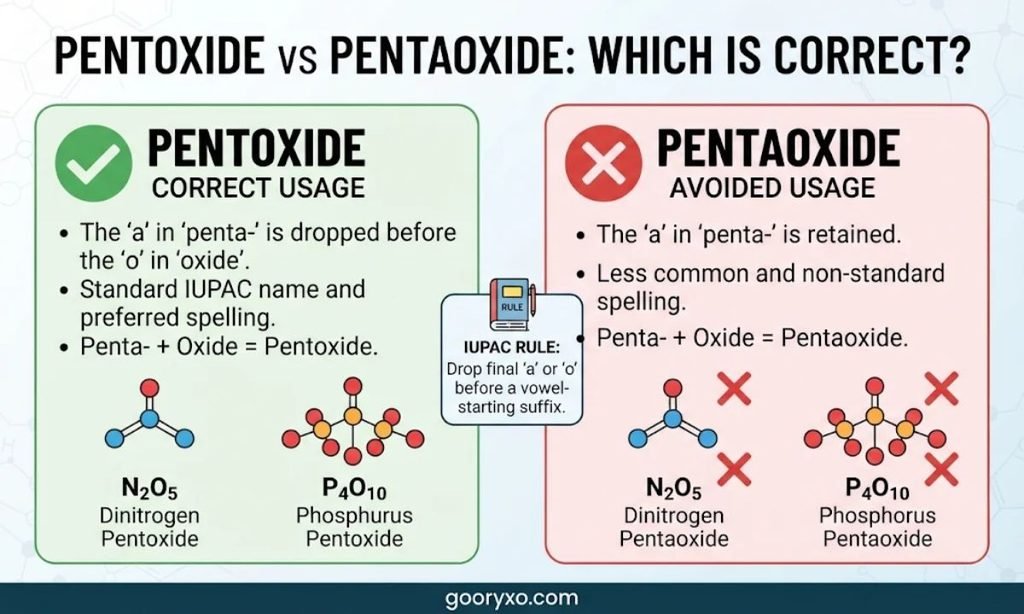
In real use, pentoxide is the form you’ll read most, and pentaoxide is the form the IUPAC rule produces. Neither one is slang or a spelling error.
Example: A textbook index lists phosphorus pentoxide, while the answer key in its naming chapter lists diphosphorus pentaoxide.
Grammatically and Systematically Correct
Pentaoxide is correct whenever you apply the IUPAC no-elision rule to build a name.
This is a nomenclature point, not an English grammar point. In a task that tests the rule, keeping the vowel shows you understand how names are built.
Example: Under the rule, As₂O₅ becomes diarsenic pentaoxide.
Grammatically Possible but Contextually Misleading
A name can be built correctly and still be a poor choice for the situation.
Changing every bottle label to the systematic form may look tidy, but then the labels no longer match supplier papers or the papers you cite.
Example: A lab manager relabels everything as phosphorus pentaoxide, and new staff can’t match the bottles to the catalogue.
Natural Everyday Scientific English
In daily lab talk, pentoxide is the familiar form, and nobody finds it strange.
Use the familiar name when you talk about a known substance. Save the systematic form for moments when the naming system is the point.
Example: “Please keep the phosphorus pentoxide sealed in the desiccator.”
Pentoxide vs Pentaoxide Comparison Table
This table puts the two forms side by side. Pentaoxide follows the no-elision rule, and pentoxide follows established use.
| Feature | Pentoxide | Pentaoxide |
| Final vowel | Dropped | Kept |
| Where it comes from | Traditional short naming | IUPAC no-elision rule |
| In IUPAC systematic naming | Not the regular form | The regular form |
| Typical home | Labels, textbooks, trade and safety records | Naming exercises, systematic names, database synonyms |
| N₂O₅ | Dinitrogen pentoxide | Dinitrogen pentaoxide |
| V₂O₅ | Vanadium pentoxide | Divanadium pentaoxide |
| Best use | Quoting an established name | Building a name from a formula |
| Risk if misused | Losing marks in a rules-based exam | Not matching labels or cited names |
Example: One substance, CAS 1314-62-1, appears in records as both vanadium pentoxide and divanadium pentaoxide.
Real Compounds Table: Pentoxide and Pentaoxide Names
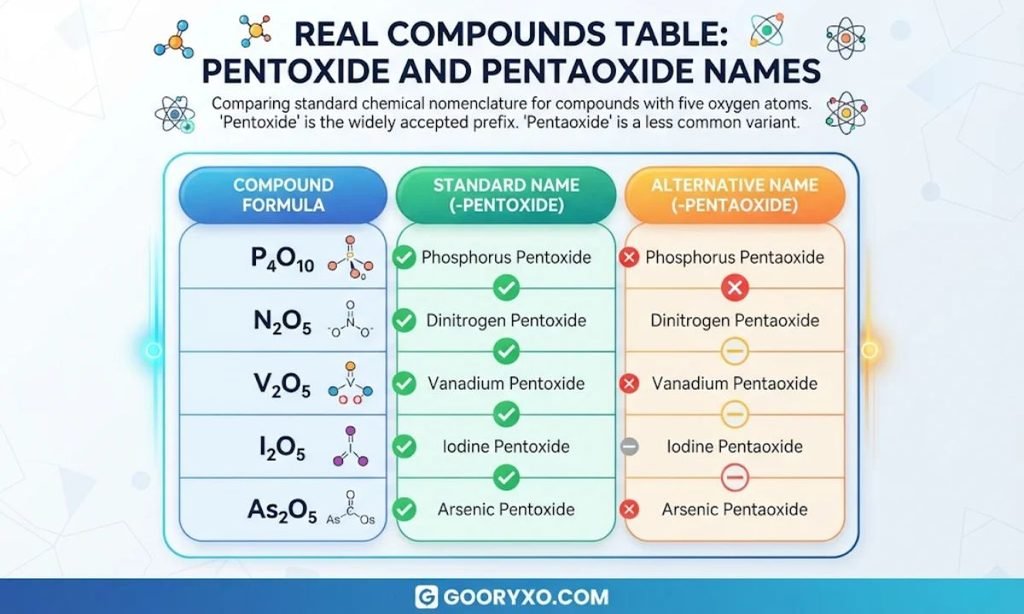
In pentoxide vs pentaoxide naming, most common compounds have a traditional name, a systematic pentaoxide name and a Stock name, and all of them point to one CAS number.
| Formula | Traditional name | Systematic name | Stock name | CAS number |
| N₂O₅ | Dinitrogen pentoxide | Dinitrogen pentaoxide | Nitrogen(V) oxide | 10102-03-1 |
| P₂O₅ (formula unit) | Phosphorus pentoxide | Diphosphorus pentaoxide | Phosphorus(V) oxide | 1314-56-3 |
| V₂O₅ | Vanadium pentoxide | Divanadium pentaoxide | Vanadium(V) oxide | 1314-62-1 |
| As₂O₅ | Arsenic pentoxide | Diarsenic pentaoxide | Arsenic(V) oxide | 1303-28-2 |
| I₂O₅ | Iodine pentoxide | Diiodine pentaoxide | Iodine(V) oxide | 12029-98-0 |
Stock notation uses a Roman numeral for the oxidation state, so it skips the prefix problem completely. Phosphorus needs one more note. The real molecule is P₄O₁₀, and its full systematic name is tetraphosphorus decaoxide. P₂O₅ is the empirical formula behind the everyday name.
Example: A search for phosphorus pentoxide, diphosphorus pentaoxide or tetraphosphorus decaoxide can lead to the same substance record.
See Also Rug vs Rag: What Is the Difference? (With Examples)
Does the Same Rule Apply to Tetroxide, Hexoxide and Heptoxide?
Yes. The pentoxide vs pentaoxide logic is the same for other prefixes: the no-elision rule covers tetroxide and tetraoxide, hexoxide and hexaoxide, and heptoxide and heptaoxide. Only monoxide is excused.
There’s a small detail here. The prefixes di- and tri- end in i, so they never clash with “oxide.” That’s why the pentoxide vs pentaoxide debate only starts from four oxygens.
Example: Osmium tetraoxide and dichlorine heptaoxide follow the rule. Osmium tetroxide and dichlorine heptoxide are the familiar short forms. P₄O₆ is tetraphosphorus hexaoxide by the rule, though many people say phosphorus trioxide.
Memory Trick
This line settles pentoxide vs pentaoxide fast: “Rulebook open, keep the A. Bottle in hand, copy the label.”
If you’re building a name by the IUPAC rule, keep the vowel and write pentaoxide. If you’re copying a name from a bottle, an SDS or a paper, write it exactly as printed.
Example: A quiz asks you to name N₂O₅. Rulebook open, so write dinitrogen pentaoxide. Your inventory lists a bottle marked “dinitrogen pentoxide.” Bottle in hand, so copy it.
For the one exception, keep this hook: only mono gets shortened.
Real-Life Situations
You’ll meet the pentoxide vs pentaoxide choice in interviews, meetings, emails, chats and exams, and the answer always starts with checking the context.
Example: A teaching assistant would give a slightly different reply in each of these five places, but the logic stays the same.
Interview
Give the systematic name first, then mention the traditional one. It shows you know both.
Example: Asked to name N₂O₅ by IUPAC rules, say: “Dinitrogen pentaoxide. Older books use dinitrogen pentoxide.”
Meeting
In a team, keep both pentoxide vs pentaoxide names in shared records and link them to one entry, so nobody loses a search.
Example: Your team merges duplicate rows by tagging vanadium pentoxide and divanadium pentaoxide as the same chemical.
Ask the editor or supervisor which style applies, instead of guessing.
Example: “Should compound names in the paper use the systematic form, like diphosphorus pentaoxide, or the established phosphorus pentoxide?”
Text Message
A one-line reply is enough: it’s a naming rule, not a typo.
Example: A friend asks, “Is pentaoxide even a word?” You reply, “Yes, it’s the IUPAC form, like dinitrogen pentaoxide. Pentoxide is the older short form.”
Exam
Read the instruction line before you write anything, because it decides the spelling.
Example: “Name As₂O₅ using IUPAC rules” expects diarsenic pentaoxide. “Give the common name of As₂O₅” expects arsenic pentoxide.
Expert Tips
With pentoxide vs pentaoxide, decide the naming system first and the spelling will follow.
- Use the CAS number for exact searches. It points to one substance, whatever spelling a record uses.
- Search both spellings. A database may list only one of them.
- Don’t change titles, quotes or product names to fit your favorite spelling.
- Remember that compositional names show only the composition, not the structure. That’s why P₂O₅ and P₄O₁₀ share one everyday name.
- If your class taught the “drop the vowel” habit, follow it for class work and learn the IUPAC form for formal writing.
- Stay consistent inside each naming context, even if one document uses both forms.
Example: When you research V₂O₅, search vanadium pentoxide, divanadium pentaoxide and CAS 1314-62-1 together.
Mini Quiz
Try these eight pentoxide vs pentaoxide questions, then check the answers below.
- What does penta + oxide become under the IUPAC no-elision rule?
- Which familiar form is the named exception to the rule?
- True or false: pentoxide is always a misspelling.
- What is the systematic name for N₂O₅?
- Why don’t di- and tri- raise the vowel question before “oxide”?
- What is the full systematic name for the molecule P₄O₁₀?
- Is it “penta-oxide” or “pentaoxide”?
- Which identifier finds a substance whatever spelling a record uses?
Answers: 1) pentaoxide. 2) monoxide. 3) False, because it’s part of many established names. 4) dinitrogen pentaoxide. 5) They end in i, which doesn’t clash with the o of oxide. 6) tetraphosphorus decaoxide. 7) pentaoxide, with no hyphen. 8) the CAS number.
Frequently Asked Questions
Is pentoxide vs pentaoxide a spelling mistake or a naming difference?
It’s a naming difference. Pentaoxide follows the IUPAC no-elision rule, and pentoxide is the established short form found in many compound names.
Is pentaoxide a real word?
Yes. Pentaoxide is a real chemical term. IUPAC’s Brief Guide uses it as an example of a prefix that keeps its final vowel.
What is the correct name for N₂O₅?
Both dinitrogen pentoxide and dinitrogen pentaoxide are valid names for N₂O₅. The first is the traditional name, and the second is what the no-elision rule gives.
Pentoxide vs pentaoxide on a chemistry exam: which should I write?
Write what the question asks for. If it says IUPAC or systematic naming, write pentaoxide. If your teacher uses the traditional rule, follow that.
Is phosphorus pentoxide the same as diphosphorus pentaoxide?
Yes, both names point to the same substance, CAS 1314-56-3. The real molecule is P₄O₁₀, so its full systematic name is tetraphosphorus decaoxide.
Why does spellcheck flag pentaoxide?
Spellcheck compares words with a general dictionary, and pentaoxide is a specialist form. The flag says nothing about whether the name is chemically correct.
Should I search both spellings when I look up a safety data sheet?
Yes, and add the CAS number too. Records for one substance can use either name, and the ECHA vanadium documents list both together.
Quick Summary
Pentoxide vs pentaoxide comes down to context. The IUPAC no-elision rule gives pentaoxide for systematic names, with monoxide as the only named exception.
Pentoxide stays correct as an established name on labels, in safety records and in older papers. For pentoxide vs pentaoxide, choose the naming system first, copy established names as printed, and use the CAS number for a search that ignores spelling.

My name is Ashfaq, and I am an English teacher with 5 years of teaching experience, specializing in English grammar. My mission is to make grammar easy to understand through simple explanations, practical examples, and helpful learning resources. At Gooryxo, I aim to help learners improve their grammar, strengthen their writing skills, and use English with confidence.

1 thought on “Pentoxide vs Pentaoxide: Which Is Correct? IUPAC Rule & Examples”