
Quick Answer: In the rug vs rag question, the rule is simple: a rug is a movable floor covering you walk on, and a rag is a piece of cloth you clean with. Floor means rug. Wiping means rag.
A rug is a floor covering, and a rag is a cleaning cloth. That single line clears up most rug vs rag confusion, yet the two words look and sound so much alike that even native speakers mix them up. This guide gives you the rule, the pronunciation, and plenty of examples.
I have seen learners pause over these two words for years, and the fix is always the same: ask what the thing does, not what it is made of. By the end of this guide, you will know exactly which word to use in the rug vs rag choice, and you will never need to guess again.
What Do Rug and Rag Mean?

The rug vs rag difference comes down to function, not fabric. A rug covers a floor. A rag does a cleaning job. Keep that in mind, and the two words stop being confusing.
What Is a Rug?
A rug is a movable floor covering that covers only part of a floor.
You can place it beside a bed, under a coffee table, or along a hallway, and move it whenever you like. Unlike fitted carpet, it never covers a whole room wall to wall. Rugs can be decorative, useful, or both. They soften hard floors, guard the surface, and bring style into a room.
Example: We laid a soft wool rug beside the bed.
What Is a Rag?
Example: She wiped the paint off the brush with an old rag.
A rag is a piece of cloth, often old or worn, that you keep for practical jobs.
People reach for rags to wipe spills, clear dust, polish surfaces, clean tools, or dry dirty hands. A rag does not have to be old, though. That is the rug vs rag split in one line: a rag works in your hand, a rug works on the floor.
Rug vs Rag: Origin and Word History
Rug and rag are distant cousins. Both trace back to the Old Norse word rǫgg, which meant a tuft or a shaggy mass, and to the older Proto-Germanic root *rawwa, meaning to tear or make rough.
Rag showed up first, in the 1300s, from the Middle English word ragge. Rug came a little later, in the mid-1400s, when English speakers used it for coarse fabric.
By the 1800s the split was set. Dictionaries such as Merriam-Webster and the Oxford English Dictionary trace both words to the same Old Norse root. The rug vs rag difference we know today was in place: rugs covered floors, rags cleaned messes.
Example: The same old root gave us rag for torn cloth and rug for a thick floor covering.
Why the Difference Matters
Example: “Please put the rug under the table” asks for a floor covering. “Please put the rag under the table” asks for a cleaning cloth in a strange place.
The rug vs rag mix-up is a vocabulary mistake, not a grammar mistake. The sentence stays correct, but the meaning goes wrong. That matters when you shop for home goods, write cleaning instructions, send a work message, or sit an English exam. Spellcheck will not save you here, because both words are spelled correctly.
The Core Rule
The rule fits in one breath: in the rug vs rag pair, a rug is a floor covering, and a rag is a cleaning cloth. That short rule solves most everyday cases.
Example: If you walk on it, it is a rug. If you wipe with it, it is a rag.
There is one famous exception: a rag rug. It is a real rug woven or braided from strips of old cloth. In that phrase, rag tells you the material, and rug tells you the finished thing.
Rug vs Rag Pronunciation
Example: Say “cup,” then “rug.” Say “cat,” then “rag.” Then switch back and forth: rug, rag, rug, rag.
Only the middle vowel changes. In rug vs rag, rug is pronounced /rʌɡ/, with the same vowel as cup. Rag is pronounced /ræɡ/, with the same vowel as cat. The starting r and the ending g stay the same, so your ear has to catch the vowel. Do not trust spelling alone. Train your ear to hear the difference.
| Word | IPA | Sounds Like | Key Vowel |
| rug | /rʌɡ/ | cup | /ʌ/ |
| rag | /ræɡ/ | cat | /æ/ |
How to Use Rug and Rag Correctly
The rug vs rag choice gets easy once you ask one question: what is this thing doing? If it lies on a floor, use rug. If you hold it to wipe something, use rag.
Use Rug for Floor Coverings
Use rug when you talk about something placed on a floor, that is the rug vs rag floor test. Common pairs include area rug, bedroom rug, bathroom rug, Persian rug, prayer rug, wool rug, and woven rug.
Example: We placed a small rug beside the bed.
Use Rag for Cleaning or Scrap Cloth
Example: Use a clean rag to wipe the paint off the handle.
Use rag for a piece of cloth meant for wiping, cleaning, polishing, repairs, or any rough practical job. The cloth can be old or new. What matters is the job you gave it.
Do Not Assume Every Cloth Is a Rag
Cloth is the wider word, and rag is only one kind of cloth. A tea towel, a washcloth, a polishing cloth, or a napkin is not a rag just because it is made of fabric. Calling something a rag hints that it is worn, low-value, scrap material, or meant for dirty work.
Example: A neatly folded napkin is a cloth, not a rag, until someone uses it to scrub a greasy pan.
Remember the Rag Rug Exception
Example: She braided strips of old shirts into a rag rug for the hallway.
A rag rug sounds like a contradiction in the rug vs rag rule, but it is not. It is a rug built from fabric strips or pieces of rag material. The finished object is still a rug, because it works as a floor covering.
Correct Examples of Rug and Rag
These everyday rug vs rag examples show the rule at work in real situations.
- Conversation: We found a soft rug for the living room.
- Conversation: Grab a rag before the juice spreads across the floor.
- Email: The new rug for the reception area arrives on Thursday.
- Email: Please keep a clean rag next to the maintenance supplies.
- School: The children sat together on the classroom rug.
- School: Maya wiped the paint off her desk with a rag.
- Workplace: The patterned rug makes the waiting area feel warmer.
- Workplace: The technician cleaned the machine with a dry rag.
- Social media: This old rug changed my whole bedroom.
- Social media: An old cotton shirt makes a handy cleaning rag.
- Instructions: Wipe off the extra polish with a soft, clean rag.
- Interior design: A bigger rug would tie the sofa and chairs together.
Incorrect vs Correct: Rug or Rag?
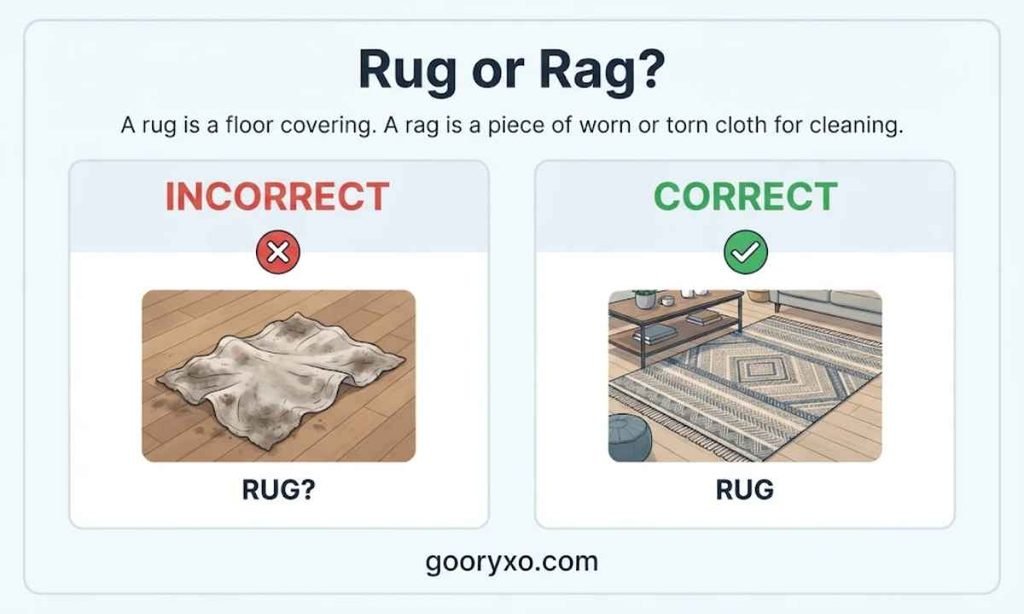
The fastest way to learn the rug vs rag difference is to see the mistake next to the fix.
| Incorrect | Correct | Why |
| I wiped the counter with a rug. | I wiped the counter with a rag. | A cloth you hold to clean with is a rag, not a floor covering. |
| We bought a new rag for the living room. | We bought a new rug for the living room. | A decorative floor covering is a rug. |
| Put the rag under the coffee table. | Put the rug under the coffee table. | The sentence needs a floor covering under furniture. |
| Take a rug and clean the oil off the tool. | Take a rag and clean the oil off the tool. | Cleaning and wiping call for a rag. |
| The dog sleeps on the soft rag by the fireplace. | The dog sleeps on the soft rug by the fireplace. | A thick floor covering is a rug. |
| She polished the metal with an old rug. | She polished the metal with an old rag. | An old cloth used for polishing is a rag. |
| The designer picked a blue rag for the bedroom floor. | The designer picked a blue rug for the bedroom floor. | Floor décor is a rug. |
| Keep several rugs in the garage for wiping grease. | Keep several rags in the garage for wiping grease. | Cloths kept for messy cleaning jobs are rags. |
| The hotel put a decorative rag beside the bed. | The hotel put a decorative rug beside the bed. | A decorative floor covering is a rug. |
| She turned the old shirts into a rug rag. | She turned the old shirts into a rag rug. | Rag rug is the fixed term: a rug made from rag material. |
| He dried the wet surface with a rug. | He dried the wet surface with a rag. | The object works as a wiping cloth here. |
| This rag matches our sofa perfectly. | This rug matches our sofa perfectly. | For matching floor décor, rug is the natural word. |
Why Do People Confuse Rug and Rag?

Six clear reasons drive the rug vs rag confusion. Once you see them, the confusion loses its power.
Similar Spelling
Both words have three letters, the same first letter, and the same last letter: r-u-g and r-a-g. Only the vowel in the middle changes. That is the classic rug vs rag trap, so a fast reader or a careless typer can miss it.
Example: Typing “rag” when you meant “rug” is a one-letter slip with a totally different meaning.
Similar Sound Structure
Example: Say “rug” and “rag” out loud. The r and the g sound the same, and only the vowel moves.
Both words start with /r/ and end with /ɡ/. Learners whose first language does not split /ʌ/ and /æ/ find the rug vs rag pair hard, and it takes real listening practice to hear the gap.
Meaning Overlap Through Fabric
Both things can be made of fabric, so learners remember “piece of material” and forget the job each one does. The rug vs rag fix is to ask what the object is doing, not what it is made of.
Example: A wool rug and a wool rag share a material, but one covers a floor and the other wipes a mess.
Overgeneralization
Example: A learner hears “rag means old fabric” and starts calling every old textile a rag, including an old rug.
That shortcut is too wide. An old rug is still a rug while it covers a floor. Age alone never decides the rug vs rag call.
Autocomplete and Spellcheck
Software cannot always catch this mistake. In rug vs rag, both words are real and correctly spelled, so spellcheck sees nothing wrong even when you picked the wrong one.
Example: Type “I need a new rag for the hall” and spellcheck stays quiet, even though you meant a rug.
Translation Interference
Some languages use one broad word for cloth, mats, and coverings. Translating straight into English can push you toward the wrong pick in the rug vs rag choice, because you choose by material instead of function.
Example: If your language has one word for “cloth mat,” ask: is it covering the floor, or wiping something?
What Rug and Rag Do NOT Mean
The rug vs rag pair gets clearer when you see what each word does not cover.
- A rug is not the same as a carpet. Carpet often runs wall to wall, while a rug covers only part of a floor.
- A rag is not every old piece of cloth, and it is not a towel. Towels have their own name unless someone turns one into a cleaning cloth.
- A rug is not always thick. A flatweave rug is thin and still a rug.
- A rag is not always dirty; a clean rag is still a rag.
Example: An old rug is still a rug. A new cloth turns into a rag only when you set it aside for cleaning.
Common Mistakes Checklist
Run through this rug vs rag checklist before you hit send:
- Using rag for any piece of fabric: cloth is the wider word.
- Using rug for anything thick: thickness alone never makes a rug; purpose does.
- Calling every floor covering a rug: carpet, mat, doormat, bath mat, and rug overlap but are not the same.
- Thinking a rag must be old: a new cloth can be a cleaning rag.
- Thinking an old rug becomes a rag: if it still covers a floor, it stays a rug.
- Writing “rug rag” instead of “rag rug”: the fixed term is rag rug.
- Ignoring pronunciation: practice /ʌ/ against /æ/, not just the spelling.
- Trusting spellcheck: proofread for meaning, since both spellings are valid.
- Using rag when you mean towel: towels keep their own name unless repurposed as rags.
- Stretching the basic rule too far: both words have extra senses beyond household use.
Rug vs Rag in Real English
Grammar and natural word choice are two different skills. These three patterns show how rug vs rag works in real English.
Grammatically Correct and Natural
“There is a rug under the table” and “Wipe it with a rag” are both correct and natural. They fit the meanings English speakers expect. As a rug vs rag rule of thumb, rugs get placed, laid, spread, bought, cleaned, or walked on, while rags get grabbed, used, washed, wiped with, or thrown away.
Example: “I vacuumed the rug” sounds right. “I vacuumed the rag” sounds wrong.
Read Also Atleast or At Least? Correct Spelling, Meaning & Examples
Grammatically Possible but Unnatural
Example: “She decorated the room with a cleaning rag on the floor” follows grammar rules, yet it sounds odd, unless she truly meant to decorate with a cleaning cloth.
A sentence can be grammatical and still feel wrong in a rug vs rag mix-up, when the noun does not fit the scene. Grammar runs the structure; meaning and everyday use pick the word.
Natural Everyday English
In daily speech, the rug vs rag choice runs on what things do, not what they are made of. Someone cleaning a garage says “Pass me a rag” even if the cloth started as an old T-shirt. Someone talking about a room just says “I like that rug” without describing its fiber.
Example: “Pass me a rag” and “I like that rug” are the kinds of lines you hear every day: short, plain, and correct.
American vs British English
The core rug vs rag meanings stay the same on both sides of the Atlantic. A floor rug is still a rug, and a cleaning cloth is still a rag.
Example: A small decorative rug is a “throw rug” in American English and a “scatter rug” in British English.
British English adds one extra use: rug can mean a thick blanket or cover placed over an animal, such as a horse. That sense never changes the basic household rule.
Formal vs Informal Usage
As names for household objects, rug and rag are plain, neutral words. You can use them in conversation, emails, instructions, and most work writing without a second thought.
Example: In a formal report, “cleaning cloth” or “wipe” can sound more precise than “rag” for a delicate surface.
Rag also carries informal extras. It can mean a newspaper, used in a rude way, and as a verb it can mean to tease or bother someone. Those senses have nothing to do with the rug vs rag cleaning-cloth meaning, so the sentence around the word tells you which meaning it is.
Rug has a slang sense too. In informal American English, a rug can mean a hairpiece, a toupee, as in “He was wearing a rug.”
Rug vs Rag Comparison Table
This rug vs rag table puts the whole difference on one page.
| Feature | Rug | Rag |
| Main meaning | A floor covering | A piece of cloth |
| Typical purpose | Comfort, protection, decoration | Wiping, cleaning, polishing, practical work |
| Usual position | On a floor | Held in the hand or stored for use |
| Typical condition | New, used, valuable, decorative, or plain | Often old, worn, scrap, or work-oriented |
| Must it be old? | No | No |
| Common interior-design term? | Yes | No |
| Common cleaning term? | Not usually | Yes |
| Pronunciation | /rʌɡ/ | /ræɡ/ |
| Plural | rugs | rags |
| Example | bedroom rug | cleaning rag |
| Can the words combine? | Yes: rag rug | Yes: rag rug |
| Same as carpet? | Not always | No |
| Same as cloth? | No | A rag is a type or use of cloth |
Rug vs Carpet: Are They the Same?
Not exactly. A rug is movable and covers only part of a floor, while carpet often means fitted material that runs across much or all of a room.
Example: “We put a rug under the coffee table.” Compare that with: “The bedroom has wall-to-wall carpet.”
The line is not absolute. With handmade pieces, people swap rug and carpet almost freely. For learners, the practical split is simple: movable and partial means rug, and the rug vs rag rule points the same way.
Read Also Atleast or At Least? Correct Spelling, Meaning & Examples
Rag vs Cloth: Are They the Same?
Example: “Use a soft cloth to clean the camera lens” sounds right. “Use a rag to clean the camera lens” hints at a rough cloth that could scratch it.
No. The rug vs rag rule helps here too. Cloth is the broad, neutral word.
A rag is one kind of cloth, or one way cloth gets used. A lovely piece of unused fabric is cloth or fabric, not a rag. The word rag fits best when the cloth is worn, scrap, or set aside for messy work.
What Is a Rag Rug?
A rag rug is a hand-woven rug made from strips of old cloth, woven or braided into a floor covering. People cut worn fabric into strips, then weave or braid them into a floor covering. The phrase proves why the rug vs rag rule is about function: rag names the material, rug names the finished object.
Example: A rag rug in the hallway can outlast the shirts it was made from.
Memory Trick
Example: Think U for Under your feet, and A for Action on the mess. R-U-G has U, R-A-G has A.
The rug vs rag trick is simple: U goes under your feet, A gets action on the mess. It is not a dictionary rule, just a memory hook for the everyday meanings.
Real-Life Situations
These short scenes show rug vs rag working in the places you actually use the words.
Interview
Interviewer: “How did you help prepare the showroom?”
Example: “I moved the furniture and laid a new rug in the display area.” In the rug vs rag choice, rug fits here because the talk is about how the room looks.
Meeting
Example: “The maintenance team needs more clean rags for the workshop.” Rags fit because the cloths are work supplies.
Example: “Could you confirm the size of the rug before we place the order?” Rug fits because this is buying and interior language. That is the rug vs rag rule in action.
Text Message
Example: “I spilled coffee. Bring me a rag!” Short, informal, and natural. The word matches the wiping job.
Exam
Example: “The children sat on the colorful ___ during story time.” The answer is rug. The sentence describes a floor covering used as a sitting spot.
Expert Tips
Four habits from the rug vs rag rulebook will keep you right every time.
Focus on Function Before Material
Do not ask only, “Is it made of fabric?” In the rug vs rag test, ask what job it does. A movable floor covering is normally a rug. Scrap or cleaning cloth is normally a rag.
Example: A wool cloth on the floor is a rug. The same wool cloth in your hand, wiping a spill, is a rag.
Learn Collocations
Example: Say “area rug,” “wool rug,” “Persian rug,” “cleaning rag,” “damp rag,” “dirty rag,” and “oily rag.” Whole phrases stick better than single definitions.
A collocation is a set of words that often go together. Learning set phrases beats memorizing definitions, and it is the fastest way to master rug vs rag. Whole combinations come to mind faster when you need them.
Use Verbs as Clues
Verbs point to the right word. You lay, place, vacuum, or walk on a rug. You wipe with, grab, rinse, or throw away a rag. These are patterns, not strict grammar rules, but they work as quick rug vs rag clues.
Example: If the verb is “vacuum,” the noun is almost always a rug. If the verb is “wipe,” it is almost always a rag.
Do Not Turn a Shortcut Into an Absolute Rule
Example: A learner who trusts “rug means floor, rag means cleaning” for every case will trip over rag rug, a rug made from rags.
That shortcut is a great starting rule for rug vs rag, but it is not the whole story. Words grow extra senses and turn up in compounds. Learn the core split first, then add the exceptions.
Frequently Asked Questions
Is a rug the same as a rag?
No. In the rug vs rag pair, a rug is a floor covering, while a rag is a piece of cloth often used for cleaning, wiping, or polishing.
Is a rag always dirty?
No. A rag can be perfectly clean. The word describes the cloth’s type or job, not whether dirt is on it right now.
Can a new cloth be called a rag?
Yes. A new piece of cloth can be called a cleaning rag once you set it aside for that purpose. Rags are often old or reused, but old is not a requirement.
Can an old rug be called a rag?
Not just because it is old. If it still covers a floor, it stays a rug. You can call it an old rug, a worn rug, or a damaged rug.
What does rag rug mean?
A rag rug is a rug made from strips of cloth or rag material. Rag tells you what it is made from, and rug tells you what the finished item is.
Is a rug the same as a carpet?
They overlap, but they are not always the same. The rug vs rag rule still helps: a rug is usually movable and covers only part of a floor, while carpet often means fitted covering across a whole room.
What is the plural of rug and rag?
Both plurals are regular: rug becomes rugs, and rag becomes rags.
Mini Quiz: Rug vs Rag
Test yourself with this quick rug vs rag quiz. Ten questions, answers included.
| # | Question | Answer | Why |
| 1 | Fill in the blank: “Please put the new ___ beside the sofa.” | rug | A floor covering beside furniture is a rug. |
| 2 | Fill in the blank: “Use a clean ___ to wipe the glass.” | rag | The cloth is being used for wiping. |
| 3 | Which word is pronounced /rʌɡ/? A) rag B) rug | B) rug | Rug holds /ʌ/; rag holds /æ/. |
| 4 | Fix this sentence: “The mechanic wiped his hands on a rug.” | “The mechanic wiped his hands on a rag.” | A work cloth used for wiping is a rag. |
| 5 | Fill in the blank: “The children gathered on the classroom ___.” | rug | The object is a floor covering used as a sitting area. |
| 6 | True or false: A rag must always be old. | False | A new cloth can be set aside as a cleaning rag. |
| 7 | Pick the correct phrase: A) rug rag B) rag rug | B) rag rug | Rag rug is the fixed term for a rug made from rag strips. |
| 8 | Fix this sentence: “We bought a patterned rag for the dining room floor.” | “We bought a patterned rug for the dining room floor.” | Floor décor is a rug. |
| 9 | Fill in the blank: “Keep a ___ nearby in case the paint spills.” | rag | A rag is handy for wiping sudden spills. |
| 10 | Pick the best word: “The hotel replaced the worn floor covering with a new ___.” A) rag B) rug | B) rug | The sentence describes a floor covering, not a cleaning cloth. |
Summary
Rug means a floor covering, and rag means a cleaning cloth. That is the whole difference in one line. The rug vs rag rule is simple: rug goes under your feet, rag handles the mess. Say them apart too: rug uses /ʌ/, rag uses /æ/.
A rag does not have to be old, and an old rug stays a rug while it still covers a floor. A rag rug is a real thing as well, a rug woven from strips of cloth. Keep one line in mind for daily use: floors take rugs, messes take rags.

My name is Ashfaq, and I am an English teacher with 5 years of teaching experience, specializing in English grammar. My mission is to make grammar easy to understand through simple explanations, practical examples, and helpful learning resources. At Gooryxo, I aim to help learners improve their grammar, strengthen their writing skills, and use English with confidence.

1 thought on “Rug vs Rag: What Is the Difference? (With Examples)”