
Hidding or hiding? “Hiding” is the correct spelling, and “hidding” is a spelling mistake. You drop the silent e from “hide” before adding -ing, so the word has only one d.
Most people double the d because words like run and sit do it. This guide shows why “hide” follows a different rule, with simple examples and a trick to remember it.
Hidding or Hiding – Quick Answer
For hidding or hiding, the answer is “hiding.” Dictionaries such as Merriam-Webster and Oxford Learner’s list only “hiding” as the -ing form of “hide,” and “hidding” isn’t a word in standard English.
The reason behind hidding or hiding is simple. “Hide” ends in a silent e, and that e drops before -ing, so nothing gets doubled.
Examples:
Example: “The cat is hiding under the bed.” That’s correct. “The cat is hidding under the bed” is the same sentence with the typo.
In hidding or hiding, put the two side by side and the second one looks wrong, even though it sounds identical. The ear can’t catch the error, so the eye has to.
Simple Rule:
Drop the silent e from “hide,” then add -ing. That gives you “hiding.”
Here’s how to spell hiding in one line: h-i-d-i-n-g. Here’s a neat check. Take the e off “hide” and you’re left with “hid,” and “hid” plus -ing is “hiding.” Example: hid + ing = hiding, with no second d anywhere.
The Origin of Hiding or Hidding

The hidding or hiding question has a long history. “Hiding” comes from the verb “hide,” which goes back to the Old English word “hȳdan,” meaning to get out of sight. The -ing ending is just a regular addition to that very old verb.
Dictionary.com says the word was first recorded before the year 900. By the Middle English period it was written “hiden,” which is where today’s spelling slowly came from.
Don’t mix it up with the other “hide,” meaning an animal’s skin. That one comes from the Old English noun “hȳd,” so it’s a separate word with a separate history.
Pattern:
Hidding or hiding is settled by a pattern, since verbs that end in a silent e all lose it before -ing. The table shows how regular the pattern is.
| Base word | -ing form |
| hide | hiding |
| bike | biking |
| give | giving |
| smile | smiling |
| dance | dancing |
Example: “bike” becomes “biking,” not “bikeing” or “bikking.” “Hide” works the same way, so it becomes “hiding” and nothing else.
Hidding vs Hiding – Meaning Explained
In hidding or hiding, only one form has a meaning. “Hiding” means staying out of sight or keeping something secret, and “hidding” has none because it isn’t a real word.
What Does “Hiding” Mean?
“Hiding” is the -ing form (the present participle) of the verb “hide.” It describes a person, animal or thing that’s being kept out of sight, or a fact that’s being kept quiet.
Examples:
Example: “The kids were hiding behind the sofa.” Here the word describes a physical action.
Another case is “He kept hiding the bad news.” That one is about information, not a person, and the spelling stays the same.
Hiding as a Noun: “In Hiding” and “A Good Hiding”
“Hiding” can also work as a noun. “In hiding” means staying out of sight on purpose, and “a good hiding” is an informal phrase for a beating, or in sport, a heavy defeat.
Example: “The witness went into hiding after the trial.” A “hiding place” is the spot where a person or thing stays out of sight.
The beating sense comes from a separate verb, and Merriam-Webster dates it to around 1825. That verb has its own past form, “hided,” which is used only in that meaning.
What Does “Hidding” Mean?
In hidding or hiding, “hidding” doesn’t mean anything, because it’s a typo. Merriam-Webster, Oxford Learner’s Dictionary and Dictionary.com don’t list it.
When a spell checker or autocorrect underlines it, the tool is right. The fix is always “hiding.”
Incorrect Examples:
Each pair below shows the mistake first and the fix second.
Example: “They are hidding the evidence.” should be “They are hiding the evidence.”
Example: “My dog is hidding again.” should be “My dog is hiding again.”
Is “Hidding” Ever Correct?
Not in modern standard English, so hidding or hiding has only one right answer today. Very old texts spell words in many odd ways, and one Middle English dictionary lists forms like “hidded” for this verb.
That’s history, not a spelling you can use today. Example: a medieval manuscript can spell the word strangely, but a school essay or a work email can’t.
Hide, Hid, Hidden and Hiding: Verb Forms
The verb has four main forms: hide, hid, hidden and hiding. Hide is the base form, hid is the past, hidden is the past participle and hiding is the -ing form.
| Form | Word | Sentence |
| Base | hide | I hide my keys here. |
| Past | hid | She hid the gift. |
| Past participle | hidden | The gift was hidden. |
| -ing form (present participle) | hiding | He is hiding the gift. |
The past participle is the form that follows “has,” “have” or “was.” “Hidden” is the one form with a real double d, and that likely feeds the confusion. Merriam-Webster also lists “hid” as an alternative past participle.
Example: “The treasure was hidden for years” uses the participle. “They are hiding the treasure” uses the -ing form, with one d.
British English vs American English Spelling
There’s no spelling difference in hidding or hiding. Both British and American English write “hiding,” and both treat “hidding” as an error.
The real UK and US difference is a different noun. In British English, a “hide” can be a small hut for watching wildlife, which Merriam-Webster links to the American word “blind.”
Example: “We watched the owls from a hide at the edge of the lake.” A British birdwatcher would say that naturally.
See Also Muah or Mwah: Which Spelling Is Correct? Meaning & Usage
Comparison Table
The hidding or hiding answer is the same in both varieties. Only the extra meanings of “hide” differ a little.
| Word | UK English | US English |
| hiding (-ing form) | correct | correct |
| hidding | incorrect | incorrect |
| hide (wildlife hut) | used | often called a “blind” |
| a good hiding (beating) | informal | informal |
Which Spelling Should You Use?
When you’re torn between hidding or hiding, always use “hiding.” It’s the only spelling of the -ing form that dictionaries accept, in every kind of English. To double-check, look it up in Merriam-Webster, Oxford Learner’s Dictionary or Cambridge Dictionary.
Use “Hiding” For:
- a person or animal out of sight
- a secret or a feeling being kept back
- games like hide-and-seek
- the phrase “in hiding”
Example: “The children are hiding for a game of hide-and-seek.” The same spelling works at home, at school and at work.
Never Use:
In any hidding or hiding choice, never write “hidding” or “hideing.” Don’t use “hidden” either when you mean the -ing form.
Example: “She is hidden the letter” is wrong. “She is hiding the letter” is right, and “The letter is hidden” is right too.
Simple Rule:
For hidding or hiding, just hide, drop the e, add -ing. That’s all you need to remember.
Before you publish anything, search your draft for “hidding.” It only takes a few seconds. Example: one find-and-replace to “hiding” fixes every slip at once.
Common Mistakes with Hidding or Hiding
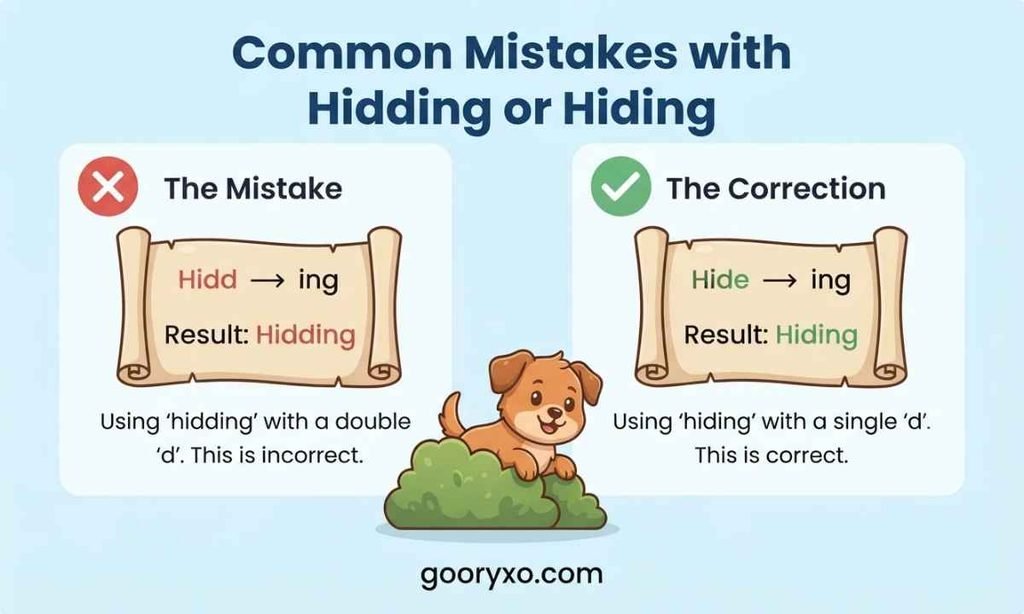
Most hidding or hiding errors come from doubling the d out of habit or typing too fast. Four mistakes show up again and again.
Mistake 1
Doubling the d in hidding or hiding because of words like run and sit. Those words end in one vowel and one consonant, and “hide” doesn’t.
Example: “The fox is hidding in the bushes.” The fix is “hiding.”
Mistake 2
Keeping the e and writing “hideing.” This feels logical because the e is part of “hide,” but it breaks the rule.
Example: “He kept hideing his phone.” The correct version is “He kept hiding his phone.”
Mistake 3
Mixing up “hiding” and “hidden.” The first is the -ing form and the second is the past participle.
Example: “She has hiding her gift” is wrong, and the fix is “She has hidden her gift.” Use “is hiding” for something happening now, and “has hidden” for something done.
Mistake 4
Starting from “hid” instead of “hide.” “Hid” ends in one vowel and one consonant, so it looks like it should double, as in “sit” and “sitting.”
The base verb is “hide,” though, not “hid.” Example: “She’s hidding” comes from treating “hid” as the root, while “She’s hiding” comes from “hide.”
Hiding in Everyday Examples

Hidding or hiding comes up in daily talk about people, pets, objects and feelings, and the answer doesn’t change from one setting to the next.
At Home
Example: “My keys were hiding under the couch.” People use “hiding” playfully for objects too, even though keys can’t hide on purpose.
At home the word is mostly about kids, pets and lost things. It’s short, friendly and easy to get right once you know the rule.
School
At school, “hiding” often comes up in stories and in games at break time. It’s also a word students misspell in quick notes.
Example: “He was hiding behind the classroom door.” A teacher would circle “hidding” in red and write “hiding” beside it.
Social Media
On social media, typos spread fast, and “hidding” is no exception. Captions look more polished with the right spelling.
Example: “Stop hiding your real self.” That kind of line gets shared a lot, so it’s worth checking the spelling before you post.
Movies and Games
In films and video games, hiding is a basic part of the action. Characters hide from enemies, and players hide to avoid being seen.
Example: “The hero was hiding from the guards.” A subtitle with “hidding” would stand out immediately.
Hidding or Hiding – Google Trends & Usage Data
In the hidding or hiding comparison, “hiding” is the normal form in published writing, and “hidding” appears mainly as a typo. Dictionaries list only “hiding.”
Search numbers change every month, so this guide doesn’t print figures that would be outdated soon. You can see the current picture yourself by comparing both spellings in Google Trends.
This guide was checked against Merriam-Webster, Oxford Learner’s Dictionary and Dictionary.com notes in November 2026.
Key Insight:
People who search hidding or hiding are most likely checking a spelling doubt, not looking for a new word. That’s why a short, clear answer helps them most.
Example: Someone types “The kids are hidding” and sees a red underline. They search the word to find out which version is right.
Comparison Table: Hidding vs Hiding
In hidding or hiding, hiding is correct and hidding isn’t. The table lays out the differences in plain terms.
| Question | Hidding | Hiding |
| Standard English | No | Yes |
| Listed in dictionaries | No | Yes |
| Fits the -ing rule | No | Yes |
| Safe for school or work | No | Yes |
| Usual cause | Typing or doubling habit | Drop-e rule |
Why People Write “Hidding”
Hidding or hiding goes wrong because people apply the consonant doubling rule they learned from words like run and sit. It feels natural, but it doesn’t fit “hide.”
Examples:
Example: run becomes running, sit becomes sitting and swim becomes swimming. Each one ends in a single vowel and a single consonant, so the last letter doubles.
“Hide” ends in an e, not a consonant, so the doubling rule never applies. The word follows the drop-e rule instead, and that’s the whole story behind “hiding.”
The Real Grammar Rule
Two rules decide how you add -ing, and they also decide hidding or hiding: the doubling rule and the silent e rule. “Hide” falls under the silent e rule, so the e drops and no letter doubles.
Silent “E” Rule
When a word ends in a silent e, drop the e before adding the suffix -ing. Teaching sites such as Understood list bike/biking, give/giving and dodge/dodging as examples.
Examples:
Example: write becomes writing, move becomes moving, chase becomes chasing and hide becomes hiding.
All four lose the e and gain -ing. None of them doubles a consonant.
See Also Muah or Mwah: Which Spelling Is Correct? Meaning & Usage
Hop vs Hope: Doubling Rule vs Silent E Rule
Hop doubles the p and becomes “hopping,” while hope drops its e and becomes “hoping.” One extra letter changes the rule completely.
Example: “He is hopping on one foot” and “He is hoping for good news” look almost the same, but they’re different words. The same logic separates a made-up “hidding” from the real “hiding.”
Words That Keep the E Before -ing
A few words keep their e. Words ending in -ee, such as see and agree, become “seeing” and “agreeing.”
“Dye” keeps its e as “dyeing” so it isn’t confused with “dying.” Example: “She is dyeing her hair” and “The plant is dying” mean very different things.
Some words allow both forms. The Canadian government’s language guide lists age as “aging” or “ageing.”
Hiding in Idioms and Expressions

“Hide” and “hiding” appear in many fixed phrases, and the spelling never varies. The one-d answer to hidding or hiding applies to every one of them.
Common Examples:
- hiding in plain sight
- hide your light under a bushel
- bury your head in the sand
- hide a multitude of sins
Oxford Learner’s Dictionary lists several of these as idioms. “Hiding in plain sight” means being easy to see but still unnoticed.
Example: “The answer was hiding in plain sight, right on the first page.”
Hiding in Emotional and Figurative English
The hidding or hiding rule works figuratively too. “Hiding” can mean keeping feelings, thoughts or the truth out of view, and nothing physical needs to be concealed.
Examples:
Example: “He was hiding his sadness behind a smile.” The sadness is hidden from others, not from the eye.
Merriam-Webster notes another figurative use: to seek protection or avoid responsibility. A person can hide behind a joke or behind a rule, and the spelling stays the same.
Why This Spelling Confuses Learners
Hidding or hiding confuses English learners because the -ing rules point in two directions. Sometimes you double a letter, and sometimes you drop one.
Sound adds to the problem. “Hiding” has a long i, like “HY-ding,” while “hid” has a short i, and learners may link the double d to the short sound.
Many learners also over-apply a rule once they’ve learned it. Example: a student who just learned the doubling rule writes “I am hidding” and then “I am ridding,” even though only one of those is a real word.
A quick fix is a three-step check. Find the base verb, look at its last letter, then add -ing, and if that last letter is an e, drop it.
Similar Words That Follow the Same Rule
Hidding or hiding isn’t a special case, since any verb that ends in a silent e follows this pattern. Ride becomes riding, bake becomes baking and use becomes using.
Examples:
The table shows the correct word, a common mistake and a note.
| Correct word | Common mistake | Note |
| riding | ridding | “Ridding” is real, from “rid” |
| baking | bakking | Drop the e, no doubling |
| writing | writting | Drop the e, no doubling |
| taping | tapping | “Tapping” comes from “tap” |
Example: “He is riding his bike” and “He is ridding the house of mice” are both correct, but only because the verbs differ. The same trap catches “hiding,” though “hidding” isn’t a real word.
Hiding in Pop Culture and Media

Hiding is a favorite theme in stories, games and the news, and writers settle hidding or hiding the same way every time: one d. The word is easy to find if you look for it.
Common Examples:
- The Diary of a Young Girl by Anne Frank, written while her family lived in hiding in Amsterdam
- hide-and-seek, the children’s game
- stealth video games such as Metal Gear Solid, where players can hide in a cardboard box
- news headlines about people “in hiding”
Example: A headline like “Suspect still in hiding, police say” uses the noun form, and it’s spelled with one d like everything else.
Simple Trick to Remember the Difference
To settle hidding or hiding fast, remember that hide minus e is hid, and hid plus -ing is hiding. Nothing needs doubling.
Easy Memory Rule
Drop the e, add -ing, never double. Example: hide, hid, hiding, and you’re done.
Quick Reminder
If a word ends in a silent e, don’t double the last consonant. Compare tap and tape.
Example: tap becomes tapping, but tape becomes taping, which is the same difference you see between a doubled word and “hiding.”
Frequently Asked Questions
Is it hidding or hiding?
In hidding or hiding, “hiding” is the correct spelling, and “hidding” is a mistake. When you add -ing to “hide,” you drop the silent e and don’t double the d.
Is “hidding” a real word?
No. Merriam-Webster, Oxford Learner’s Dictionary and Dictionary.com list “hiding” and don’t list “hidding.”
Why is hiding spelled with one d?
The silent e at the end of “hide” drops before -ing. Doubling only happens in words that end in one vowel and one consonant, like “sit.”
What is the past tense of hide?
The past tense is “hid,” and the past participle is “hidden.” Merriam-Webster also lists “hid” as another past participle.
Is it hid or hidden?
Use “hid” for the simple past, as in “She hid the key.” Use “hidden” after “has,” “have,” “had” or “was,” as in “The key was hidden.”
Is hidding or hiding different in British and American English?
No. Both varieties use “hiding” and both treat “hidding” as an error. The only UK and US difference is that a British “hide” can also be a hut for watching wildlife.
Why do people write “hidding”?
Hidding or hiding trips people up because they copy the doubling rule from words like “run” and “sit,” or start from “hid” instead of “hide.” Typing fast makes the slip even easier.
Summary
Hidding or hiding has a clear answer: “hiding” is correct, and “hidding” is a mistake. The silent e of “hide” drops before -ing, and no letter gets doubled.
The easy hidding or hiding check is this: hide minus e is hid, and hid plus -ing is hiding. Keep that in mind and the spelling will stay right every time.

My name is Ashfaq, and I am an English teacher with 5 years of teaching experience, specializing in English grammar. My mission is to make grammar easy to understand through simple explanations, practical examples, and helpful learning resources. At Gooryxo, I aim to help learners improve their grammar, strengthen their writing skills, and use English with confidence.

1 thought on “Hidding or Hiding: Which Is Correct? Easy Spelling Rule”