
Judgmental or judgemental? Both spellings are correct, but they aren’t used the same way everywhere. Americans write “judgmental,” the British often add an e, and “judgmental” is the safer choice if you’re unsure.
The rules aren’t simple, because dictionaries, style guides and courts don’t all agree. This guide explains what they say and how to pick the right spelling for your reader.
Judgmental or Judgemental – Quick Answer
For judgmental or judgemental, both forms are correct, and both mean “likely to criticize or look down on other people.” “Judgmental” is the American standard. “Judgemental” is common in British writing but counts as a mistake in US writing.
In short, US English uses “judgmental.” British English accepts both and often prefers “judgemental.” If you’re not sure who will read your work, use “judgmental.”
Wiktionary says both spellings are common, but each one is stronger on its own side of the Atlantic.
Examples:
The meaning is the same in both sentences below, and only the spelling changes.
Example: “Please don’t be so judgmental about my cooking.” (US) and “Please don’t be so judgemental about my cooking.” (UK).
The spelling of the adjective changes because the spelling of the noun “judgment” or “judgement” changes. Everything else in this guide follows from that one point.
What Does Judgmental Mean?
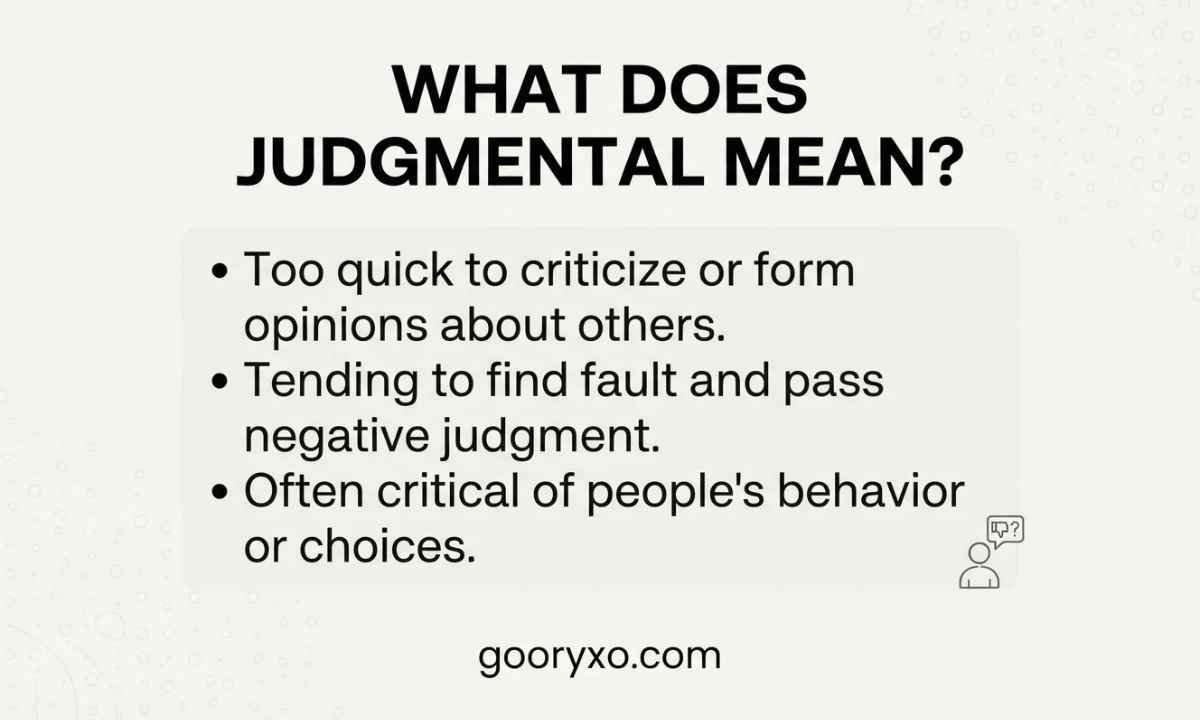
A judgmental person quickly forms and shares critical opinions about others. The word almost always sounds disapproving.
Example: A manager looks at a coworker’s lunch and says, “Again? Really?” She never insulted anyone, but her tone is judgmental.
Making a judgment isn’t the same as being judgmental. A doctor who weighs a diagnosis is judging carefully, while a neighbor who sneers at your car is just being harsh.
A “judgment call” is also a different thing. It means a decision based on your own opinion, and it doesn’t have to be critical at all.
Close synonyms for either side of judgmental or judgemental include critical, disapproving, harsh and preachy.
The Origin of Judgmental or Judgemental

The judgmental or judgemental question starts with the noun. “Judgment” came into English from Old French “jugement,” and the adjective was made by adding -al.
Many people blame Noah Webster for dropping the e. But the short spelling was already used on both sides of the Atlantic by the late 1600s, so he followed a habit more than he started one.
In the 1800s the e-form became more common in general British writing. British courts kept the short spelling for court decisions, and that split still exists today.
Example: The film title Terminator 2: Judgment Day shows the American spelling in popular culture, with no e anywhere.
British English vs American English Spelling
On the judgmental or judgemental question, American English accepts only “judgmental.” British English accepts both, and many British publishers use the e-form for general writing.
Sources don’t agree on which spelling is more common in Britain. Some studies of printed books show the short form slightly ahead, and other tools show the e-form ahead. It depends on the source and the type of writing.
Key Difference:
The whole judgmental or judgemental difference is one silent letter after the g. Americans drop it, and the British often keep it.
The same letter shows up in related words. Judgmentally, judgmentalism and non-judgmental all follow the spelling of the root word.
Example: US English writes “judgment, judgmental.” UK English often writes “judgement, judgemental.”
Comparison Table
The table shows how the judgmental or judgemental pattern repeats across related words.
| Feature | American English | British English |
| Noun | judgment | judgement (judgment for court rulings) |
| Adjective | judgmental | judgemental (judgmental also seen) |
| Adverb | judgmentally | judgementally |
| Attitude noun | judgmentalism | judgementalism |
| Spell-check result | e-form flagged | both usually accepted |
Examples:
Example: “He gave her a judgmental look across the table.” (US) and “He gave her a judgemental look across the table.” (UK).
In the judgmental or judgemental pair, neither sentence is wrong for its own audience. The mistake only appears when a writer uses the wrong spelling for the reader, such as the e-form in a US college essay.
See Also Hidding or Hiding: Which Is Correct? Easy Spelling Rule
Judgment vs Judgement in Legal Writing
In law, “judgment” without the e is the standard spelling for a court’s decision, even in Britain. A legal judgment from a High Court almost never takes the extra letter.
Example: A British newspaper might write “The court gave its judgment on Friday” and, in the same issue, “It was poor judgement on his part.”
The adjective isn’t a legal word, so this rule only affects the noun. It still explains why British readers see both spellings all the time.
Which Spelling Should You Use?
Match the spelling to the English your reader expects. Judgmental or judgemental is really a question about your audience, and if you can’t tell, “judgmental” is the safer pick because readers everywhere recognize it.
Merriam-Webster lists “judgment” as the main spelling and the e-form as a variant. The Oxford English Dictionary says the e-form is usual in general British writing, which is why one quick rule won’t fit every case.
You can check any word fast in the Oxford, Merriam-Webster or Cambridge dictionaries, then follow your own style guide.
Use “Judgmental” when:
Choose the short form for judgmental or judgemental when any of these apply:
- You’re writing for a US audience, school or publication.
- Your readers come from several countries.
- Your style guide is AP or Chicago Manual of Style, which are both American.
Example: A US wellness blog that describes “a judgmental culture around parenting” should use the short form every time.
Use “Judgemental” when:
Use the e-form when your reader or publisher is British and spells it that way. Check the style guide first, because many UK outlets still prefer the short form.
Example: A UK charity leaflet that promises “a safe, non-judgemental space” fits British style, as long as the rest of the leaflet uses British spelling too.
Canada, Australia, India and New Zealand
These countries mix both styles, and sources disagree, so follow your publisher’s style guide instead of guessing. Canada often uses the shorter spelling and Australia often uses the e-form, but both are accepted in each place.
New Zealand is split, since some dictionaries and newspapers lean one way and some usage tools lean the other. Indian English usually follows British habits, so you’ll often see the e-form there, but court rulings still say “judgment.”
Example: A Sydney marketing agency may write “judgemental” in client copy, while a Toronto agency could just as easily write “judgmental.”
For Global Use:
For judgmental or judgemental at a global scale, choose “judgmental.” It’s the standard in the United States and it appears often in British, Canadian and Australian writing too, so very few readers will see it as an error.
Example: A global HR platform that writes “keep feedback constructive, not judgmental” stays safe in every market.
Pro Tip:
With judgmental or judgemental, set your spell checker to the right English before you start. Then search the finished draft for the other spelling, which takes about ten seconds.
Example: Writing for a US client? Search your draft for “judgemental” and change every match to “judgmental.” Here’s an easy memory hook too: the extra e in “judgemental” can stand for England.
Common Mistakes with Judgmental or Judgemental

Most judgmental or judgemental errors come from mixing styles, not from choosing a “wrong” word. Four mistakes show up again and again.
Mistake 1:
Using both judgmental or judgemental spellings inside one document. Readers who spot two versions start to doubt the rest of your editing.
Example: “She’s judgmental, and her brother is judgemental too.” Pick one form and use it everywhere.
Mistake 2:
Calling the e-form a typo everywhere. That’s true for American writing, but in British writing it’s a normal spelling, so “fixing” it can add a new error.
Example: A UK editor sees “judgemental” in a London writer’s draft. Changing it to “judgmental” adds a US spelling the writer never wanted.
Mistake 3:
Using the e-form in work for American readers, such as US exams, applications or publications. AP style follows American spelling, so “judgmental” is what editors expect there.
Example: A student who writes “judgemental” in a US college essay may see it flagged, even though the word is fine in London.
Mistake 4:
Spelling the adjective and the noun in different styles. This is one of the most common slips in long documents.
Example: “His judgemental tone showed poor judgment.” The adjective has the e and the noun doesn’t. Use the same pattern for both.
See Also Hidding or Hiding: Which Is Correct? Easy Spelling Rule
Judgmental or Judgemental in Everyday Examples

You’ll meet judgmental or judgemental in the same places whichever spelling you use. What changes is the tone and how formal the setting is.
In Daily Conversation:
When you speak, nobody can hear the difference, because both spellings sound the same. The pronunciation is almost identical in the US and the UK.
Example: “I’m not being judgmental, I’m just curious why you wore that to a wedding.” People say that sentence the same way in Boston and Birmingham.
In Emails:
In an email, tone matters more than spelling, and readers notice the word “judgmental” fast. Use it carefully when a message might upset someone.
Example: “I didn’t mean to sound judgmental about the deadline.” Clients often read a line like this as a soft apology, so match your spelling to their region.
In Social Media:
People mix spellings freely online, so don’t take a comment with the “wrong” one too seriously. Brands should still stay consistent across their posts.
Example: A caption that says “a judgment-free zone for new gym members” uses the American form. A UK gym would more likely write “judgement-free.”
In Formal Writing:
In essays, reports and articles, follow the assigned style guide and keep the spelling the same from start to finish. The word also has a technical use in “judgmental forecasting,” which means predictions based on expert opinion instead of only statistics.
Example: “The team used judgmental forecasting to estimate demand for the new product.” Here the word has nothing to do with criticism.
Non-Judgmental, Judgmentally and Judgmentalism
The judgmental or judgemental rule applies to the whole word family. You can write non-judgmental or non-judgemental, judgmentally or judgementally, and judgmentalism or judgementalism, so match each one to your main spelling.
Example: A US counselor might promise “non-judgmental listening,” while a UK support service could advertise “non-judgemental listening.” Both phrases mean the same thing.
Writers also vary on the hyphen, since “non-judgmental” and “nonjudgmental” both appear in print. Pick one pattern and keep it.
“Judgmentalism” names the attitude itself, as in “her judgmentalism put people off.” The adverb “judgmentally” describes how someone acts, as in “he checked the receipt judgmentally.”
Judgmental vs Judgy vs Critical

“Judgmental” describes a lasting trait, “judgy” is the casual version, and “critical” can be fair or harsh. Judgmental or judgemental is a spelling choice, while judgy versus critical is a tone choice.
A linguist writing in Lingua Franca argued that “judgy” feels lighter and points to one moment, while “judgmental” sounds harsher and points to a person’s character.
Example: “She was a bit judgy about my playlist” sounds playful. “She’s so judgmental” sounds like a verdict on her character.
“Critical” can also be fair. A critical review of a film isn’t judgmental, it’s just an honest opinion.
Judgmental or Judgemental – Google Trends & Usage Data
Usage data supports the regional split, but the numbers depend on the source. For the noun, “judgment” leads American writing by more than ten to one, while British data is much closer.
Search interest changes every month, so this guide doesn’t print a number that would soon be outdated. You can check the current picture yourself by comparing both spellings in the Google Books Ngram Viewer, using the American and British book collections.
This guide was checked against dictionary and style guide notes in November 2026.
Usage Insight:
“Judgmental” is the main form online and in American publishing. “Judgemental” still holds a real share in Britain and in some other English-speaking countries.
Example: A US news site and a UK news site can both describe “a judgmental comment” correctly, but only the UK site will also use “judgemental” without a second thought.
Because the e-form is the smaller choice in US writing, it can look careless to American readers. That’s the practical reason to pick “judgmental” in the judgmental or judgemental choice for a mixed audience.
Comparison Table: Judgmental vs Judgemental
Judgmental or judgemental means the same thing to every reader, but the best choice depends on the audience. This table sums up where each form fits.
| Question | Judgmental | Judgemental |
| Meaning | Likely to criticize | Likely to criticize |
| Home region | United States | United Kingdom and some Commonwealth writing |
| Accepted in US English | Yes | No, flagged as an error |
| Accepted in UK English | Yes, seen often | Yes |
| Best for | US or global audiences | UK-style publications |
| Safe default | Yes | Only for a British audience |
Frequently Asked Questions
Is it judgmental or judgemental?
Both are correct, depending on the English you’re writing, and the judgmental or judgemental choice follows your audience. Use “judgmental” for American and mixed audiences, and “judgemental” when a British style guide asks for it.
What does judgmental mean?
Judgmental means quick to criticize or form negative opinions about other people. It describes a person, a tone or an attitude.
Is “judgemental” spelled wrong?
No, but in the judgmental or judgemental pair it’s wrong in American English. In British writing it’s a normal spelling, so the right answer depends on who’s reading.
Which spelling is more common?
“Judgmental” is more common overall, mainly because of American usage. In Britain the gap is smaller, and sources differ on which one leads.
Is it non-judgmental or non-judgemental?
Follow the spelling of your main form. Write “non-judgmental” if you use “judgmental,” and “non-judgemental” if you use the e-form.
Should I use judgmental or judgemental in a US exam?
For judgmental or judgemental in an exam, use “judgmental.” American teachers and style guides treat the e-form as an error, so it can cost you marks even though the meaning is clear.
Can I use both spellings in one document?
No. Mixing them makes a document look unedited, so choose one form and use it for the whole word family.
Summary
Judgmental or judgemental comes down to your audience. Both spellings mean the same thing, “judgmental” is the American standard, and “judgemental” is a common British choice.
When your readers come from different countries, use “judgmental” and match related words like non-judgmental and judgmentally to it. Whichever side of judgmental or judgemental you choose, keep it the same from the first line to the last.

My name is Ashfaq, and I am an English teacher with 5 years of teaching experience, specializing in English grammar. My mission is to make grammar easy to understand through simple explanations, practical examples, and helpful learning resources. At Gooryxo, I aim to help learners improve their grammar, strengthen their writing skills, and use English with confidence.
