
Behaviour or behavior? Both are correct. Behavior is the American spelling, while behaviour is standard in the UK, Canada, Australia, India and most other English-speaking countries.
The meaning never changes, only the spelling does. This guide shows where the split came from, which form suits your reader, and how to stop your spellchecker from arguing with you.
Behaviour
Behaviour is the British spelling of a noun that describes how a person, animal or thing acts, especially in response to a situation or to other people. British speakers say it as /bɪˈheɪvjə/.
You’ll see it in the UK, Ireland, Australia, New Zealand, India, South Africa and Canada. Researchers often use the plural “behaviours” when they talk about several different patterns at once.
Example: “The inspector praised the pupils’ behaviour throughout the museum visit.”
That sentence is correct in any British-based English. If you swap in the American spelling, the meaning stays the same and only the region changes.
Behavior
Behavior is the American spelling of the same noun. It has the same meaning and almost the same sound: /bɪˈheɪvjər/. US publishers, universities, newspapers and government offices all use it, and so does Philippine English.
The only difference from behaviour is the missing u. If your readers are American, use this form everywhere, from a school newsletter to a clinical paper.
Example: “The company’s code of conduct explains the expected behavior at client events.”
Behaviour or Behavior: Quick Answer
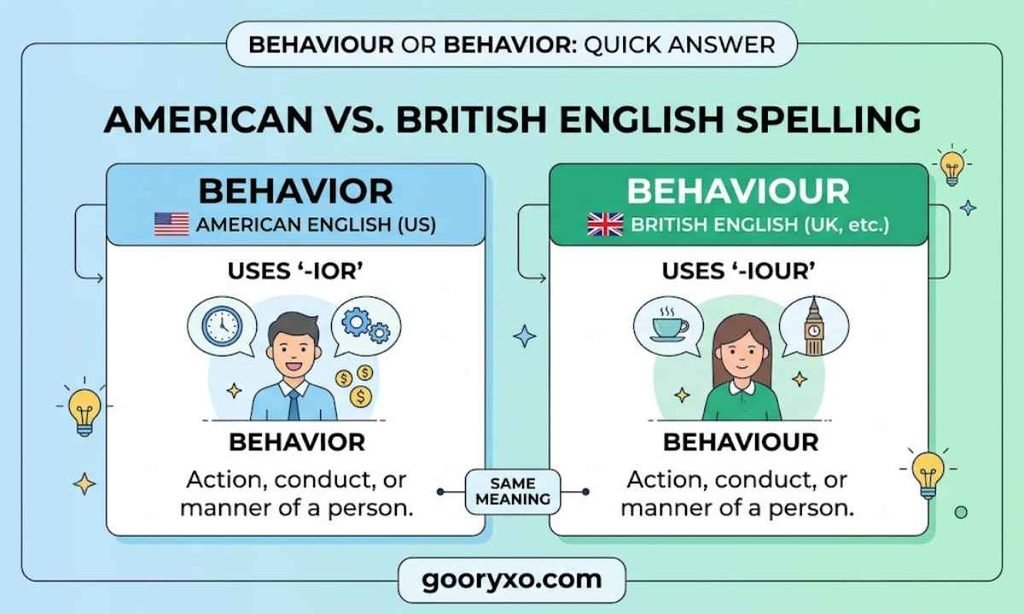
Both spellings are correct, so choose the one your readers use. American English writes behavior, and British and Commonwealth English write behaviour.
Example: US: “The coach was pleased with the team’s behavior.” UK: “The coach was pleased with the team’s behaviour.” The sentences mean exactly the same thing.
The short rule: American spelling drops the u in -our endings, and British spelling keeps it. Here is how to pick in practice:
- Readers in the US or the Philippines: use behavior.
- Readers in the UK, Ireland, Canada, Australia, New Zealand, India or South Africa: use behaviour.
- Mixed or unsure audience: follow your publisher’s style guide, then use one form from start to finish.
Dictionaries agree on this. Cambridge Dictionary and Collins Dictionary both list the two forms and mark behavior as the American one. Neither form is a typo. The only real mistake is mixing them in one text.
The Origin of Behaviour/Behavior
Behaviour comes from the verb “behave,” not from a Latin word the way colour and honour do. The u was normal English spelling for centuries, and American reformers later removed it.
“Behave” is made from the prefix be- and the verb “have,” so it first meant something like “to carry yourself.” By the 1400s, in Middle English, the noun had appeared. It was shaped on the older word “haviour,” which meant bearing or conduct and is linked to the Old French verb for “to have.” The Oxford English Dictionary and Merriam-Webster both record this history.
For a long time, -our was simply how these words looked, and Samuel Johnson’s 1755 dictionary kept the u. Noah Webster went the other way. In his early 1800s dictionaries, ending with the 1828 American Dictionary of the English Language, he cut colour, honour and behaviour down to color, honor and behavior. He wanted simpler spelling and an identity of its own for American English. Publishers followed slowly, and Britain never did.
Example: The verb never changed. “She behaves well” looks the same in Boston and Birmingham. Only the noun and its relatives carry the u.
British English vs American English Spelling
Behaviour and behavior are one example of a bigger rule: British English keeps -our, and American English uses -or. Once you spot this pattern in regional spelling, many other spelling variations become easy to predict.
| American English | British English |
| behavior | behaviour |
| color | colour |
| favor | favour |
| honor | honour |
| neighbor | neighbour |
| labor | labour |
| humor | humour |
A few words break the pattern. Americans still write “hour,” “four” and “tour,” but those belong to a different group because the -our is not the same ending. Some words, like “glamour,” often keep the u in American writing too. British writers also drop the u before -ous, which is why they write “humorous,” “laborious” and “vigorous.”
Example: “The neighbour’s sense of humour won everyone over.” In American English it becomes “The neighbor’s sense of humor won everyone over.” Two u’s disappear and nothing else changes.
Behavioural vs Behavioral: Related Words (behaviourism, misbehaviour, best behaviour)
Every word built on behaviour follows the same split. Americans write behavioral, behaviorism and misbehavior. British and Commonwealth writers keep the u in behavioural, behaviourism and misbehaviour.
Example: “The university’s behavioural science department studies consumer behaviour and misbehaviour in online games.”
The same goes for common phrases. You hear “good behaviour” and “on your best behaviour” in London, and “good behavior” and “on your best behavior” in Chicago. Business and science terms split too: organizational behavior and behavioral economics in the US, organisational behaviour and behavioural economics in the UK. Only the verb stays the same. Behave, behaved and behaving are identical on both sides of the Atlantic.
The psychology school called behaviorism took its name from John B. Watson’s 1913 article “Psychology as the Behaviorist Views It.” British textbooks print the same movement as behaviourism. Journal titles show the split too. Behaviour Research and Therapy uses the British form, and the Journal of Applied Behavior Analysis uses the American one. When you cite a title, copy it exactly as published.
Behaviour or Behavior in Canada, Australia and India
Canada, Australia and India all write behaviour. Canadian English is the one to watch, because it mixes British -our with American -ize.
Canadians write colour, neighbour and behaviour, but they usually write organize and realize. Australian and Indian English follow the British -our pattern, and so do Irish, New Zealand and South African English. Together these are often called Commonwealth English. The Philippines is the big exception, since it follows American spelling.
Canadians read a lot of American media, so behavior sometimes shows up in casual writing. Formal Canadian writing, like school policies, government documents and published books, uses behaviour.
Example: A Toronto school board might write, “The new behaviour policy asks staff to organize weekly check-ins.” Behaviour keeps its u, and organize keeps its z.
Which Spelling Should You Use?
Use the spelling your reader’s country uses, unless a style guide or publisher says otherwise. These checks will help you decide, in this order:
- Audience first. Where do your readers live?
- Style guide second. APA and the Chicago Manual of Style both call for American spelling. Oxford-style guides and most UK publishers use behaviour.
- Journals. The author guidelines decide, even if you normally write the other way.
- Exams and school work. Follow your school or exam board. IELTS accepts either spelling if you stay consistent.
- Websites. Match your main audience. If your readers are split between countries, think about making a separate UK page and US page.
Example: A UK charity writing to donors in Manchester uses “behaviour.” The same charity’s US fundraising page uses “behavior.” Each page has one clear audience, so the choice is easy.
If you can’t name one audience, pick one form and keep it through the whole document.
Easy Trick to Remember the Difference
Think “UK keeps the U.” The British spelling has the extra letter, and the American spelling is the shorter one.
Here is a second shortcut: Americans trim, Brits keep. If you know how a writer spells colour, you can usually guess behaviour, favour and honour too. It won’t help with hour, four or tour, because those never had this ending.
Example: Writing to a client in Leeds? UK has a U, so write behaviour. Emailing someone in Austin, Texas? Drop the u and write behavior.
How to Set UK or US Spelling in Word and Google Docs
Set the proofing language to English (UK) for behaviour or English (US) for behavior, and your spellchecker will follow. The red line under a word does not mean it is wrong. It only means the word does not match the language you picked.
Example: A UK writer uses Replace All to change every “behaviour,” and it also changes the Behavioural Insights Team, a UK-founded organization, into “Behavioral Insights Team.” Official names should never be changed.
In Microsoft Word:
- Press Ctrl+A to select all the text.
- Open the Review tab, choose Language, then Set Proofing Language.
- Pick English (United Kingdom), English (Canada), English (Australia), English (India) or English (United States).
- Click OK. Choose “Set As Default” if you want it to apply to new documents.
In Google Docs, go to File, then Language, and pick the English version you need. In Grammarly, you can switch between American, British, Canadian and Australian English in the settings. If you use Find and Replace, check each match, because names, quotations and book titles keep their original spelling.
Common Mistakes with Behaviour/Behavior
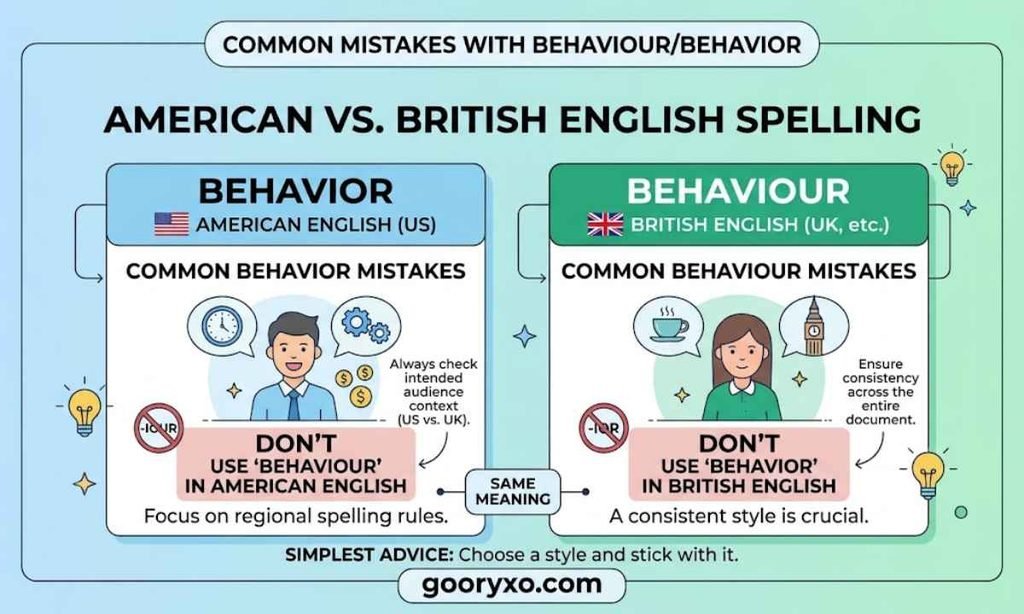
The most common mistakes are mixing both spellings in one text, “fixing” a spelling that was already right, and getting the letters wrong. Here are five to watch for.
- Mixing both spellings in one document. This often happens when sections are pasted in from different writers.
Example: Wrong: “Her behaviour improved, and the new behavior chart helped.” Right: “Her behaviour improved, and the new behaviour chart helped.” - Changing the word but not its family. Writers fix “behaviour” and forget the related words.
Example: Wrong: “The behavioural study measured color preferences.” Right: “The behavioural study measured colour preferences.” - Calling the other spelling a typo. If a reviewer writes “Typo: behaviour” on a UK report, the reviewer has added an error, not found one. Leave the spelling alone when it matches the audience, and change the spellchecker’s language instead.
- Changing official names. A title is fixed, so copy it as published.
Example: Wrong: “Journal of Applied Behaviour Analysis” in a UK bibliography. Right: “Journal of Applied Behavior Analysis,” exactly as published. - Misspelling the letters. The correct spelling is b-e-h-a-v-i-o-u-r, with “i” before “our.”
Example: Wrong: behavour, behaviuor, behavoir. Right: behaviour (or behavior).
Behaviour/Behavior in Everyday Examples

Behaviour/behavior appears in schools, offices, news and research, and the spelling follows the writer’s country. These examples show how it reads in real situations.
- Example (school report, UK): “Maya’s behaviour in class has improved this term.”
- Example (workplace email, US): “Thank you for the professional behavior your team showed during the audit.”
- Example (news, UK): “Police say anti-social behaviour in the town center has fallen.” UK law uses this spelling in the Anti-social Behaviour Act 2003, while American writers usually write “antisocial behavior.”
- Example (pet care, US): “Chewing is normal puppy behavior, but it needs redirecting.”
- Example (app analytics): “Review your users’ behaviour data before changing the checkout page.” In the US, it would be “behavior data.”
- Example (idiom, Australia): “The kids were on their best behaviour for Gran.”
The meaning never shifts. A reader in any country understands all six sentences right away.
Behaviour/Behavior: Google Trends & Usage Data
Usage follows geography. American writers and searchers lean toward behavior, while British and Commonwealth ones lean toward behaviour.
Exact numbers change every day, so this guide does not print them. An old screenshot would mislead you. You can check the current picture yourself with free tools:
- Google Trends: compare the two spellings, then switch the region between the US, the UK, Canada, Australia and India.
- Google Books Ngram Viewer: compare both spellings in its British English and American English collections.
- COCA and the British National Corpus: these show how real writers use each word in context.
Most people who search this question are probably students, editors, researchers preparing a journal paper, content writers and English learners. Canada is worth a second look, because its mix of British and American habits makes it the most interesting case.
Example: Open Google Trends, type “behaviour” and “behavior,” and set the region to the UK. Then switch to the US and compare what changes.
Behaviour vs Behavior: Comparison Table
Here is the side-by-side view of the two spellings.
| Feature | Behavior | Behaviour |
| Dialect | American English | British and Commonwealth English |
| Common in | US, Philippines | UK, Ireland, Canada, Australia, New Zealand, India, South Africa |
| Pronunciation | /bɪˈheɪvjər/ | /bɪˈheɪvjə/ |
| Adjective | behavioral | behavioural |
| Psychology school | behaviorism | behaviourism |
| Opposite | misbehavior | misbehaviour |
| Idiom | on your best behavior | on your best behaviour |
| Style guides | APA, Chicago | Oxford-style, UK publisher guides |
| Word proofing language | English (US) | English (UK), Canada, Australia, India |
Example: US: “Behavioral science explains why people put things off.” UK: “Behavioural science explains why people put things off.”
Summary
Behaviour or behavior comes down to your reader, not to right and wrong. American English uses behavior, and British and Commonwealth English use behaviour.
Set your proofing language, follow your style guide, and keep the whole word family consistent, from behavioural to misbehaviour. Then the spelling takes care of itself.
Frequently Asked Questions
Is it behaviour or behavior?
Both are correct. Behavior is the American spelling, and behaviour is the British and Commonwealth spelling, so choose by your audience.
Is “behaviour” wrong in American English?
No, but American readers expect “behavior” in formal writing. A US publisher or teacher will usually change it to match their style.
Why do Americans spell it without the u?
Noah Webster’s early 1800s dictionaries promoted simpler spellings like color, honor and behavior. American publishers slowly adopted them, while British writers kept the u.
Is “behavioural” spelled with a u?
In British, Canadian, Australian and Indian English, yes: behavioural. In American English, it is behavioral.
Can I use behaviour or behavior in the same document?
No. Pick one form and use it throughout, together with related words like behavioural or behavioral and misbehaviour or misbehavior.
How do I switch Word from behavior to behaviour?
Select your text, open Review, choose Language, then Set Proofing Language, and pick English (UK) or another non-US option. Word will then accept behaviour and flag behavior.
Which spelling do academic journals want?
It depends on the journal, so check the author guidelines. APA-style journals ask for American spelling, while many UK and Commonwealth journals expect behaviour.

My name is Ashfaq, and I am an English teacher with 5 years of teaching experience, specializing in English grammar. My mission is to make grammar easy to understand through simple explanations, practical examples, and helpful learning resources. At Gooryxo, I aim to help learners improve their grammar, strengthen their writing skills, and use English with confidence.

1 thought on “Behaviour or Behavior: Which Spelling Is Correct?”