
Comparable is the correct spelling. Comprable is a typo, and no major dictionary lists it. If you’re stuck on comprable or comparable, the answer is simple, and the reason is easy to learn.
This guide explains where the word comes from, how people say it, and which words go with it. You’ll also find real sentences you can use. After this, the comprable or comparable question won’t slow you down.
Comprable or Comparable – Quick Answer
Comparable is the correct spelling. Comprable is a misspelling, and it isn’t an English word.
Comparable is an adjective. It means able to be compared, or similar enough that a comparison makes sense. Common synonyms are similar, equivalent, and alike.
People type comprable because the first “a” sounds soft when we talk. Your ear skips it, and your fingers follow. That is the whole comprable or comparable problem.
Example: Two phones with the same price and features are comparable. Writing “comprable phones” in an email looks like a typo.
Examples:
Here are three correct sentences. Each one uses the word in a slightly different way.
Example: The café’s prices are comparable to the place across the street.
Example: After a year of training, her times were comparable with the club’s best runners.
Example: These two job offers aren’t comparable, because only one pays for moving costs.
In every sentence, the word tells the reader that two things are close enough to compare. Use these as a guide the next time comprable or comparable crosses your mind.
The Origin of Comparable
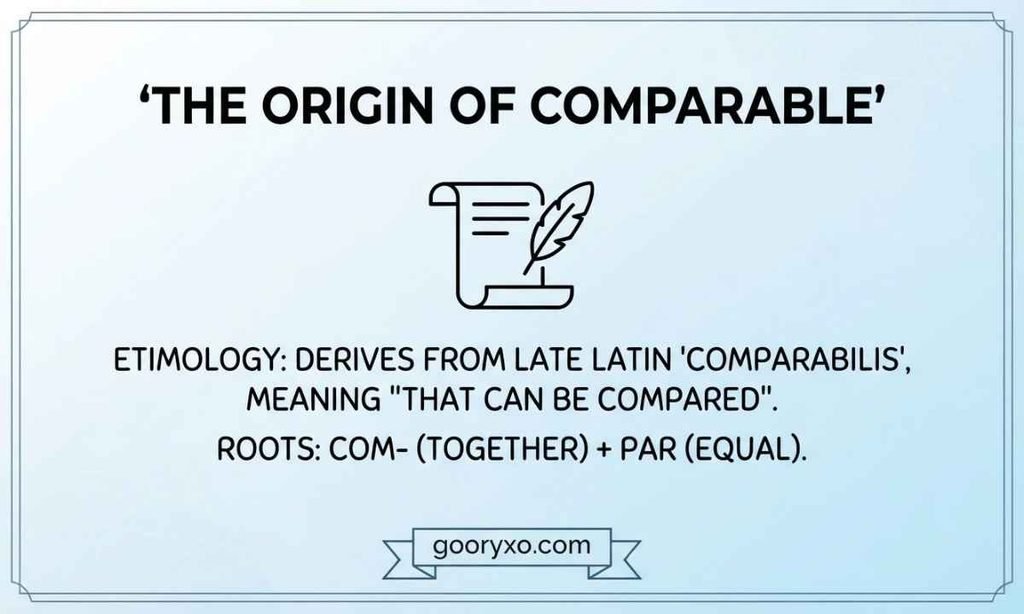
Comparable comes from the Latin word comparābilis, which came from comparāre, meaning “to compare.” English took the word in the 15th century.
Example: Use becomes usable, and desire becomes desirable. In the same way, compare becomes comparable, and the last e drops off.
Merriam-Webster gives the 15th century as the first known use. Dictionary.com says late Middle English, around 1375 to 1425.
The root word compare is easy to see inside the spelling. So the comprable or comparable choice is simple: keep the “a” that comes from compare.
Related words follow the same pattern. Comparably is the adverb, and comparability is the noun. Incomparable usually means so good that nothing else matches it.
Example: The two engines perform comparably on flat roads.
British English vs American English Spelling
There’s no difference in spelling. American and British writers both use comparable, and neither accepts comprable.
Example: A New Yorker and a Londoner may say the word differently, but both write “comparable” on the same invoice.
Many other words do change, like color and colour, or center and centre. This word doesn’t.
The sound is what changes. Some speakers stress the first part (COM-pruh-bul), and others stress the second part (cum-PAIR-uh-bul). Merriam-Webster lists both for American English, and Dictionary.com shows the British stress on the first part.
So the comprable or comparable mistake isn’t a UK or US problem. People in both places make it.
Which Spelling Should You Use?
Use comparable every time. When you choose between comprable or comparable, comparable wins in every country.
Only the writing situation changes, and the next three sections cover it.
Example: One offer sent to clients in Texas, Manchester, and Toronto should say comparable in all three places.
If Your Audience is in the US:
Write comparable. Americans use it a lot in real estate, hiring, and product reviews.
Example: We’re offering a salary comparable to what similar analysts earn in Chicago.
It’s a handy word for salary checks and side-by-side reviews.
See Also These or Theese? Correct Spelling, Meaning & Examples
If Your Audience is in the UK or Commonwealth:
The spelling is the same, and there’s no other version.
British dictionary entries often explain the word as “able to be compared (with).” That’s why you may see “comparable with” more often there. Both forms are fine.
Example: The university’s fees are comparable with those at other Russell Group schools.
If You Write for a Global Audience:
Use comparable, and choose “comparable to” as your usual form. Readers will accept it without a second thought.
Many global readers use English as a second language. Short, plain sentences work best for them.
Example: Our support response times are comparable to industry standards.
Common Mistakes with Comprable or Comparable

Four mistakes keep coming up: dropping the “a”, adding an extra e, spelling by sound, and using the wrong word after comparable.
Each one is easy to fix once you can spot it. Here are the four errors behind most comprable or comparable mix-ups.
1. Dropping the “a”
The most common error is comprable, with no “a” after the p. Put the “a” back: com-par-a-ble.
It happens because the word has four syllables on paper but sounds like three when we speak. A weak vowel sound, called a schwa, hides inside the word.
Example: Wrong: “The two plans offer comprable coverage.” Right: “The two plans offer comparable coverage.”
Tap out four beats as you type: com, par, a, ble.
2. Confusing It with “Compareable”
Compareable has one extra e. The e from compare drops before the ending -able, so the right spelling is comparable.
Example: Wrong: “The two quotes are compareable.” Right: “The two quotes are comparable.”
Some people also write comparible, with -ible at the end. That’s wrong too. The correct suffix here is -able.
3. Wrong Pronunciation Leading to Wrong Spelling
If you spell by sound, you may write comprable. The stress often falls on the first syllable, so the middle part gets squeezed.
The American Heritage Dictionary favors that first-syllable stress. Merriam-Webster also lists a second-syllable stress. Both are normal speech.
Example: Say “COM-pruh-bul” and type exactly what you hear, and you’ll get comprable. Spell it from compare instead.
Your spelling should follow the written root, not the spoken shortcut.
4. Using It Incorrectly in a Sentence
Use comparable with “to” or “with,” never “than.” The phrase “comparable than” is wrong.
The word than belongs with comparatives like better than or cheaper than. Comparable isn’t a comparative.
Example: Wrong: “This tablet is comparable than that one.” Right: “This tablet is comparable to that one in screen quality.”
Also say what is being compared. “The results are comparable” leaves readers asking, in what way? Add in price, in size, or in speed.
Comparable to vs Comparable with
Both forms are correct. “Comparable to” is the everyday choice when you say two things are alike.
Example: Our new plan is comparable to the old one in cost.
“Comparable with” fits best when you line up data or results to measure them. Pick one form and keep it the same across your document. The preposition can change, but the comprable or comparable spelling choice doesn’t.
Example: This year’s survey is comparable with last year’s, because we asked the same questions.
See Also These or Theese? Correct Spelling, Meaning & Examples
Comparable vs Comparative

Comparable means similar enough to compare. Comparative means involving a comparison, or measured against something else.
In grammar, comparative also names forms like taller and better. The two words look close, but they do different jobs.
Example: “A comparative study of two schools” is research built around comparing them. “Two schools with comparable class sizes” are schools that are alike in size.
Mixing them up is nearly as common as the comprable or comparable slip.
Comparable in Everyday Examples
These five settings show comparable at work, and the spelling stays the same each time.
In Emails:
In email, comparable often backs up a point about price or timing.
Example: The quote you sent is comparable to what two other vendors offered, so can we talk about the delivery date?
It sounds fair and calm, which helps in a negotiation. Even in a quick email, the comprable or comparable choice shows how careful you are.
In News:
News writers use comparable to match a number against an earlier period or a similar case.
Dictionary.com’s examples include a Barron’s piece from July 2026 about sales on a comparable basis.
Example: The ministry said enrollment is comparable to last year’s figures.
On Social Media:
Social posts use the word in a casual, bragging way, but the spelling doesn’t change.
Example: Camera quality on this phone is comparable to models that cost twice as much.
In Academic Writing:
Academic writing uses comparable to show that two groups are alike enough to be set side by side.
Example: The two groups were comparable in age and prior test scores.
This helps readers trust that the comparison is fair. A typo like comprable can weaken a strong paper, so settle the comprable or comparable question before you submit.
In Business Reports:
Reports use comparable for benchmarks and year-on-year checks. In a report, the comprable or comparable choice changes how professional the page looks.
Example: Operating costs this quarter are comparable to the same period last year.
Comparable as a Noun: Comparables and Comps
Yes, comparable can also be a noun. In real estate and finance, comparables, often called comps, are similar properties or companies used to judge value.
Example: The appraiser pulled three comps: houses of similar size that sold recently in the same neighborhood.
You’ll also see the phrase comparable market analysis in property listings. The comprable or comparable rule holds here too, so “comprables” is as wrong as comprable.
Easy Memory Trick to Never Misspell Comparable
Think of compare plus able, and keep every letter of compare except the last e.
Example: Say it slowly in four parts, com-par-a-ble, and you can’t skip the “a.”
Here’s one more way to remember it. If you’re able to compare two things, they are comparable. The “able” sits at the end of the word and says exactly that. It’s a quick fix for the comprable or comparable doubt.
Comparable – Google Trends & Usage Data
Dictionaries and published writing use comparable. Comprable mostly lives on as a typo.
Merriam-Webster’s entry for comparable includes example sentences from news outlets. Dictionary.com’s examples include that Barron’s piece. Neither entry lists comprable.
The typo shows up in casual places. A 2005 Dell community thread about a computer “comprable” to an Apple PowerMac G5 used it twice. Autocorrect and spell checkers usually flag it today.
Spanish adds to the confusion. In Spanish, comprable is a real word that means something you can buy.
Search numbers change every month, so check them yourself. Type both spellings into the compare box in Google Trends.
Example: Set the region to your own country, then compare “comparable” with “comprable” to see how people there type it.
Comparison Table: Comprable vs Comparable
This table settles the comprable or comparable question at a glance. Only the comparable column is correct.
| Feature | Comprable | Comparable |
| Valid English word | No | Yes |
| Listed in Merriam-Webster and Dictionary.com | No | Yes |
| Meaning | None in English (it means “purchasable” in Spanish) | Able to be compared; similar |
| Syllables when spelled | Three | Four |
| Matches the root word “compare” | No | Yes |
| Safe for emails, reports, essays | No | Yes |
| Words that follow it | Not applicable | to or with |
Example: “Our rates are comparable to the market average” works well. Swap in comprable, and the sentence has a spelling error.
Frequently Asked Questions
Is it comprable or comparable?
It’s comparable. Comprable is a misspelling, so write comparable in every email, report, and essay.
Is comprable ever correct?
Not in English. In Spanish, comprable is a real word that means purchasable, but that’s a different language.
Why do so many people write comprable?
Because the middle vowel is often said very softly, the ear hears three syllables instead of four. That is why the comprable or comparable mix-up is so common.
Is comparable spelled differently in British and American English?
No. Both write comparable, so the comprable or comparable choice is the same in every country. Only the stress changes when people say it, and each side has more than one accepted way.
Should I write comparable to or comparable with?
Either is correct. Comparable to is the safer default for saying two things are alike.
Is comparable the same as comparative?
No. Comparable means similar enough to compare. Comparative means involving a comparison, or relative to something else.
What are good synonyms for comparable?
Similar, equivalent, and alike all work, depending on the sentence. Equal is stronger, so use it only when the match is exact.
Summary
Comprable or comparable comes down to one rule: spell it comparable, with four syllables and an “a” after the p. Your ear may skip that vowel, but the word is built from compare, so keep the root in view.
Use “to” or “with” after it, keep it apart from comparative, and use comparables for property or finance comps. Next time you catch yourself typing comprable, tap out com-par-a-ble and fix it.

My name is Ashfaq, and I am an English teacher with 5 years of teaching experience, specializing in English grammar. My mission is to make grammar easy to understand through simple explanations, practical examples, and helpful learning resources. At Gooryxo, I aim to help learners improve their grammar, strengthen their writing skills, and use English with confidence.

1 thought on “Comprable or Comparable? Correct Spelling, Meaning & Examples”