
Devine or Divine? Divine is the correct word for anything holy, heavenly or wonderful, and it’s the spelling you want in almost every sentence. Devine is mainly an Irish surname, and a spelling slip when it shows up in place of divine.
The two look and sound almost the same, so autocorrect and tired fingers mix them up. Here’s what each one means, where they come from, and a few easy ways to get it right every time.
Devine or Divine: Quick Answer
Divine is the correct spelling for the everyday word meaning holy, heavenly or extremely good. Devine is a surname and a place name, and outside those uses it’s a common misspelling.
That’s the whole story in two lines. The rest of this guide fills in the why.
| Word | What it is | Use it for |
| Divine | Standard English word (adjective, noun and verb) | Religion, praise, beauty, guessing or predicting |
| Devine | Irish surname and place name | People, families and towns |
Examples:
Example: The lemon tart at the new bakery was divine.
Example: Ms. Devine joined the call a few minutes late.
Example: The soup was devine. (This one needs fixing. It should be divine.)
The first sentence uses the word, the second uses a name, and the third is the slip most people make.
Simple Rule:
If you’re writing a word, spell it divine. If you’re writing a name, copy the spelling the person or place uses.
Example: A sign reading “Dr. Devine” keeps its e, but “a divine view” never does.
The Origin of Devine or Divine

Divine comes from Latin, while Devine comes from Irish. In most cases the two words have separate roots and only look alike.
Example: Picture a Roman writer using divinus for something godly, and an Irish family in the north of Ireland using Ó Daimhín as a family name. Two different worlds that ended up one letter apart in English.
Origin of “Divine”
Divine comes from the Latin divinus, which means “of a god.” It reached English through Old French in the late 1300s.
Divinus grew out of divus, meaning “god,” which is related to deus. According to the Online Etymology Dictionary, the deeper root is an ancient word for “to shine” that also gave us words for sky and heaven. That’s a lovely picture for a word we now use for dessert.
Here’s a detail that explains today’s confusion. Dictionary.com notes that Middle English writers spelled the word both divin(e) and devin(e), so an e in that spot was once normal.
Examples:
Example: Divinity, divination and deity all come from the same family as divine.
Even the French city of Dijon is linked to it. Its name traces back to a Latin personal name, Divius, which meant “godly.”
Origin of “Devine”
Devine is an Irish surname that comes from the Gaelic name Ó Daimhín. English speakers shortened and reshaped it over the centuries.
The root is damh, which means “ox” or “stag,” so the name works out to something like “descendant of the little stag.” Some sources also trace Devine to Ó Duibhín, “little black one.” Wikipedia says the surname is found mostly in Tyrone and Londonderry.
Example: Divine also exists as a surname, as another form of Devine. So a person named Divine isn’t making a spelling error at all.
Devine vs Divine: Meaning Explained
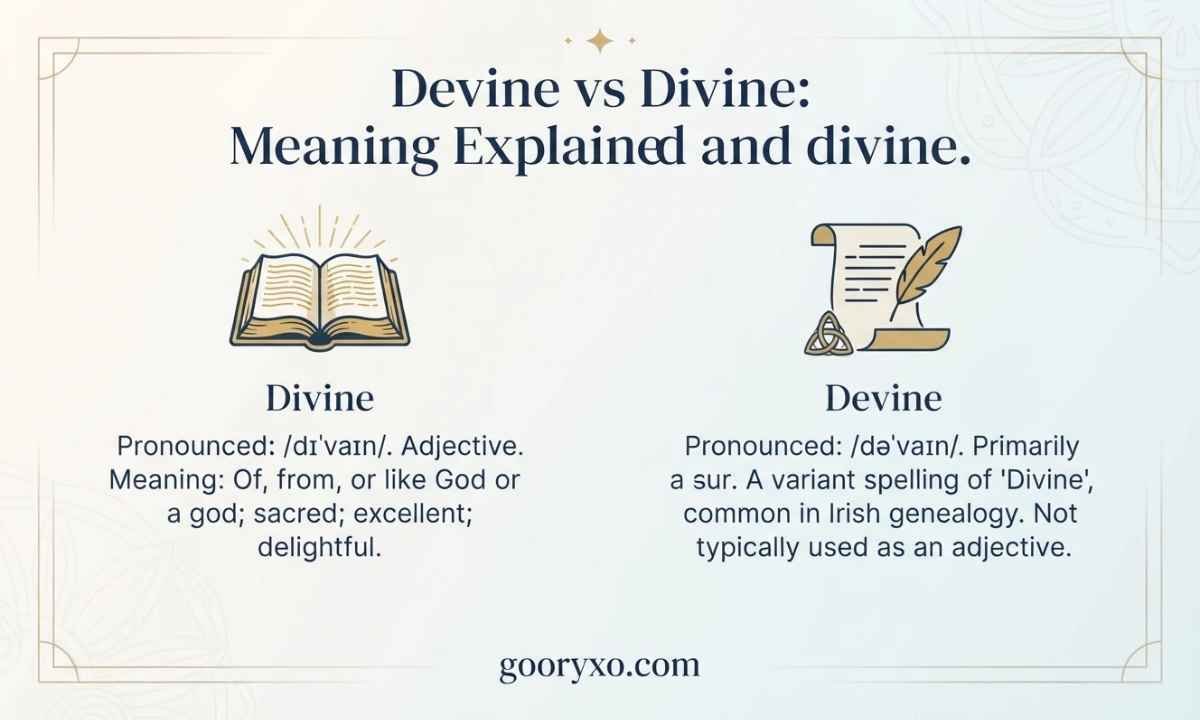
In the Devine or Divine question, only divine is a word with meanings: holy, godlike or extremely good. Devine has no meaning as an English word because it’s a name.
Keep those two jobs apart and the confusion mostly disappears.
What Does “Divine” Mean?
As an adjective, divine means coming from or belonging to God or a god. In a casual sense it also means wonderful or superb.
Close synonyms include holy, godly, sacred, heavenly and splendid. The adverb is divinely, as in “She sang divinely.”
Dictionary.com calls the “wonderful” meaning informal and a little old-fashioned. That’s useful to know before you use it in a formal report.
Examples:
Example: The villagers prayed for divine guidance before the harvest.
Example: The hilltop view at sunrise was divine.
The first sentence is the religious sense. The second is everyday praise, and it’s a bit more relaxed.
Divine as a Verb and a Noun
Divine is also a verb meaning to find something out by instinct or insight, and a noun meaning a member of the clergy. Most people only know the adjective, which is why this surprises them.
Example: Some farmers still use a forked stick to divine where underground water lies. Merriam-Webster lists this as a standard meaning.
As a noun, a divine is a clergyman or religion scholar, as in “an Anglican divine.” With a capital letter, “the Divine” means God. The verb forms are divined and divining, and a person who divines is a diviner, which is why you’ll see “divining rod” in older books.
What Does “Devine” Mean?
As a word, Devine doesn’t mean anything in English. It’s a family name, and it also names a few places.
Example: Devine, Texas is a city in Medina County, in the San Antonio area. People there write Devine because it’s the town’s actual name.
There’s one more twist. In French, devine is a form of the verb deviner, “to guess.” It’s the first word in the French title of the children’s book known in English as Guess How Much I Love You.
Examples:
Example: The actor Andy Devine was a familiar face in classic Westerns, including Stagecoach.
Example: Loretta Devine is an American actress, and Adam DeVine is an American comedian and actor.
Notice the capital V in DeVine. Some people style their names that way, so check before you type.
How to Pronounce Divine and Devine
Divine is said duh-VYNE, with the stress on the second part and a long i, like the word vine. The surname Devine is often said the same way, though some people say duh-VEEN.
That’s a big reason people mix them up. The first syllable is said softly and sounds like “duh,” so your ear can’t tell whether an i or an e belongs there.
Example: Say “a divine day” and then “Mr. Devine” out loud. You may hear almost no difference, which is why the spelling has to carry the meaning. Some Devine families say duh-VEEN instead, so ask if it matters.
British English vs American English Usage
There’s no British or American difference for Devine or Divine. Both varieties spell the word divine.
Unlike colour and color, nothing about this pair changes by country. The surname Devine turns up in both, especially among Irish and Irish-American families.
Example: An editor in London and an editor in Texas would both change “a devine dessert” to “a divine dessert.”
Comparison Table
Divine and Devine are treated the same way in UK and US English. The only thing that changes is who’s reading.
| Word | UK English | US English |
| Divine | Standard word | Standard word |
| Devine | Surname or place | Surname or place, such as Devine, Texas |
Example: A British school newsletter and an American one would both print the pupil’s surname Devine exactly as the family writes it.
See Also Micheal or Michael: Correct Spelling and Irish Variant Explained
Which Spelling Should You Use?
With Devine or Divine, use divine for the word and Devine only for a name. When you’re unsure, divine is almost always the safe pick.
Example: “The choir sounded divine” uses the word. “Thanks, Sean Devine” uses a name.
Use “Divine” When Talking About:
Use divine for anything that comes from God or a god, anything very beautiful or excellent, and the act of guessing something through insight.
- religion, worship and faith
- beauty, food, music and views
- foretelling or sensing something without proof
- the clergy, in older or formal writing
Example: “She seemed to divine his mood from across the room” is a correct and slightly literary use.
Use “Devine” Only When:
Use Devine only when you’re writing the name of a person, family, place or business.
Check the exact spelling each time. Some people write DeVine, and some businesses style the name in their own way.
Example: An email signature that reads “Tom Devine” settles the question. Copy it as it appears.
Simple Rule:
Try the swap test. If you can replace the word with holy or wonderful and the sentence still works, write divine.
Example: “The cake was holy” sounds odd, but “the cake was wonderful” works, so “the cake was divine” is right.
Common Mistakes with Devine or Divine
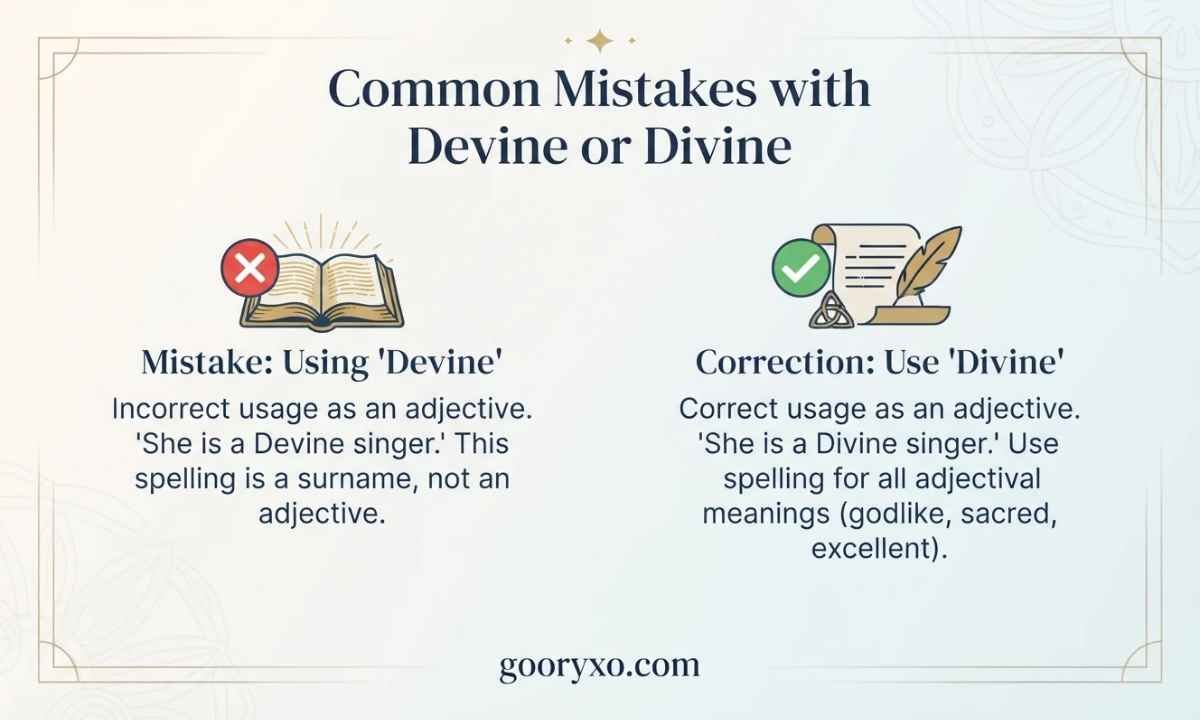
Four mistakes cause most of the trouble with Devine or Divine: writing devine for the word, treating both as accepted spellings, trusting a spell checker, and mixing up capital letters.
Mistake 1
Writing devine when you mean the word divine is the classic error. Dictionary.com even has an entry noting that devine is a frequent misspelling of divine.
Example: “That song is absolutely devine” should be “That song is absolutely divine.”
Mistake 2
Some writers assume both spellings are fine for the word. They aren’t. Only divine works in a normal sentence.
Treat Devine as a name and nothing more. Example: “Her devine grace” is wrong, while “her divine grace” is right.
Mistake 3
Trusting the spell checker can backfire. Because Devine is a known surname, some tools won’t flag it, so the error slides through.
Example: A cover letter says “a devine opportunity” and nothing gets underlined. A quick read-through catches what the software missed.
Mistake 4
Getting capital letters wrong is the last common slip. Devine as a name takes a capital, while divine stays lowercase unless it starts a sentence or names God as “the Divine.”
Example: “We met Mr. devine” is wrong. “We met Mr. Devine” is right.
Divine in Everyday Examples
People use divine most often to praise food and places, and in religious and literary writing. The four short sections below show how it sounds in real life.
Compliments
Divine works as a strong compliment for food, clothes, weather and places. It’s warm, a little dramatic and best kept for casual talk.
Example: “That lavender candle smells divine” is the kind of line you’d say to a friend.
Religion
In religious settings, divine points to God or a higher power. Phrases like divine mercy, divine will and divine intervention are common.
Example: The congregation sang about divine mercy at the end of the service.
Social Media
Captions are where the devine slip shows up most, since people type fast. Divine fits a happy photo of food, travel or a sunset.
Example: “Sunday brunch was divine” would suit a photo of pancakes.
Literature
Writers have used divine for centuries. Dante’s Divine Comedy, written in the early 1300s, is probably the most famous title with the word in it.
The poet Alexander Pope gave us the line “To err is human, to forgive divine.” Example: Quote that line in an essay and the spelling has to be right, or the joke falls flat.
Devine or Divine: Google Trends & Usage Data
Divine is far more common in everyday writing, since it’s an ordinary English word and Devine is a surname. This guide doesn’t quote exact search figures, because they change all the time and can’t be checked here.
You can see the pattern yourself. Open Google Trends, type both terms and compare them over any period you like.
Key Insight:
Searches for devine come from several groups of people, not just those checking a spelling. Some want a surname, some want a town, and some want a business.
Example: Someone typing “Devine Texas” wants a city on a map, not a lesson on divine. That’s why raw search numbers can mislead.
Comparison Table: Devine vs Divine
Divine is the standard word with several meanings, and Devine is a name with Irish roots. The table below puts the main differences side by side.
| Feature | Divine | Devine |
| Standard English word | Yes | No |
| Parts of speech | Adjective, noun, verb | Proper noun (a name) |
| Main meaning | Holy, godlike, or extremely good | Family or place name |
| Origin | Latin divinus, through Old French | Gaelic Ó Daimhín |
| Used as a surname | Sometimes, as a variant | Yes |
| Capital letter | Only at sentence start or for “the Divine” | Always |
Example: “A divine voice” describes a singer. “Adam DeVine” names a person.
Divine in Figurative English
Divine is often used in a loose, non-religious way to mean extremely good, often about food, looks, music or weather. It’s casual and a bit old-fashioned, so it suits friendly writing better than formal reports.
In a business report, “excellent” or “outstanding” usually sounds more professional.
Examples:
Example: The hotel’s rooftop pool was divine after a long day of walking.
A divine tune, a divine hat and a divine afternoon all show the same idea. The word stretches a religious meaning into plain delight.
Divine in Religious Writing
In religious writing, divine refers to God or a god, or to something that comes from or belongs to God. It’s one of the most common words in sermons, prayers and sacred texts.
Common phrases include divine guidance, divine intervention and divine right. The last one dates from around 1600 and refers to the idea that kings ruled by God’s decree.
Example: A historian might write that the king claimed a divine right to rule. With a capital D, “the Divine” can also stand for God.
See Also Micheal or Michael: Correct Spelling and Irish Variant Explained
Related Words: Divinely, Divinity and Divination
Divine has a whole family of related words, and they all keep the letter i. That makes them a handy cross-check for your spelling.
- divinely: in a wonderful or godlike way
- divinity: the quality of being divine, or the study of religion
- divination: the practice of trying to foretell the future
- diviner: a person who divines, such as a water finder
- deity: a god or goddess
Example: Nobody writes “devinity,” and that’s a good clue that the first syllable of divine is spelled with an i.
Why People Spell It “Devine”
The Devine or Divine mix-up has three causes. People write devine because the words sound alike, because devine was once a normal spelling, and because Devine is a real name that software may accept.
The soft first syllable is the main culprit. It sounds like “duh,” so the ear can’t pick an i or an e. Words like separate and definite cause the same trouble for the same reason.
Example: You type “dev” out of habit, since you’ve seen the name Devin or Devon many times, and your fingers finish the word wrong.
Devine as a Name
Devine is a real and respected surname with Irish roots, and it’s also used for places and businesses. It’s never a wrong spelling when it belongs to a person or place.
Example: A customer named Mary Devine should always see her name written Devine, never “corrected” to Divine.
Examples:
Example: Andy Devine, Loretta Devine and Adam DeVine are all well-known people with this surname.
Devine, Texas is a city in Medina County. Divine also appears as a name, such as the stage name of the American performer Harris Glenn Milstead, and Divine Chocolate, a British brand.
When a name is involved, match what the owner uses.
Simple Trick to Remember the Difference
Say divinity in your head. Since there’s no such word as devinity, the spelling divine falls into place.
For names, think of Dev, as in Devin or Devon. If you’re writing a family name, Dev may be right.
Easy Memory Rule
Di is for deity, and Dev is for a name. That one line covers most cases.
Example: “A heavenly choir” points to Di, so write divine. “My friend Sam Devine” points to a person, so write Devine.
Quick Reminder
Run the swap test before you hit send. Holy, wonderful or heavenly fits? Write divine.
Example: “The sunset was wonderful” works, so “the sunset was divine” is correct.
Frequently Asked Questions
Is it Devine or Divine?
Divine is the correct spelling of the English word meaning holy, heavenly or wonderful. Devine is a surname and place name, and a misspelling elsewhere.
Is devine a real word?
No, devine isn’t a standard English word. It’s an Irish surname and a place name, and Dictionary.com lists it as a frequent misspelling of divine.
What does divine mean?
Divine means coming from God or a god, godlike, or extremely good. It’s also a noun for a clergyman and a verb meaning to find something out by insight.
Can divine be used as a verb?
Yes. To divine means to discover something through intuition or to find hidden things, such as water, with a divining rod.
Why do people mix up Devine or Divine?
The two sound almost identical, and the first syllable is said softly, so the ear can’t tell which vowel belongs. Devine is also a real surname, which spell checkers may accept.
Is it okay to call food divine in formal writing?
It’s correct but informal. In a formal report, words like excellent or outstanding sound more professional, and divine suits friendly writing.
Summary
Devine or Divine comes down to word versus name. Divine is the standard English word, and Devine is an Irish surname and place name.
Write divine for holy, heavenly or wonderful, and copy the owner’s spelling when a name is involved. Say divinity in your head, and the spelling will follow.

My name is Ashfaq, and I am an English teacher with 5 years of teaching experience, specializing in English grammar. My mission is to make grammar easy to understand through simple explanations, practical examples, and helpful learning resources. At Gooryxo, I aim to help learners improve their grammar, strengthen their writing skills, and use English with confidence.

1 thought on “Devine or Divine: Correct Spelling, Meaning and Irish Surname”