
Either is the correct spelling, and ither is a misspelling in standard English. So if you’re stuck between either or ither, use the E and move on.
There’s a small twist, though. Ither is a real word in Scots, which is why some dictionaries list it. This guide covers the origin, pronunciation, grammar rules, and common spelling mistakes around either or ither.
Either or Ither – Quick Answer
The answer to either or ither is simple: use either. It’s the correct spelling of either in standard English, and it’s the same in the US, the UK, and everywhere else.
At a glance:
- Correct spelling: either
- Meaning: one of two, each of two, or “also not” in negative sentences
- Ither: a Scots word for “other,” not standard English
- Pronunciation: EE-ther or EYE-ther, and both are correct
| Word | Standard English? | What it means |
| either | Yes | One of two, each of two, or “also not” in negatives |
| ither | No (Scots only) | “Other” in Scots, and sometimes “either” |
- Right: Pick either card, because both are valid.
- Wrong: Pick ither card, because both are valid.
Ither isn’t a random typo. Scots speakers use it for “other,” so you may see it in Scottish poems, songs, or dialect writing. In everyday English, it’s a mistake.
Example Sentences
Here are six short sentences that settle either or ither in practice. In the correct ones, either always means “one of two.”
Correct:
- Take either exit, because they both lead to the highway.
- Layla is happy with either date.
- Either the printer or the scanner needs a new cable.
Incorrect, with the fix after each:
- Wrong: Ither shirt looks great on you. Fix: Either shirt looks great on you.
- Wrong: I’ll take the window or the aisle, ither is fine. Fix: I’ll take the window or the aisle, either is fine.
- Wrong: We could leave now or later, ither way. Fix: We could leave now or later, either way.
Notice that in every wrong sentence, ither sits exactly where either belongs. The sentence still makes sense, so the slip is easy to miss when you proofread fast.
The Origin of the Word “Either”

Either comes from Old English ǣġhwæþer, which meant “each of two.” Knowing this makes the either or ither mix-up easier to understand.
The first part of that old word meant something like “ever” or “always.” The second part is the same root as modern whether. Together they pointed to one item out of a pair, and Wiktionary traces the “each of two” meaning back to the 9th century.
Spelling wasn’t fixed in the Middle Ages. The Middle English Dictionary from the University of Michigan lists forms like eider, ethir, and euther.
That old “both” meaning still lives in phrases like either side. “There were lanterns on either side of the path” means lanterns on both sides, not just one.
Ither has a separate story. It’s the Scots form of “other,” so it isn’t a broken version of either.
British English vs American English Usage
Either is spelled the same in British and American English. Unlike colour/color or realise/realize, there’s no regional split to memorize.
For example, “Bring either a coat or an umbrella” is correct in a London newspaper and in a Chicago one. So the either or ither question has the same answer in both countries.
What changes is the sound, and that depends more on the speaker than on the country.
Pronunciation Differences
Both EE-ther and EYE-ther are correct in the US and the UK, so sound alone can’t settle either or ither. Major dictionaries, including Merriam-Webster and Cambridge, list both.
| Pronunciation | IPA | Notes |
| EE-ther | /ˈiːðə/ (UK), /ˈiðɚ/ (US) | Long E, like “eat” |
| EYE-ther | /ˈaɪðə/ (UK), /ˈaɪðɚ/ (US) | Long I, like “ice” |
| ither (Scots) | /ˈɪðər/ | Short I, like “it”; Scots only |
Picture two sisters. One says “I’m fine with either one” as EE-ther, the other says it as EYE-ther, and the spelling stays the same.
This is the root of the either or ither confusion. The letters ei make different sounds in English, as in eight, receive, and height. People who say EYE-ther sometimes think a lone I must start the word.
See Also Cankles or Kankles: Which Spelling Is Correct?
Which Spelling Should You Use?
In standard English, use either every time. Keep ither for Scots writing or direct quotes, and that’s the practical answer to either or ither.
Use “Either”
Use either when you mean “one of two,” “each of two,” or “also not.” That’s the side of either or ither most writers need. It works in four grammar roles, shown below.
For a quick feel: Either version of the report is fine.
Word Classes of Either (Determiner, Pronoun, Adverb, Conjunction)
Either can work as a determiner, pronoun, adverb, or conjunction, depending on the sentence.
- Determiner (before a noun): Either road leads to the station.
- Pronoun (alone, or followed by “of”): I didn’t like either of the films.
- Adverb (negative sentences, meaning “also not”): Maryam can’t swim, and I can’t either.
- Conjunction (paired with or): You can either call me tonight or text me tomorrow.
The spelling stays the same in all four roles. Some grammar books also call it a distributive determiner, because it points to one item of a pair at a time.
When either teams up with “or,” the pair is called correlative conjunctions. That just means two words that work together, like either…or and neither…nor.
Avoid “Ither”
Avoid ither in standard writing, from school essays to work emails. It reads as a misspelling, and spell-checkers usually flag it.
Write “You can use either entrance,” never “You can use ither entrance.” Whenever you face either or ither in a formal document, either is the right pick.
The only safe uses of ither are Scots writing and direct quotes.
What Does “Ither” Mean in Scots?
In Scots, ither means “other,” and sometimes “either.” That’s the real word behind this search.
“I saw her the ither day” is Scots for “I saw her the other day.” And “ither folk” means “other people.”
Scots is a language variety spoken in Scotland and parts of Northern Ireland. It isn’t Scottish Gaelic. You’ll see it called a Scottish dialect or a language, depending on who you ask.
If you’re not writing Scots on purpose, ither isn’t the word you want.
Easy Trick to Remember the Spelling
Think “E for each of two.” Either starts with E, and so does the idea behind it.
Then add the neither trick. Neither is just n + either, so if you can spell one, you’ve already spelled the other.
One more habit helps. Say the word however you like, but remember the first letter is E in both versions, because the “eye” sound comes from the ei pair.
Common Mistakes with Either
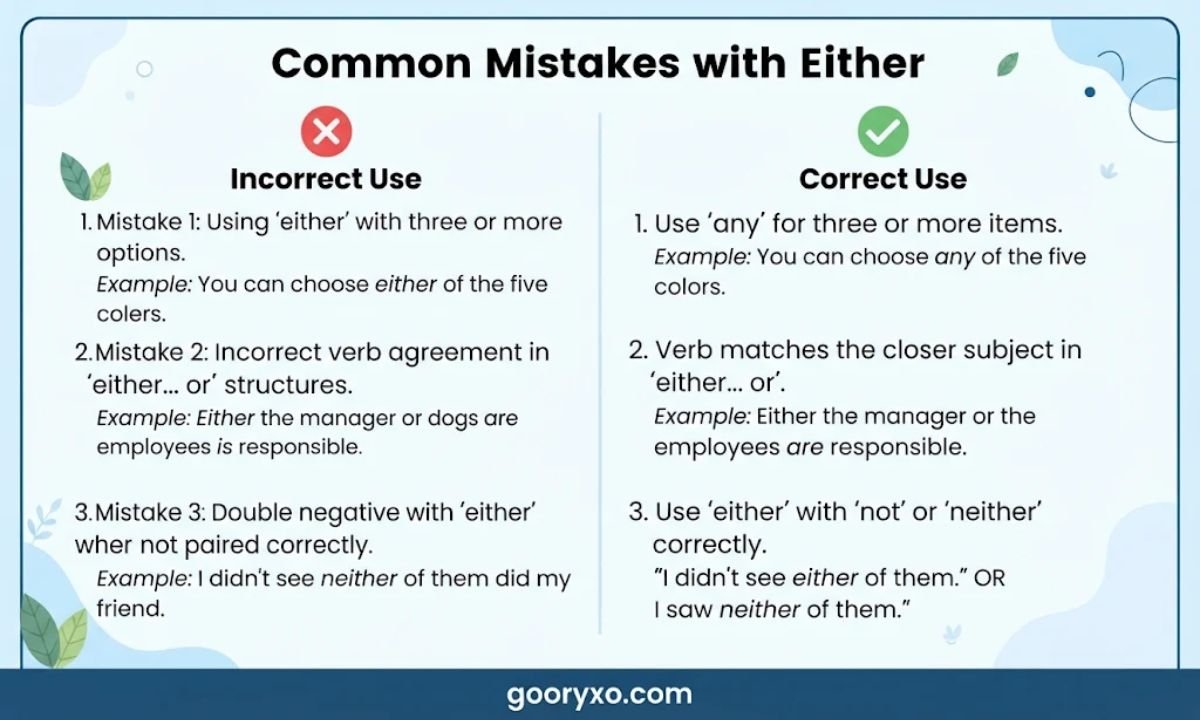
Most errors around either or ither fall into three groups: spelling, counting, and mixing it up with neither. Each one is easy to fix.
Mistake 1: Spelling It as “Ither”
Writing ither instead of either is a spelling mistake that comes from spelling by ear. The fix is to put an E at the front.
- Wrong: Ither candidate would do a good job.
- Right: Either candidate would do a good job.
This either or ither slip happens most to people who say EYE-ther. If you proofread on screen, search your draft for “ither” and fix whatever turns up.
Related Misspellings: Eather, Eyether and Ether
Eather, eyether, and eether are all misspellings of either, while ether is a different word. These common spelling mistakes usually come from spelling by sound.
- eather: wrong
- eyether: wrong
- eether: wrong
- ether: a real word, but not the one you want
Ether is the old word for the upper air (from Greek aithēr), and it’s also a chemical. “The rumor vanished into the ether” is correct. “I’ll take either one” is the choice word.
Mistake 2: Misusing Either with More Than Two Options
Once either or ither is settled, the next trap is counting. Traditionally, either points to exactly two options. For three or more, use any, any one of, or simply list them.
- Stiff: Take either the bus, the train, or a taxi.
- Cleaner: Take the bus, the train, or a taxi.
- Cleaner still: Take any of the three.
That said, this isn’t a spelling error. Some dictionaries record the looser, informal use, so it’s really a style call. Formal writing like exams, contracts, and academic papers should stick to two.
Mistake 3: Confusing Either with Neither
Either means one or the other, while neither means not one and not the other. Swap them and your sentence says the opposite.
- Either exit is open.
- Neither exit is open.
The first lets you walk out, and the second tells you both doors are blocked. Neither already carries a negative, so don’t add another one. “I don’t have neither” is a double negative, while “She doesn’t want either” and “She wants neither” are both fine.
See Also Cankles or Kankles: Which Spelling Is Correct?
Either…Or: Grammar Rules (Subject-Verb Agreement)
In either…or sentences, the verb agrees with the subject closest to it. Grammar guides call this the proximity rule, which just means the nearest subject wins.
- Either the manager or the engineers are joining the call.
- Either the engineers or the manager is joining the call.
Three more rules are worth knowing:
- Used alone or with “of,” either is singular in formal writing: “Either of the options is acceptable.” You’ll hear “are” in casual speech.
- Keep the structure parallel by putting either right before the first option. Not “You can either pay online or by cheque,” but “You can pay either online or by cheque.”
- Short pairs don’t need a comma (“Either stay or go”). Long clauses can take one before “or.”
Either in Everyday Examples
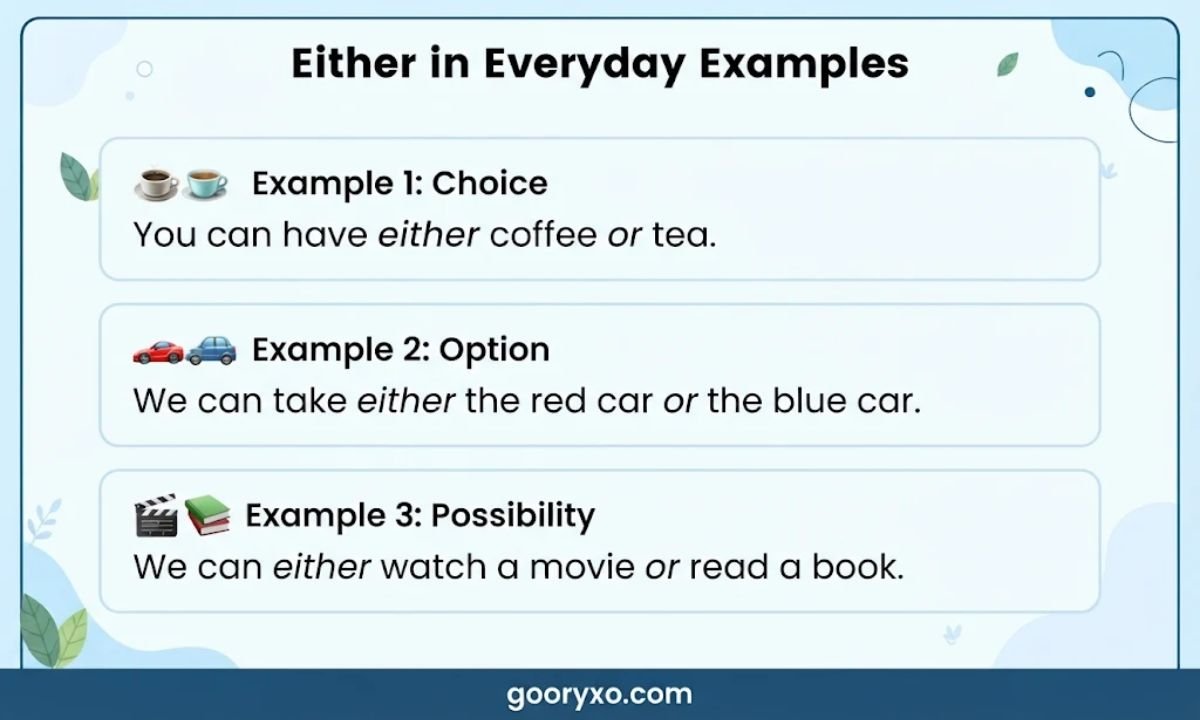
Either turns up in five everyday settings: casual chats, decisions, emails, negatives, and choices. If you’re ever unsure about either or ither, these sentences show the right pattern.
In Conversations
In conversation, either signals “I’m happy with both.” It’s short, friendly, and easy to say.
“Tea or coffee?” “Either is fine by me.” Or: “Which seat do you want?” “Either, honestly.”
Standing alone like that, either works as a pronoun, and it keeps the exchange moving.
In Decision Making
When two options weigh about the same, either keeps your sentence neutral while you decide.
- Either route adds about ten minutes, so let’s take the scenic one.
- Choosing either supplier means signing a two-year contract.
In Emails
Either keeps an email clear when you’re offering two choices or naming two contacts.
Try: “Please reply to either Priya or Daniel by Friday.” Or: “Does either time work for a quick call?”
Sorting out either or ither before you send saves you from this. A typo like ither in an opening line can make a careful email look rushed, so give it one last look before you hit send.
In Negative Statements
Put either at the end of a negative clause to mean “also not.” For example: “I haven’t read the report, and Daniel hasn’t either.”
Don’t use too in that spot. “I don’t like it too” sounds wrong, and “I don’t like it either” fixes it.
You’ll hear “me either” in casual speech, but “me neither” is the safer pick in writing.
In Choices
Either frames a choice between exactly two things. Paired with words like side or end, it can also mean both.
- You can have the soup or the salad, and either comes with bread.
- Security guards stood at either end of the hall.
The second sentence uses the same old “each of two” sense from the word’s origin.
Google Trends & Usage Data
Usage data points one way: either is everyday vocabulary, while ither is a rarity that mostly shows up as a typo or in Scots writing. Search engines and spell-checkers typically suggest either when you type ither.
You can check this yourself in a minute. Open Google Trends, compare “either” and “ither,” and expect the “either” line to dwarf the other. The either or ither comparison is a good test case.
For illustration, if either scores 100, a score of 1 for ither would mean it gets roughly one percent of the interest. We’re leaving exact numbers out on purpose, because Trends shows relative interest from 0 to 100, not raw search volume, and it shifts over time.
Try “ither” in the Google Books Ngram Viewer too, and note which kinds of books it appears in. Scots and dialect writing are what you’d expect to see.
Comparison Table: Either vs Ither
Either is standard English, while ither is a Scots word that reads as a typo in standard writing.
| Feature | Either | Ither |
| Language | Standard English | Scots (dialect) |
| Core meaning | One of two, each of two, or “also not” | “Other,” sometimes “either” |
| Word classes | Determiner, pronoun, adverb, conjunction | Mainly a determiner, meaning “other” |
| Pronunciation | EE-ther or EYE-ther | /ˈɪðər/ (short I) |
| Safe in formal writing | Yes | No, unless quoting Scots |
| Example | Take either road. | I saw him the ither day. |
| Spell-check result | Passes | Usually flagged |
If you only remember one row, make it “Safe in formal writing.” It settles the either or ither question for almost every email, essay, and report you’ll write.
Frequently Asked Questions
Is it either or ither?
It’s either. Ither isn’t correct in standard English, so use either in essays, emails, and everyday writing. For example, “Either option works for me.”
Is “ither” a real word?
Yes in Scots, where it means “other,” but no in standard English. If you searched either or ither hoping to find a hidden dictionary word, the Scots meaning is the answer. Think of “the ither day.”
Why do people spell either as ither?
Because the word sounds like it starts with a long I when said EYE-ther. The ei letters make that sound, so the correct spelling still starts with E. That’s why either or ither trips up so many writers.
How do you pronounce either?
Two ways are standard, and neither changes the either or ither spelling rule: EE-ther (/ˈiːðə/) and EYE-ther (/ˈaɪðə/). Both are accepted in the US and the UK, and the spelling never changes.
Can you use either with more than two options?
In formal writing, no. Use any or list the options instead. Casual English stretches the word sometimes, but “Choose any of the three” is the safer wording.
Is it “either is” or “either are”?
Use “is” in formal writing when either stands alone or comes before “of”: “Either of them is fine.” With either…or, match the verb to the nearer subject.
What’s the difference between either and neither?
Either means one of two, and neither means none of the two. “Either door opens” and “Neither door opens” mean opposite things.
Summary
Either is the spelling to use whenever you mean one of two options, and ither belongs to Scots. That’s the whole rule behind the either or ither question.
Remember that neither is just n + either, say the word however you like, and skip ither unless you’re writing Scots on purpose. Keep that in mind and either or ither won’t slow you down again.

My name is Ashfaq, and I am an English teacher with 5 years of teaching experience, specializing in English grammar. My mission is to make grammar easy to understand through simple explanations, practical examples, and helpful learning resources. At Gooryxo, I aim to help learners improve their grammar, strengthen their writing skills, and use English with confidence.

1 thought on “Either or Ither? Correct Spelling, Meaning & Examples”