
Jinks or jinx? Use jinx for bad luck, and keep jinks for the phrase high jinks. The two words sound the same, so the mix-up is easy to make.
This guide explains jinks or jinx in plain English. You’ll learn what each word means, where it came from, and how to pick the right one every time.
Jinks
Jinks is the plural of jink, and it’s also the second half of the phrase high jinks. It’s a real word, but it isn’t the right pick when the choice is jinks or jinx for bad luck.
As a plural noun, it means quick dodges. As a verb, it’s the form you use with he, she or it.
The winger’s quick jinks left two defenders behind.
Jinx
Jinx is the correct spelling for bad luck, and for the act of causing it. In the jinks or jinx debate, this is the word that wins.
We were top of the table until I jinxed it by talking about the trophy.
As a noun, a jinx is a person, object or streak that seems to bring trouble. As a verb, to jinx something is to bring it bad luck, often by speaking too soon.
Dictionaries such as Merriam-Webster and the Oxford English Dictionary list jinx as a standard noun and verb. Its forms are jinxes, jinxed and jinxing.
Jinks or Jinx: Quick Answer

Write jinx when you mean bad luck, a curse, or tempting fate. Write jinks only in the phrase high jinks, or when you mean the plural of jink (a quick dodge).
That’s the whole answer to jinks or jinx. The rest of this guide explains why, so you never have to second-guess it again.
Please don’t jinx the exam by saying it’ll be easy.
Quick Examples
Here is the jinks or jinx choice in four common situations.
| You mean | Write | Sample sentence |
| Bad luck or a curse | jinx | That old scarf has become a jinx at every match. |
| Tempting fate | jinx (verb) | Don’t jinx the launch. |
| Noisy, playful fun | high jinks | The class trip was full of high jinks. |
| Quick dodges | jinks (plural of jink) | Her jinks down the wing split the defence. |
The Origin of Jinks or Jinx
The word jinx first appeared in American print in the early 1900s. High jinks is much older, so the two sides of jinks or jinx have different histories.
By 1910, sportswriters were already blaming a losing streak on a jinx.
The best-known spark is a stage character. In 1887, a musical comedy called Little Puck introduced Jinks Hoodoo, a man described as a curse to everyone around him, himself included. Newspapers soon borrowed the name.
Worldwide Words suggests a second character helped: Captain Jinks, a famous stage buffoon. People seem to have blended the two names into one unlucky figure.
The early spelling wasn’t fixed. Researchers on the American Dialect Society list (ADS-L) found “put a jinks on” in print from 1904. That suggests jinks came first and jinx settled in later.
You may also read that jinx comes from the Greek iynx, a wryneck bird used in ancient love spells. It’s a fun story, but it isn’t proven. The written record points to American newspapers, so treat the bird as a possible influence only.
Where does jinks come from?
Jinks, in the sense of fun and games, comes from high jinks. That phrase began as a Scottish drinking game in the 1600s, where a dice roll decided who had to drink as a penalty.
Over time, the phrase came to mean noisy mischief and merrymaking. Merriam-Webster points out that high jinks can’t come from jinx, because jinx appeared in print long after high jinks was established.
The reunion turned into an evening of high jinks with the old team.
What Does “Jink” Mean?
To jink is to dodge or swerve suddenly. The plural noun and the he/she/it verb form are both spelled jinks, so the word has a real life outside high jinks.
He jinks inside, slips the tackle and shoots.
You’ll hear it mostly in British sports commentary. In American English, the word juke is much more common.
British English vs American English Spelling
Jinx is spelled the same in British and American English. The only small difference is hijinks, a one-word spelling you often see in American writing.
So if you’ve wondered whether jinks or jinx is the British one, the answer is neither.
Whether it’s a pub in Manchester or a dugout in Chicago, the superstition is still a jinx.
Comparison Table
Nothing changes between UK and US spelling, except the optional one-word hijinks.
| Word | British English | American English | Notes |
| jinx | Standard | Standard | Bad luck, or to bring it |
| jinxed | Standard | Standard | Past tense or adjective |
| high jinks | Standard | Standard | Noisy, playful fun |
| hijinks | Seen, but less common | Common, informal | One-word form of high jinks |
Examples
British and American writers use these words in the same way. Only the setting changes.
British
- Don’t jinx the cup final.
- The sixth-form high jinks ended with a call to the head teacher.
American
- Don’t jinx the playoffs.
- The movie is packed with dorm-room hijinks.
Hijinks vs High Jinks
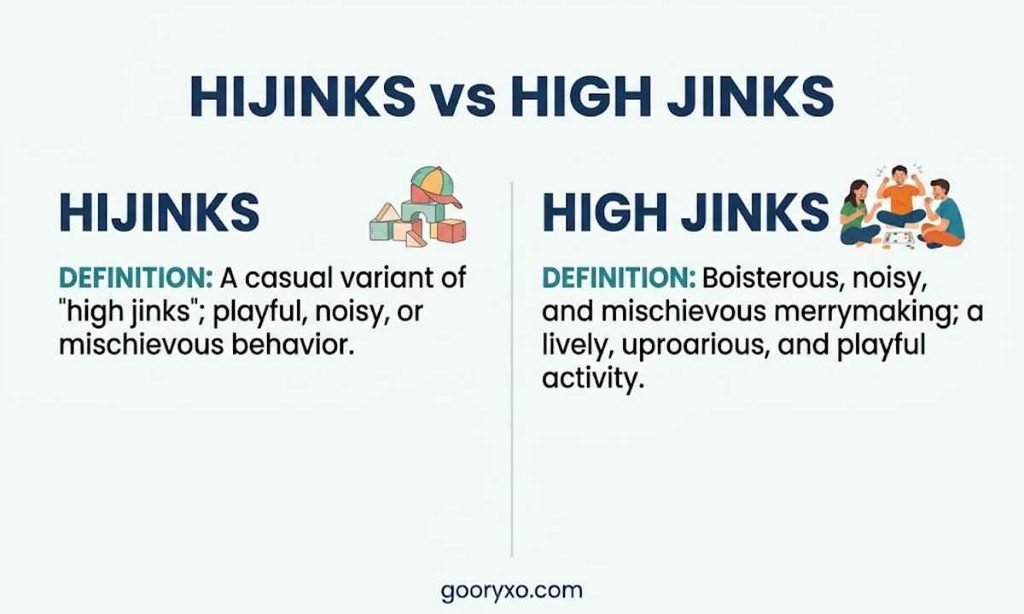
Both are correct. High jinks is the traditional two-word form, and hijinks is the one-word version that’s common in American writing.
You may also see high jinx. Some dictionaries list it, but most editors prefer jinks. Pick one form and use it the same way all through your writing.
The sitcom runs on office hijinks and awkward elevator rides.
Which Spelling Should You Use?
When you’re stuck on jinks or jinx, ask yourself if the sentence is about luck. If it is, write jinx. If it’s about noisy fun, write high jinks.
Try this swap test. Put the word hex in its place. If the sentence still makes sense, you need jinx. Try mischief instead. If that fits, you need jinks.
“Don’t ___ it” works with hex, so the answer is jinx.
Read Also Occurring or Occuring: Correct Spelling, Meaning & Examples
If you’re talking about bad luck
Use jinx for the noun, the verb and the adjective jinxed. It belongs to the same family as hex, curse, hoodoo and Jonah.
- That building seems jinxed.
- I hope I haven’t jinxed the weather.
- Our team has a jinx on Tuesday games.
If you’re writing the expression high jinks
Use jinks, but only inside the phrase high jinks (or hijinks). It usually takes a plural verb, as in “the high jinks were harmless.”
The comedy follows a group of roommates and their college high jinks.
Practical Advice
For jinks or jinx, trust the meaning, not the sound. Because the two words are homophones (words that sound the same but are spelled differently), your ear can’t help you.
- Texting: stop on “don’t ___ it.” It’s always jinx.
- Work emails: keep jinx light and friendly.
- School essays: pair jinx with a clear noun like superstition.
- Captions and headlines: check the spelling once more before you post.
Spell checkers usually stay quiet about jinks, because it’s a real word.
Spellcheck won’t flag “Don’t jinks it,” but the right version is “Don’t jinx it.”
Memory Trick
Here’s an easy way to remember jinks or jinx. The x in jinx is the cross you put through a plan that’s gone wrong. The k in jinks is for kicks, as in doing something for kicks.
We didn’t hurt anyone. It was just high jinks for kicks.
Common Mistakes with Jinks and Jinx

Most jinks or jinx errors fall into three groups: the wrong spelling, the wrong verb form, and the wrong plural. Here’s a quick fix for each.
- “Don’t jinks it” should be “Don’t jinx it.”
- “She jinksed the match” should be “She jinxed the match.”
- “Two jinxs this season” should be “Two jinxes this season.”
- “A weekend of jinx” should be “A weekend of high jinks.”
- “That car’s a real jinks” should be “That car’s a real jinx.”
I think I jinxed it. I didn’t “jinksed” it.
Why does this mistake happen?
Mostly because jinks is a real word, so nothing turns red on your screen. The two words also sound exactly the same, and the s on jinks looks like a normal plural or verb ending.
Many people also hear the phrase high jinks and assume that one spelling covers every meaning. It doesn’t.
If you type “Fingers crossed, don’t jinks it,” your editor stays quiet, even though it should be jinx.
Jinks or Jinx in Everyday Examples
Jinx fits anywhere superstition shows up, and jinks lives almost only in the phrase high jinks. These jinks or jinx examples show both in real situations.
Professional email
In a work email, jinx works best in friendly, low-stakes lines.
Let’s hold off on celebrating until the contract is signed. I’d hate to jinx it.
News headline
Headlines like jinx because it’s short and punchy.
Will Home-Crowd Nerves Jinx the Final?
Social media post
On social media, jinx often comes with a hashtag, and it’s still spelled jinx.
Three wins in a row and I’m saying nothing. No jinx here. #superstition
Formal writing
Formal writing can use jinx when it’s paired with a clear word like superstition or belief.
Many players avoid talking about results in advance, because of a superstition that it might jinx the outcome.
Everyday conversation
In speech, jinx is quick and casual, so spelling only matters when you text it.
“Think we’ll finish early?” “Don’t jinx it.”
Using high jinks
Use high jinks for lighthearted mischief. Avoid it for anything that causes real harm, because the phrase makes things sound playful.
The campers’ high jinks included a water-balloon ambush and one very confused counselor.
The Childhood Game of Jinx
Jinx is also a playground game. When two people say the same words at the same time, the first one to shout “jinx” wins.
The other person usually has to stay silent until someone says their name, or they owe the winner a soda.
“We said that together. Jinx! You owe me a soda.”
Jinx in Pop Culture
Jinx and Jinks are both used as names, which is one reason the spellings blur. The cartoon cat in Pixie and Dixie and Mr. Jinks, part of The Huckleberry Hound Show, is spelled Jinks.
Other famous Jinxes include radio host Jinx Falkenburg and the character Jinx in the Bond film Die Another Day. Pokémon has Jynx, and Arcane fans know Jinx from League of Legends.
The cartoon cat is Mr. Jinks, but the Arcane fan favorite is Jinx.
Read Also Occurring or Occuring: Correct Spelling, Meaning & Examples
Jinks or Jinx: Google Trends & Usage Data
People search jinks or jinx when they want a fast spelling check, usually in the middle of writing. The search intent is informational, and they want an answer in seconds.
Exact search numbers change every month, so this guide doesn’t list any. To see the live trend, compare “jinx” and “high jinks” in Google Trends, or check long-term usage in the Google Books Ngram Viewer.
A typical search: jinks or jinx spelling.
Where is this topic popular?
Searches for jinks or jinx tend to come from English-speaking countries, such as the US, UK, Canada, Australia and India. It also shows up wherever people learn English as a second language.
Someone in Toronto types “jinx or jinks” into a search bar before sending a text.
Who searches for it?
Students, teachers, English learners, bloggers, editors and social media managers are the most likely searchers. All of them need the right spelling quickly.
A social media manager writes “Don’t jinx the launch” and wants to double-check it.
Why is it still searched?
Jinks or jinx is one of the commonly confused words that spell check can’t solve. The phrase high jinks keeps the confusion alive for each new writer.
Seeing “high jinks” in a novel can make “don’t jinks it” look correct.
Jinks vs. Jinx Comparison Table
Jinx is about luck, jinks is about dodges, and high jinks is about fun. Use this jinks or jinx table as a quick reference.
| Word | Part of speech | Meaning | Example |
| jinx | Noun, verb | Bad luck, or to bring it | Don’t jinx it. |
| jinxed | Adjective, past tense | Affected by bad luck | The trip felt jinxed. |
| jinks | Plural noun, verb form | Quick dodges (from jink) | His jinks beat the defender. |
| jink | Noun, verb | A quick dodge, or to dodge | She jinked left. |
| high jinks | Noun (phrase) | Noisy, playful mischief | The party was full of high jinks. |
| hijinks | Noun (variant) | One-word form of high jinks | Office hijinks fill the show. |
Pronunciation
Jinx and jinks sound exactly the same, and both are pronounced /dʒɪŋks/. That’s why the jinks or jinx mix-up happens in writing, not in speech.
Jinx
Jinx rhymes with minx and sphinx. It sounds the same in the UK and the US.
Say it out loud: “Don’t jinx it.”
High jinks
High jinks is pronounced /ˌhaɪ ˈdʒɪŋks/, with the stress usually on “high.” The one-word hijinks is /ˈhaɪˌdʒɪŋks/.
The weekend was nothing but high jinks.
Frequently Asked Questions
Is it jinks or jinx?
Jinx is correct for bad luck, curses and tempting fate. Jinks is only right in the phrase high jinks, or as the plural of jink.
Is jinks a real word?
Yes. Jinks is the plural of jink, the he/she/it verb form, and the second half of high jinks. It just isn’t a spelling of jinx.
What does jinx mean?
A jinx is something believed to bring bad luck, and to jinx something is to cause that bad luck. The word became popular in early 1900s America.
Is “high jinks” the same as “hijinks”?
Yes. Hijinks is the one-word version, and it’s common in American writing. Both mean noisy, playful mischief.
Where does the word jinx come from?
It most likely grew out of early 1900s American newspapers. Jinks Hoodoo from Little Puck and Captain Jinks are the strongest candidates, while the Greek iynx is a popular but unproven link.
Is there a British spelling of jinx?
No. British and American English both spell it jinx.
Which is right, jinks or jinx, in “don’t ___ it”?
Jinx. When it’s jinks or jinx in that phrase, “Don’t jinx it” is the standard wording in every kind of English.
Summary
Jinks or jinx comes down to meaning. Write jinx for bad luck, curses and tempting fate, and write jinks only in high jinks (or hijinks) or as the plural of jink.
Because the two words sound the same, your ear won’t help, and spell check usually won’t either. Use the swap test, remember the x and the k, and you’ll get jinks or jinx right every time. Even a quick “don’t jinx it” looks better when it’s spelled correctly.

My name is Ashfaq, and I am an English teacher with 5 years of teaching experience, specializing in English grammar. My mission is to make grammar easy to understand through simple explanations, practical examples, and helpful learning resources. At Gooryxo, I aim to help learners improve their grammar, strengthen their writing skills, and use English with confidence.

1 thought on “Jinks or Jinx: Which Is Correct? (Meaning, Origin & Examples)”