
Pre vs post is a timing question: pre- means before an event, and post- means after it. Once that one idea clicks, words like preheat, postpone, and post-test stop feeling like guesswork.
This guide covers where the two prefixes come from, how to pick the right one, and the exceptions most articles get wrong. You’ll also see how pre vs post plays out in medicine, research, money, and everyday writing.
Pre vs Post: Quick Answer
In the pre vs post question, pre- means before, and post- means after. Both attach to the front of a word to show when something happens compared with a main event.
| Prefix | Means | Example word | Plain English |
| Pre- | before | pre-match | before the match |
| Post- | after | post-match | after the match |
The coach gave a short talk in the pre-match huddle and a longer one in the post-match review.
Understanding What “Pre” and “Post” Mean
Pre- marks something that comes before a main event, and post- marks something that comes after it. Each one is a prefix, a small word part added to the start of another word to change its meaning.
Picture a timeline with one event in the middle, such as a launch, a surgery, or a test. Everything on the left of that event gets pre-. Everything on the right gets post-. That picture is the heart of pre vs post.
A pre-inspection happens before a house changes hands, and a post-inspection report is written once the work is finished.
The Origins of “Pre” and “Post”

The pre vs post pair comes straight from Latin. Pre- comes from prae, meaning “before” or “in front of,” and post- comes from post, meaning “after” or “behind.”
The word postscript comes from Latin words meaning “written after,” which is why a P.S. sits at the bottom of a letter. In the same way, predict literally means “say beforehand.”
Latin also had a close cousin of prae called ante. You see it every day in a.m. and p.m., which stand for ante meridiem (before midday) and post meridiem (after midday). That’s a built-in pre vs post pair on every clock.
Many English words with these prefixes came in through Latin and French. Medicine and law kept them in daily use, which is why you meet them so often in hospital notes and legal papers.
How “Pre” Functions in English
On the pre vs post timeline, pre- is the early side. It signals that something happens ahead of a main event, often as preparation for it. It almost always attaches directly to the base word.
Pre-launch work covers everything that happens before a product goes on sale.
When to Use Pre-
Use pre- when you mean “before.” Four situations come up most often:
- Preparation for something: preheat, prepay.
- A time long before now: prehistoric, pre-dawn.
- Something that has to come first: prerequisite.
- The stretch before a named event: pre-wedding, pre-exam.
She did her pre-exam revision at the library, and she finished the night before.
Common Word Formations with Pre-
These pre- words show up again and again. Knowing what each one literally means makes new ones easier to guess.
| Word | What it means |
| Preview | A look at something before it’s released |
| Prefix | A word part “fixed” on before the main word |
| Precaution | A step taken ahead of time to avoid harm |
| Preschool | Education before formal school begins |
| Prerequisite | Something required before you can move on |
| Prehistoric | From the time before written records |
The word prefix is itself built with a prefix: pre- plus fix, “attach before.”
Quick Rule of Thumb
Swap pre- for “before the.” If the phrase still makes sense, pre- is the right choice in any pre vs post decision.
Take pre-match nerves. It becomes “nerves before the match,” and that reads naturally, so the prefix fits.
Read Also Quizes or Quizzes? Correct Plural, Spelling Rule & Examples
How “Post” Functions in English
On the pre vs post timeline, post- is the late side. It flips the direction and marks what comes after a main event has already happened.
Post-match interviews are the ones that happen once the final whistle blows.
When to Use Post-
Use post- when you mean “after.” These are the most common cases:
- Effects that follow an event: post-traumatic, post-storm cleanup.
- A period after something big: post-war, post-pandemic.
- A time after harvest or a season: post-harvest, postseason.
- Study after a degree: postgraduate, postdoctoral.
The farm sold its crop at a good price during the post-harvest rush.
Common Word Formations with Post-
Here are some post- words you’ll see in news, school, and medical writing.
| Word | What it means |
| Postpone | To move something to a later time |
| Postscript | A note added after the main message |
| Postgraduate | Study done after a first degree |
| Postnatal | After a baby is born |
| Postseason | Games played after the regular season |
| Postdate | To put a date on something that’s later than the real one |
A postdated cheque carries a date in the future, so the bank shouldn’t cash it before then.
Quick Rule of Thumb
Swap post- for “after the.” If the phrase still reads well, post- is correct.
Post-game analysis turns into “analysis after the game,” which is exactly what the phrase means.
Pre vs Post: A Clear Comparison
In a pre vs post comparison, pre- points to before an event, and post- points to after it. The base word stays the same, but the timeline runs in opposite directions.
| Prefix | Meaning | Sample word | What it tells you |
| Pre- | before | pre-test | A test given before teaching starts |
| Post- | after | post-test | A test given once teaching ends |
| Pre- | before | prenatal | Care before a baby is born |
| Post- | after | postnatal | Care after a baby is born |
| Pre- | before | pre-season | Training before competition begins |
| Post- | after | post-season | Games after the regular season ends |
Same stem, opposite meaning: pre-war prices describe life before the conflict, and post-war prices describe life after it.
Side-by-Side Examples
Every pre vs post pair works the same way: flip one prefix and the whole timeline flips with it. Here are a few pairs you’ll run into often.
Pre-exam stress peaks the night before, while post-exam relief usually arrives about ten minutes after the last answer.
- Pre-game and post-game
- Pre-lunch and post-lunch
- Pre-launch and post-launch
- Pre-merger and post-merger
Pre vs Post vs During
Pre vs post covers the time before and after an event. For the part in the middle, English uses the word “during” or a different prefix.
Think of a product launch. Pre-launch checks happen first, launch day happens in the middle, and post-launch review comes last.
| Stage | Example phrase | Timing |
| Pre | pre-launch checks | before the product goes live |
| During | launch day | while it’s happening |
| Post | post-launch review | after it’s live |
Writers sometimes grab pre- or post- when the real idea is “during.” If something happens in real time, neither prefix fits, and you’ll need a different word.
Mid-, Intra- and Peri-: The Real “During” Prefixes
English does have prefixes for the middle: mid- means “in the middle of,” intra- means “within,” and peri- means “around.” Medicine uses the last two all the time.
Intraoperative means during surgery, while perioperative covers the whole stretch around it: before, during, and after. So perioperative care includes pre-operative and post-operative care together, which makes it the whole pre vs post story in one word.
The anaesthetist tracked her intraoperative blood pressure, and the team handled her perioperative notes in one chart.
Where the Difference Really Matters
In some fields, timing changes the facts. Medicine, education, business, and research all depend on pre vs post labels being right.
A chart that says post-operative when it should say pre-operative can send the wrong instructions to the wrong team.
1. Medicine
Hospitals keep pre-operative and post-operative instructions apart because the two stages need different care. Before surgery that usually means things like fasting rules, consent forms, and tests, and after surgery it means pain relief, wound care, and movement. Getting pre vs post right here protects patients.
The nurse reviewed the pre-operative fasting rules, then handed over the post-operative medicine schedule.
2. Education
Teachers give a pre-test to see what students know before a lesson, and a post-test to measure what they learned afterward. The gap between the two shows how much progress was made, and a pre vs post comparison is the simplest way to show it.
If the pre-test average was 52% and the post-test average was 74%, the class gained 22 points.
3. Business and Marketing
Marketing teams plan pre-launch and post-launch work as two separate phases. Before launch they build interest, and after launch they track results and handle support. Splitting pre vs post work keeps goals and budgets clear for each phase.
Teasers and waitlists belong to pre-launch, while reviews and customer questions belong to post-launch.
4. Research and Data Analysis
Researchers measure something before and after an intervention to see whether it made a difference. Textbooks call the simplest version a one-group pretest-posttest design: the outcome is measured twice, once before and once after a group receives the treatment.
The catch is that other events can change results between the two measurements. That’s why a pre vs post gap is a useful clue, not proof, unless the study also has a comparison group.
A stress survey given as a pre-intervention check and again as a post-intervention check shows change, but it can’t say what caused it on its own.
Pre vs Post in Money, Health and Sports
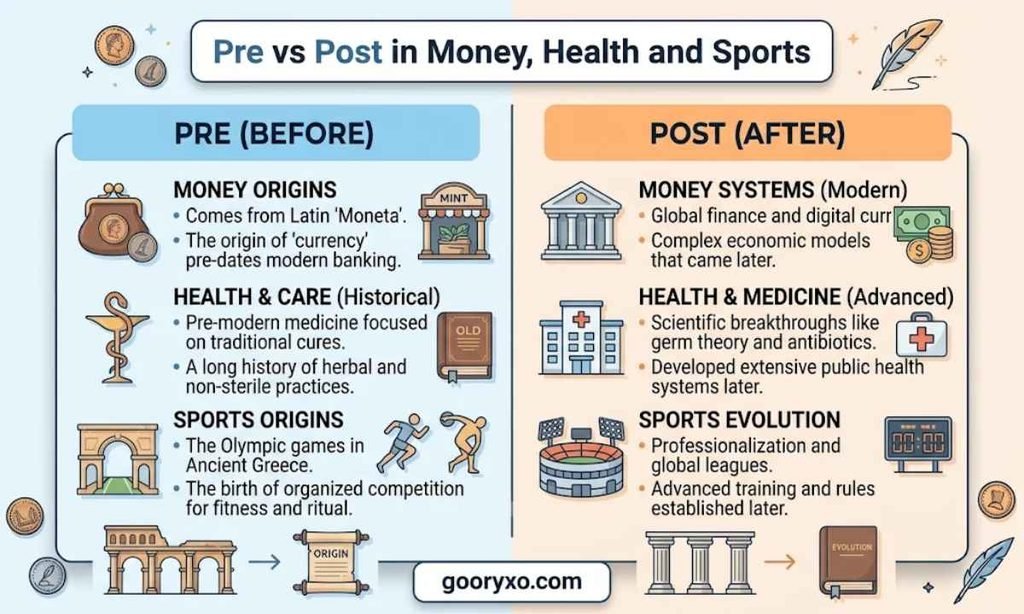
Beyond grammar, pre vs post labels appear in tax, investing, pregnancy care, and sport. Each one means before or after a specific moment.
In money, pre-tax income is what you earn before taxes come out, and post-tax income is what’s left. Startups use the same idea: pre-money valuation is a company’s value before new investment, and post-money valuation adds the new money on top.
A company worth $8 million pre-money that raises $2 million has a $10 million post-money valuation.
Stock exchanges also run sessions before and after regular hours, often called pre-market and post-market (or after-hours) trading.
In health, prenatal means before birth and postnatal means after birth. Preprandial means before a meal and postprandial means after one, which is why blood sugar tests sometimes use both words.
In sport, the pre-season is the training period before competition starts, and the post-season is the playoff stage after the regular schedule ends. Each of these follows the same pre vs post logic: a fixed moment, with the before and the after named around it.
Avoiding Common Mistakes with Pre and Post

Three mistakes cause most pre vs post errors: treating the two prefixes as interchangeable, adding them when they aren’t needed, and mixing them up with similar-sounding words.
Most of these slips happen when you’re writing fast, so a quick reread of the timing usually catches them.
Mistake 1: Using Pre and Post Interchangeably
In any pre vs post choice, the prefixes are opposites, so swapping them reverses your meaning. They aren’t two spellings of the same idea.
Wrong: Post-payment is due before delivery. Right: Pre-payment is due before delivery. The first sentence contradicts itself, because you can’t pay after something and before it at the same time.
Mistake 2: Adding Them When Not Needed
If a sentence already says when something happens, the prefix repeats the point. That’s a small redundancy, but it makes writing feel padded.
Take “pre-book your ticket in advance.” Either write “book your ticket in advance” or “pre-book your ticket,” but not both.
Read Also Quizes or Quizzes? Correct Plural, Spelling Rule & Examples
Mistake 3: Confusing Meaning Because of Similar Sound
Some words sound alike but start with different prefixes, so the timing idea gets lost. The best-known pair is precede and proceed.
When you aren’t sure, say what you mean in plain words first, then pick the spelling that matches.
Pre- vs Pro-: Why Precede and Proceed Differ
Precede means to come before something, and proceed means to go forward or continue. The first starts with pre- (before), and the second starts with pro- (forward).
Speeches precede the meal, and once they end, guests proceed to the buffet.
The same split shows up in related nouns. A precedent is something that came before, and a procedure is the way you proceed.
Does “Post” Always Mean After?
As a prefix, yes: post- always means after. The confusion comes from the standalone word “post,” which has other meanings, like a fence post, a job, a letter, or something you share online.
A post-race photo was posted online by the evening. The first word is a prefix about timing, and the second is a verb about sharing.
Even postpone isn’t built from the everyday word “post.” It comes from a Latin verb meaning “to place after.”
Words That Only Take Pre- or Only Take Post- (Exceptions)
Not every pre vs post pair is complete. Some words exist in only one form, and the “opposite” either doesn’t exist or means something else.
| Only with pre- | Why there’s no mirror word |
| Prequel | The opposite of a prequel is a sequel, not a “postquel” |
| Precocious | Describes developing early, with no “postcocious” partner |
| Prefatory | Relates to a preface, which comes first by nature |
| Only with post- | Why there’s no mirror word |
| Postscript | A note “written after,” with no “prescript” in common use |
| Posthumous | Happening after death, with no standard “prehumous” |
| Postpone | See the note on “prepone” below |
A common mistake is to treat words like “preemie” as pre- words. It’s a nickname cut down from “premature,” not a new pre- plus a root.
Postpone is the most interesting case. Many people use prepone as its opposite, as in “The seminar was preponed to 9 a.m.” Merriam-Webster describes it as an Indian English word that means “to move to an earlier time,” and dictionary.com labels it Indian English too.
Outside that region, writers in the US and UK usually say “bring forward” or “move up.” If your readers are international, those are the safer choices. Oddly, prepone existed in the 1500s with a different meaning, “to place in front of.”
Premortem vs Postmortem
A postmortem looks back at a project after it ends, and a premortem imagines failure before it starts. Researcher Gary Klein described the premortem in a September 2007 article in the Harvard Business Review, titled “Performing a Project Premortem.”
In a premortem, the team pictures the project as already failed and lists what went wrong. In a postmortem, the team reviews what actually happened.
So postmortem isn’t a one-sided word after all. It has a real pre- partner, and project teams use both, which makes it a neat pre vs post pair in project work.
Practical Tips to Improve Prefix Usage
Five small habits make choosing between pre vs post almost automatic: translate the prefix, split the word, test the sentence, draw a timeline, and learn from real examples.
Try them on a tricky word like post-trial and see how fast the meaning clicks.
1. Translate the Prefix
Say “before” for pre- and “after” for post- every time you meet a new word. The meaning usually appears on its own.
When you see postnatal in a leaflet, translate it: “after birth.” That’s all you need.
2. Break Down the Word
Split the word into a prefix and a root, then read each part. It works even on long words.
Postdoctoral is post + doctoral, so it means “after a doctorate,” and prenuptial is pre + nuptial, so it means “before the wedding.”
3. Use the Before/After Test
Put “before the” or “after the” into the whole sentence, not just the word. If the sentence turns strange, you’ve found a mistake. It’s the quickest pre vs post proofreading check.
Take “Pre-season training starts in July.” Read it as “training before the season starts in July,” and it makes sense.
4. Think in Terms of Timelines
Draw a short line, mark the main event, and place each word on the correct side. This helps most when one sentence has several time words.
For a school exam, put pre-exam revision on the left, exam day in the middle, and post-exam results on the right.
5. Learn Through Real-World Examples
Pairs stick faster when you meet them in context. Notice them in news stories, medical leaflets, and school tests, and keep a short list of the ones you see.
You’ll spot pre-registration forms and post-event surveys within a week of looking.
Hyphenation & Spelling Rules for Pre- and Post-
Most pre- and post- words are written closed, with no hyphen: prepay, postpone, postgraduate. Hyphens show up only in specific cases, so the pre vs post spelling rules stay short.
Most style guides, including The Chicago Manual of Style, follow this pattern. Here are the main rules:
- Close up common words: prepay, postwar, preschool.
- Use a hyphen before a capital letter or a number: post-Cold War, pre-1990, post-2020.
- Use a hyphen when two vowels meet awkwardly and make the word hard to read, as in pre-eminent or pre-existing, though many dictionaries now list closed forms like preexisting.
- Use a suspended hyphen when two prefixes share one base word: pre- and post-intervention scores.
When you’re unsure, check a current dictionary. Hyphen habits change over time, and style guides don’t always agree.
Case Studies: Real Applications of Pre vs Post
Three real-world uses show why pre vs post labels matter: a project launch, a hospital checklist, and a research study. Each one depends on knowing exactly what came before and what came after.
Every case below uses the same idea you’ve been reading about, only at higher stakes.
Case Study 1: Marketing Launch Strategy
Project teams often pair a pre-launch step with a post-launch step. Before launch, they run a premortem, an idea Gary Klein described in the Harvard Business Review in 2007. After launch, they hold a postmortem.
In the premortem, the team imagines the launch has already failed and lists the reasons. After launch, the postmortem checks which of those risks really happened.
Pre-launch premortem: “The sign-up page crashes under heavy traffic.” Post-launch postmortem: “The page held, but support emails piled up.”
Case Study 2: Hospital Procedure
The World Health Organization published its Surgical Safety Checklist in 2008. It has 19 items grouped into three phases: Sign In (before anaesthesia), Time Out (before the first cut), and Sign Out (before the patient leaves the operating room).
Each phase has a clear timing label, which keeps the team from mixing up what belongs before surgery and what belongs after it.
A 2009 study across eight hospitals compared outcomes before and after the checklist was introduced. The reported figures showed deaths falling from 1.5% to 0.8% and complications falling from 11% to 7%. The study itself was a pre vs post comparison.
Time Out is the pause just before the incision, when the team confirms the patient, the procedure, and the site.
Case Study 3: Academic Research
In one study, researchers tested whether clay work as art therapy could reduce anxiety in 49 psychiatric inpatient volunteers. They measured anxiety before the clay sessions and again after them.
That’s a one-group pretest-posttest design. It’s a practical way to look for change, but it has limits, because events outside the study can also shift the results.
The pre-test anxiety scores were the baseline, and the post-test scores showed whether anything changed. Adding a comparison group would make the conclusion stronger.
Helpful Quotes on Language and Meaning
A few short, well-sourced lines show how one prefix, in the pre vs post pair, can change a whole method. Each of these comes from a named author or publisher.
On the premortem, Gary Klein wrote in the Harvard Business Review that it “operates on the assumption that the patient has died.” The word play is the point: flip post to pre and a review becomes a forecast.
Daniel Kahneman, in Thinking, Fast and Slow, wrote that “the main virtue of the premortem is that it legitimizes doubts.” A team can speak up about risks because the project hasn’t started yet.
On language itself, Merriam-Webster describes prepone as meaning “to move to an earlier time.” It’s a reminder that people keep inventing words to fill gaps in the pre vs post pattern.
The premortem and postmortem pair is the clearest example of a single prefix swap changing the whole purpose.
Quick Practice: Test Yourself
Test your pre vs post skills: fill in each blank with pre- or post-, or pick the right word, before you check the answers.
- The nurse reviewed the ___-operative checklist before surgery.
- Students sat a ___-test after the unit ended.
- Speeches ___ the meal. (precede / proceed)
- ___-tax income is what you earn before taxes come out.
- A ___-mortem imagines failure before a project starts.
- Which word means “during surgery”: preoperative, intraoperative, or postoperative?
Answers: 1) pre, 2) post, 3) precede, 4) pre, 5) pre, 6) intraoperative
Summary
Pre vs post comes down to timing: pre- means before an event, and post- means after it. Both come from Latin, and a quick “before the” or “after the” test settles most doubts.
Watch the exceptions, such as prequel, posthumous, and prepone, and use mid-, intra-, or peri- when the action happens during the event. Keep the hyphen rules in mind, and you’ll handle pre vs post with confidence.
Frequently Asked Questions
What does “pre” mean?
Pre- means before. It marks the early side of the pre vs post timeline: something that happens earlier than a main event or as preparation for it.
Pre-order means you reserve something before it goes on sale.
Does “post” mean before or after?
In any pre vs post pair, post- always means after when it’s a prefix. The standalone word “post” can mean a fence post, a job, or an online update, but those have nothing to do with timing.
Post-war years are the years after the war.
What is the difference between pre vs post in one sentence?
Pre- points to the time before an event, and post- points to the time after it. That single timing difference is the whole idea behind pre vs post.
Pre-surgery tests happen before the operation, and post-surgery checkups happen after it.
What is the opposite of postpone?
There’s no standard single-word opposite in US or UK English. People usually say “bring forward” or “move up.”
“Prepone” is widely used in Indian English to mean the same thing, and some dictionaries list it with that label. Example: the meeting was preponed to Monday.
What is the difference between pre, post and during?
In pre vs post vs during, pre- means before, post- means after, and “during” means while the event is happening. Some prefixes cover the middle, such as intra- (within) and peri- (around).
Intraoperative means during surgery.
Should pre- and post- have a hyphen?
Usually no. Most common words are closed, like prepay and postpone. Use a hyphen before a capital letter or number, such as post-2020 or pre-Renaissance.
Pre-1990 records are the ones from before 1990.
What do pre-test and post-test mean?
A pre-test is given before teaching or treatment, and a post-test is given after it. Comparing the two shows how much changed, which is the core of pre vs post measurement.
The pre-test score was 52, and the post-test score was 74.

My name is Ashfaq, and I am an English teacher with 5 years of teaching experience, specializing in English grammar. My mission is to make grammar easy to understand through simple explanations, practical examples, and helpful learning resources. At Gooryxo, I aim to help learners improve their grammar, strengthen their writing skills, and use English with confidence.

1 thought on “Pre vs Post: Meaning, Difference & Examples”