
Taught or tought? Taught is the correct spelling, and it’s the past tense of the verb teach. Tought looks like it should work, but in modern English it’s a typo.
This guide shows why taught wins, where “tought” really came from, and how it differs from thought and taut. You’ll also get memory tricks, sentence patterns, and a 14-question quiz.
Taught or Tought: The Quick Answer
Taught is the correct spelling. It’s both the simple past tense and the past participle of teach, so “tought” counts as a misspelling in standard English today.
The mistake makes sense, though. Words like thought, bought, and fought all end in a similar sound, so “tought” feels like it belongs in the group. It doesn’t.
Example: “My uncle taught me how to ride a bike.” You can’t swap in “tought” here, however natural it looks on screen.
Key facts at a glance:
- Correct spelling: taught (teach, taught, taught).
- Meaning: gave instruction, a skill, or a lesson.
- “Tought”: a typo today, and an old Middle English spelling of “taut.”
- Sound-alikes: taut (tight) and, in some accents, tort.
Taught vs Tought: Quick Comparison
Taught is a real, everyday word, while tought is a typo in modern writing. The table shows the main differences side by side.
| Point | Taught | Tought |
| Status in modern English | Correct | Misspelling |
| Base verb | Teach | None |
| Grammar job | Past tense and past participle | None |
| Safe for school and work | Yes | No |
| Where you may see it | Everywhere | Old texts, as an early spelling of “taut” |
Example: “She taught the class” is correct. “She tought the class” would get a red underline in any editor.
Featured Snippet Answer
Taught is the only correct spelling for the past tense and past participle of teach. It means someone gave instruction, skill, or knowledge to another person. Tought isn’t a word in modern English, so treat it as an error.
Example: “Last year, a neighbor taught me basic Spanish.” Both the meaning and the spelling are right.
What Does “Taught” Mean?
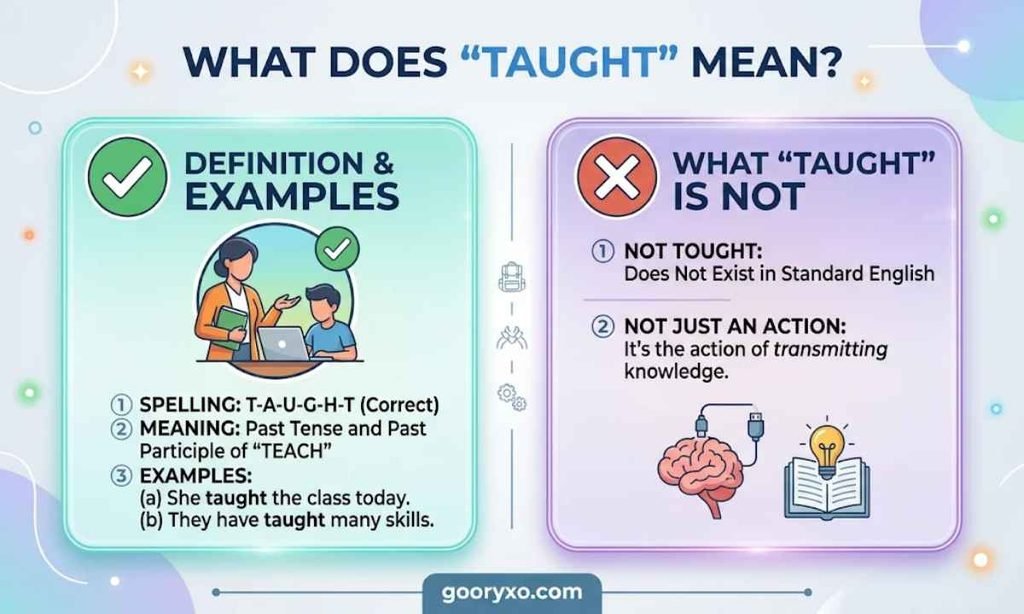
Example: “Her first boss taught her how to negotiate.” The boss gave her a skill, and the action is finished.
Taught means someone shared knowledge, a skill, or guidance with another person. It’s the past form of teach.
Teaching doesn’t need a classroom. Parents, coaches, friends, and even books can teach, and each time the past form is the same word. Because teach is an irregular verb, it skips the usual “-ed” ending. The full pattern is teach, taught, taught.
Taught as the Past Tense of Teach
Use taught when the teaching already happened and it’s over. It’s the simple past form, with no helper verb needed.
Pointing to a time in the past usually signals it: yesterday, last year, in 2019, when I was ten.
Example: “Our chemistry teacher taught that unit in March.” The unit is done, so the past tense fits.
A few more:
- My cousin taught me to swim at a public pool.
- The trainer taught three new stretches on Monday.
- That summer job taught her a lot about patience.
Taught as a Past Participle
Taught is also the past participle of teach, which means it follows helper verbs like have, has, had, and was. The spelling stays exactly the same.
Example: “He has taught chemistry for twelve years.” The word “has” pulls in the participle, and it’s still taught.
Here’s how the tense changes while the spelling stays put:
- Simple past: She taught art last term.
- Present perfect: She has taught art since 2020.
- Past perfect: She had taught art before moving abroad.
Taught Can Also Refer to Lessons Learned Through Experience
Yes, taught can describe a lesson learned from life, not only from a person. Events, mistakes, and places can all “teach” you something.
Writers use this meaning a lot in personal essays and speeches, because it’s about growth rather than formal study.
Example: “Missing that flight taught me to check my booking twice.” Nobody stood at a whiteboard, but the lesson is real.
More like it:
- Moving cities taught him to make friends quickly.
- A bad review taught the cafe owner to listen.
- Years of night shifts taught her to manage energy.
Where Does “Taught” Come From?
Taught comes from the Old English past form tǣhte, which belonged to the verb tǣcan, “to teach.” In Middle English it was spelled taught(e), and later it settled into the spelling we use now.
The odd “gh” is a leftover. It once stood for a throaty sound that English later dropped, but the spelling stayed. That’s why taught, thought, and caught look strange next to how they sound.
Example: Compare “light” and “night” with taught. All three keep a silent “gh” that tells you the word is old.
How Do You Pronounce “Taught”?
Taught is usually pronounced /tɔːt/ in British English. Many American speakers say it closer to /tɔt/ or /tɑt/, depending on their accent.
The “gh” is silent. The word rhymes with thought, bought, caught, and fought, and it sounds the same as “taut” for most speakers.
Example: Say these out loud: taught, thought, caught. If they all end the same way for you, you’re hearing why spelling mistakes happen.
Why Is “Tought” Incorrect?
“Tought” is incorrect because English never made it the past tense of teach. The standard form has been taught for centuries, and dictionaries list only that.
People type “tought” for a few reasons. It looks like thought or bought, it comes from a quick finger slip, or it’s a half-remembered mix of taught and thought.
Example: Compare “He tought me chess” with “He taught me chess.” Only the second one is correct English.
The “Thought” and “Taught” Confusion
Taught comes from teach, and thought comes from think. They sound almost alike, but they never mean the same thing.
Just ask which verb you’re using. If it’s about instruction, it’s taught. If it’s about ideas, opinions, or the mind, it’s thought.
Example: “I thought about it, then remembered what my coach taught me.” Both words show up, and each one is right for its own verb.
Some quick pairs:
- Think becomes thought: “I thought you’d left.”
- Teach becomes taught: “I taught the workshop.”
Taught vs Taut: Don’t Mix Up These Homophones
Taut is a different word that sounds the same as taught. It means pulled tight, with no slack.
Taught is a verb about teaching, while taut is an adjective about tension. A rope, a muscle, a nerve, or even a story can be taut.
Example: “The coach taught us to keep the rope taut.” Same sound twice, two different spellings and meanings.
Don’t confuse taut with taunt either. Taunt means to tease or mock someone, and it has an extra “n.”
Why English Learners Often Make This Mistake
English learners often write “tought” because teach and taught sound very different. The vowel changes from a long “ee” to an “aw” sound, and the spelling changes with it.
Regular verbs are easier, since walk becomes walked and the base word stays visible. Teach doesn’t work that way.
Example: A student writes “I teach English” correctly, then writes “Yesterday I tought English.” The sound jump felt unrelated to the spelling jump.
The fix isn’t guessing from sound. Learn the three forms as a set: teach, taught, taught.
Does “Tought” Ever Mean Something Else?
In modern standard English, no. But the history is more interesting than “it’s not a word.”
In Middle English, “tought” was one early spelling of the word we now write as taut, meaning stretched tight. You can still find it in very old texts, including a 1567 translation that uses it for a bowstring.
Example: A reader opens a 16th-century poem and sees “tought” next to a bowstring. It means tight, not taught.
For your own writing, the rule is simple. Use taught for teaching, thought for thinking, and taut for tight.
Taught or Tought: How to Remember the Correct Spelling

The easiest way to remember taught or tought is to learn teach, taught, taught as one pattern. Then use a small visual trick for the vowels.
Saying the pattern out loud helps. It takes about five seconds, and it works better than rereading a rule.
Example: “Today I teach, yesterday I taught, and I have taught for years.” Say it twice and the spelling sticks.
The Best Memory Trick: Teach Has “EA,” but Taught Has “AU”
Teach has the letters EA, and taught swaps them for AU. Notice the swap, and “tought” looks wrong right away.
Another way to see it: taught has an “a” in the middle, just like teach has an “a.” The letter “o” never appears before the “u.”
Example: Write tEAch and tAUght on a sticky note and circle the vowel pairs. Do it once, and you’ll spot the pattern for good.
Connect Taught With Other Common Irregular Verbs
Taught belongs to a small group of irregular verbs whose past forms end in a similar sound. Seeing the group helps you spot which spelling goes where.
Here’s a handy pattern. Teach and catch both contain the letter “a,” and both take -aught: taught and caught. Buy, bring, fight, seek, and think don’t have an “a,” and they take -ought: bought, brought, fought, sought, thought.
Example: “She caught the bus, bought a snack, and taught her class.” Two -aught words and one -ought word, all spelled correctly.
Ask Yourself: “What Is the Base Verb?”
When you’re stuck on taught or tought, find the base verb first. If the base verb is teach, the past form is taught. There’s no other choice.
This check is quick and works even when you’re tired or typing fast.
Example: In “My tutor ___ me algebra,” the base verb is teach. So the blank is taught.
How to Use “Taught” Correctly in Sentences
Taught fits into a few common sentence patterns, and you can reuse them again and again. Once you know the patterns, the word feels natural instead of memorized.
Example: “Our manager taught the new hires how the system works.” Subject, verb, people, topic. Simple and correct.
Using Taught With a Person
The most common pattern is someone + taught + someone + something. You can also say someone + taught + something + to + someone.
Both are correct. Pick the one that sounds smoother in your sentence.
Example: “My aunt taught me embroidery.” The other version reads: “My aunt taught embroidery to me.” The first is shorter and more natural.
Using Taught With “How to”
Use taught + person + how to + verb when the lesson is a skill or a set of steps. It fits tasks, crafts, and habits well.
Example: “His older brother taught him how to fix a flat tire.” The “how to” tells you the skill.
More like it:
- The chef taught the class how to knead dough.
- My dad taught me how to compare prices.
- She taught her roommate how to plan a monthly budget.
Using Taught in Passive Voice
In passive voice, the learner comes first, and the verb is was taught or were taught. The teacher can be left out or added with “by.”
Example: “We were taught to double-check every source.” Nobody is named as the teacher, and that’s fine.
More like it:
- The recruits were taught basic first aid.
- I was taught to read contracts slowly.
- She was taught by a former national coach.
Common Examples of Correct Usage
Here are everyday sentences that use taught well. Notice how many different settings it fits, from school to work to home.
- My high school teacher taught us how to outline an essay.
- The course taught thousands of beginners how to code.
- He taught himself guitar from online videos.
- Her grandmother taught her a lesson about honesty.
Example: Look at the third sentence. “Taught himself” works the same way, and it gives us the word “self-taught.”
Taught or Tought in 2025 to 2026: What Current Reference Data Shows
Current references, including Merriam-Webster, Cambridge Dictionary, and the Oxford English Dictionary, follow the same pattern. Taught is the past tense and past participle of teach, and tought appears only as an old spelling of taut.
The table below sums up what you’ll find when you look the words up.
| Check | What references show |
| Base verb | Teach |
| Simple past | Taught |
| Past participle | Taught |
| “Tought” as a modern spelling of teach’s past | Not listed |
| “Tought” in word histories | An early Middle English spelling of taut |
Example: Look up “taut” in a dictionary that shows word history, such as Merriam-Webster or Dictionary.com, and you’ll see “tought” listed among its older forms. That’s the only place it belongs.
Usage data points the same way. Google Books Ngram comparisons of the four spellings show taught, thought, and taut far ahead of tought. Spelling mistakes can spread online, but repetition doesn’t make them correct.
Why Reliable References Matter
Spellcheck helps with taught or tought, but it isn’t perfect. Your phone can learn your typos and stop marking them as wrong.
Example: You type “tought” three times in a text thread and tap “keep.” After that, your phone may stop underlining it.
A simple routine keeps you safe:
- Decide what you want to say.
- Find the base verb.
- Check whether it’s regular or irregular.
- Confirm the spelling in a trusted dictionary.
- Reread the sentence before you send it.
Real-Life Case Study: A Small Spelling Error in Professional Writing
A single slip between taught or tought in a bio line can cost trust, even when the rest of the page is strong. The scenario below is invented, but editors see versions of it all the time.
Imagine Hamza, a freelance designer, updating his portfolio. His bio says, “Hamza has tought design workshops in four cities.” The layout is polished and the projects are strong.
A friend reads the page before launch and spots the error. The fixed line says, “Hamza has taught design workshops in four cities.” The change takes ten seconds.
Example: Picture a client skimming the page for proof that Hamza can teach. The first thing they notice is the misspelled word, not the four cities.
Read Also Vagrant vs Hobo: Meaning, Differences & Legal History
What This Case Study Teaches
A taught or tought slip matters more in some places than others. The word sits right where readers decide whether to trust you.
Be extra careful in these spots:
- Resumes and portfolio bios
- Client proposals and pitch decks
- Academic papers and theses
- First emails to new contacts
- Published blog posts and website copy
Example: A typo in a casual chat with a friend costs nothing. The same typo in a job application can cost you an interview.
Common Mistakes to Avoid With Taught

Most errors around taught or tought and its verb fall into five groups, plus one extra. Learn them once and you’ll catch them in your own drafts.
Example: “Yesterday my coach teach us a new drill” uses the wrong tense. The fix is “Yesterday my coach taught us a new drill.”
Mistake 1: Writing “Tought” Instead of “Taught”
This is the core mistake. The wrong spelling replaces the “au” with “ou.”
Example: Wrong: “She tought me how to bake bread.” Right: “She taught me how to bake bread.”
Mistake 2: Using “Teach” When You Need the Past Tense
Teach is the present form. If the action is finished, you need taught.
Example: Wrong: “Last year, he teach a course on public speaking.” Right: “Last year, he taught a course on public speaking.”
Mistake 3: Using “Taught” When the Present Tense Is Needed
Taught only works for the past. For what’s happening now, use teach, teaches, or is teaching.
Note that a past habit is fine with taught: “Every Friday last year, she taught guitar.” The problem is when the time clue points to now.
Example: Wrong: “Right now, Mr. Khan taught the Grade 5 class.” Right: “Right now, Mr. Khan is teaching the Grade 5 class.”
Mistake 4: Confusing Taught With Thought
Thought belongs to thinking. Taught belongs to teaching.
Example: Wrong: “My mentor thought me to negotiate.” Right: “My mentor taught me to negotiate.”
Mistake 5: Forgetting the Past Participle Form
After have, has, or had, you need the participle taught, not teach.
Example: Wrong: “She has teach English abroad for years.” Right: “She has taught English abroad for years.”
“Teached” and Other Wrong Past Forms
“Teached” isn’t standard English. Teach is irregular, so the past form is taught, never “teached” or “taughted.”
Learners often add “-ed” because most verbs work that way. It’s a sensible guess, and it’s still wrong.
Example: Wrong: “He teached us the rules.” Right: “He taught us the rules.”
A Simple Checklist Before Using “Taught”
Run through five quick questions before you hit send, especially when taught or tought crosses your mind. If every answer is yes, taught is the right word.
- Is the base verb teach?
- Is the action in the past?
- Does the sentence involve giving instruction or a lesson?
- Is there a helper verb like has, had, was, or were?
- Have you spelled it t-a-u-g-h-t?
Example: “My uncle ___ me how to fix a bike.” Teach, past, instruction, no helper verb needed, and the spelling is t-a-u-g-h-t. Taught fits.
A Five-Second Grammar Test
Settle any taught or tought doubt by filling the blank, then naming the base verb and the time. That’s the whole test.
Example: “Last week, my coach ___ me a new technique.” Base verb: teach. Time: past. Answer: taught.
Taught vs Thought vs Bought vs Caught
These four words sound alike, but they come from four different verbs. The table shows the base verb and meaning for each, plus taut as a bonus.
| Word | Base word | Meaning |
| Taught | Teach | Gave instruction |
| Thought | Think | Had an idea |
| Bought | Buy | Purchased something |
| Caught | Catch | Grabbed or received |
| Taut | Adjective | Pulled tight |
Example: “She thought about it, bought a ticket, caught the train, and taught her class on time.” Each word does its own job.
The Meaning Test
Ask what the sentence is about. Teaching points to taught, thinking points to thought, buying points to bought, and catching points to caught.
Meaning should drive your choice, not sound.
Example: “He ___ her the guitar.” Nobody is buying, thinking, or catching here. The sentence is about instruction, so the answer is taught.
When Should You Use “Taught”?
Use taught whenever you need the past tense or past participle of teach. That covers finished actions, perfect tenses, passive sentences, and lessons from experience.
Example: “That one mistake taught me more than a whole semester.” The lesson came from experience, and the verb is still taught.
Read Also Vagrant vs Hobo: Meaning, Differences & Legal History
Use Taught for Completed Past Actions
Choose taught when the teaching is over and the time is in the past.
Example: “My professor taught that seminar for three semesters.”
- The trainer taught a full class yesterday.
- My parents taught me to ask questions.
Use Taught With Perfect Tenses
Choose taught after have, has, or had.
Example: “She has taught abroad for nearly a decade.”
- They have taught thousands of students.
- He had taught the material before changing schools.
Use Taught in Passive Sentences
Choose taught after was, were, or been when the learner is the subject.
Example: “I was taught to read carefully before signing anything.”
- We were taught the basics during week one.
- The recruits were taught by an experienced supervisor.
Use Taught for Lessons From Experience
Choose taught when an event or situation gave you a lesson.
Example: “That setback taught him to plan further ahead.”
- Traveling alone taught her independence.
- Years in customer service taught them patience.
Mini Quiz: Taught or Tought
Test yourself with 14 quick questions. Cover the answers first, then check.
Quiz 1: Pick the Correct Spelling
Which is correct? A. My teacher tought me English. B. My teacher taught me English.
Answer: B. Taught is the past tense of teach.
Quiz 2: Fill in the Blank
Yesterday, my father ______ me how to change a tire. A. teach B. taught C. tought D. teaching
Answer: B. The action is finished, so taught fits.
Quiz 3: Quick Choice
Which is the correct past tense of teach? A. Teached B. Tought C. Taught D. Teachen
Answer: C. The pattern is teach, taught, taught.
Quiz 4: Fill in the Blank
She has ______ dance for over ten years. A. teach B. tought C. taught D. teaching
Answer: C. After has, you need the past participle taught.
Quiz 5: Spot the Mistake
“Our mentor tought us a valuable lesson.”
Answer: “Tought” is wrong. The correct sentence is “Our mentor taught us a valuable lesson.”
Quiz 6: Choose the Right Sentence
A. I was tought how to swim. B. I was taught how to swim.
Answer: B. The passive form was taught is correct.
Quiz 7: Fill in the Blank
Last summer, my grandmother ______ me to bake from scratch. A. taught B. tought C. teach D. teaches
Answer: A. “Last summer” points to the past, so taught is the only fit.
Quiz 8: Taught or Thought?
I ______ about your offer before I decided. A. taught B. thought C. tought D. teach
Answer: B. Thought comes from think, not teach.
Quiz 9: Easy Grammar Check
Complete the pattern: Teach, ______, Taught. A. Tought B. Teached C. Taught D. Teaching
Answer: C. The full pattern is teach, taught, taught.
Quiz 10: Fill in the Blank
That hard year ______ me more than any class could. A. teach B. taught C. tought D. teaches
Answer: B. Experiences can teach, and the past form is taught.
Quiz 11: Find the Correct Word
Which word means “gave someone instruction”? A. Thought B. Bought C. Taught D. Taut
Answer: C. Taught comes from teach.
Quiz 12: Fill in the Blank
The recruits were ______ basic safety rules. A. teach B. tought C. taught D. teaches
Answer: C. After were, taught is the correct passive form.
Quiz 13: Which One Sounds Right?
A. She had tought the class before. B. She had taught the class before.
Answer: B. Taught is correct after had.
Quiz 14: Final Challenge: Fill in the Blank
“That failure has ______ me to plan ahead.” A. tought B. thought C. taught D. teach
Answer: C. The full sentence is “That failure has taught me to plan ahead.”
Summary
Taught or tought has one answer: taught. It’s the past tense and past participle of teach, and tought is a typo in modern English, though it once appeared as an early spelling of taut.
Keep the pattern in your head: teach, taught, taught. Remember that teach has EA while taught has AU, and check the base verb whenever you’re unsure.
Frequently Asked Questions
Is it taught or tought?
It’s taught. Taught is the correct past tense and past participle of teach, and “tought” is a misspelling in standard English.
Is “tought” a real word?
Not in modern English. “Tought” was an early Middle English spelling of the word now written taut, so you may meet it in old texts, but you shouldn’t use it today.
What’s the difference between taught and thought?
Taught comes from teach and is about instruction. Thought comes from think and is about ideas or opinions.
What’s the difference between taught and taut?
Taught is the past tense of teach. Taut is an adjective that means pulled tight. They sound alike but never share a meaning.
Can “taught” follow have, has, or had?
Yes. Taught is the past participle, so it works after have, has, had, was, and were.
Is “teached” correct?
No. Teach is irregular, so the correct past form is taught. “Teached” is nonstandard.
What’s the easiest way to remember the spelling?
For taught or tought, learn teach, taught, taught as one set, and notice that teach has EA while taught has AU. Saying “Today I teach, yesterday I taught” also helps.

My name is Ashfaq, and I am an English teacher with 5 years of teaching experience, specializing in English grammar. My mission is to make grammar easy to understand through simple explanations, practical examples, and helpful learning resources. At Gooryxo, I aim to help learners improve their grammar, strengthen their writing skills, and use English with confidence.

1 thought on “Taught or Tought: Correct Spelling, Meaning & Examples”