
Ween or wean: for almost anything you write today, the correct word is wean. It means to slowly move a baby, a young animal, or yourself away from milk, a medicine, or a habit.
Ween is a different word. It’s an old-fashioned verb that means “to think” or “to suppose,” and you mostly find it in old poems. This guide covers the meaning, origin, grammar, and common mistakes.
Ween or Wean: Quick Answer
Ween or wean? Use wean. It means to slowly stop milk, a medicine, or a habit. Ween is an archaic verb, which means very old-fashioned, and it means “to think” or “to suppose.”
Here are both words in real sentences:
- Correct: We’ll wean the puppies onto solid food over the next few weeks.
- Correct: She’s trying to wean herself off late-night snacking.
- Incorrect: He wants to ween his toddler off the bottle.
A quick test helps. If your sentence is about stopping or cutting back on something, you need wean.
If it’s a poetic “I think,” ween fits, as in “The old sailor, I ween, never saw home again.” Modern English would simply say “think.”
The Origin of Ween or Wean

Ween or wean looks like one word spelled two ways, but they come from two different Old English verbs. Over time, both ended up sounding the same.
Origin of Wean
Wean comes from the Old English verb wenian, which meant to get someone used to something new.
Example: The farm will wean the foals in autumn, once they eat hay well.
Etymonline gives the old meaning as to get used to something, to train, and to wean. Merriam-Webster says English speakers were using wean before the 12th century.
Later, the wean meaning narrowed to getting a young animal used to food other than its mother’s milk. After that, it grew to cover breaking any dependence, from nicotine to a favorite show.
Origin of Ween
Ween comes from the Old English verb wēnan, which meant to expect, imagine, or suppose. Middle English had it as wenen, and it’s related to German wähnen, “to imagine.”
The ween definition in Dictionary.com is archaic, with the meanings “to think” and “to suppose,” plus “to hope” and “to intend.” Writers still use “I ween” on purpose to sound old.
W. S. Gilbert used it in Princess Ida (1884). A 1974 English translation of Stanisław Lem’s The Cyberiad also uses it in a rhyming verse.
A made-up line shows the style: “The innkeeper, I ween, buried the silver long ago.”
Why People Confuse “Ween” and “Wean”
They’re homophones, which means they sound the same. Both are pronounced /wiːn/, and only one letter is different, so your ear can’t help you.
Spell-check can’t help either, because both are real words. Dictionary.com even shows news sentences where ween is used in place of wean, and Wiktionary lists ween as a misspelling of wean.
Take this classic slip: “The company wants to ween itself off cheap imports.” It looks fine at a glance. But the meaning is “stop depending on,” so the sentence needs wean.
See Also Icy or Icey? Correct Spelling, Meaning & Examples
British English vs American English Spelling
For ween or wean, there’s no regional difference. Wean is spelled the same in the UK, the US, and everywhere else. It’s not like color and colour.
One thing does change by region. In Scotland and Ireland, wean is also a noun for a child, and you can read more about that below.
Comparison Table
Both varieties agree on every ween or wean spelling point, so the wean vs ween choice is about meaning, not region.
| Point | British English | American English |
| Stopping a habit or milk | wean | wean |
| “Think” or “suppose” (archaic) | ween | ween |
| Pronunciation | /wiːn/ | /wiːn/ |
| Wean as a noun for a child | Regional (Scotland, Ireland) | Rare |
| “Ween off” in modern writing | Incorrect | Incorrect |
Examples
The spelling and the job of the word stay the same on both sides of the Atlantic.
- British: “Our health visitor explained how to wean a baby onto solid foods.”
- American: “He’s trying to wean himself off energy drinks before the marathon.”
You could swap those two sentences between countries and nothing would need to change.
Which Spelling Should You Use?
Whenever you face ween or wean, use wean unless you’re quoting or copying old English. That answer is the same for every reader.
If your readers are in the United States
Use wean. American dictionaries treat ween as archaic, so using it for habits will look like a typo to most readers.
Example: “The district plans to wean schools off the old software by spring.”
If your readers are in the United Kingdom
Example first: “The clinic helps patients wean off sleeping tablets with their GP’s advice.”
Use wean here too. British writing follows the same rule, and the Scots noun belongs only in dialect or dialogue.
If your audience is international
Use wean. For readers around the world, ween or wean has one safe answer, because wean is the only form most English learners ever need for “stop” or “reduce.”
Example: “Teachers slowly wean students off translation apps.”
Is “Wean” a Verb or Noun?
In the ween or wean pair, only wean is a common everyday verb. It takes an object, so you wean someone or something. In Scots and Irish English, it’s also a noun that means a child.
| Form | Role | In a sentence |
| wean | base form | We wean the lambs in stages. |
| weans | he, she, or it form | She weans her kids off screens at dinner. |
| weaned | past tense and past participle | He weaned himself off soda. |
| weaning | -ing form, noun, and adjective | Weaning foods are soft and mild. |
Weaning does three jobs with one spelling. It’s the -ing form of the verb, a noun, and an adjective. You’ll often see it in the phrase weaning off.
Animals can also wean without help, as in “The kittens are weaning already.”
Ween has its own old forms: weens, weened, and weening. Don’t use them in place of wean’s forms.
Wean Off, Wean From or Wean On? (Prepositions)
Wean off and wean from both mean to stop or reduce something. Wean on means to raise someone with something from an early age.
Britannica Dictionary and Merriam-Webster list them as separate phrasal verbs, which are verbs that work with a small word like off or on.
- Off: Lena weaned her brother off instant coffee.
- From: The program aims to wean farmers from a single crop.
- Onto: We weaned the baby onto mashed vegetables.
- On: They were weaned on road trips and AM radio.
Off and from are interchangeable. Once you’ve settled ween or wean, the small word is the next thing to get right. Off sounds more casual, while from sounds a little more formal.
“Weaned on” describes early, repeated contact with something, and it isn’t negative. “Weaned onto” introduces something new, usually food.
One caution: never start to wean off medication without your doctor’s advice. A doctor should guide any lowering of a dose.
Other Meanings of Wean and Ween

Wean also means “child” in Scotland and parts of Ireland, and Ween is also the name of an American rock band. Wiktionary lists a few slang meanings of ween too, which have nothing to do with this topic.
The noun comes from Scots and literally means “wee one.” You’ll hear it in places like Glasgow and Belfast. As one local might say: “Mind the wean on the stairs, would you?”
Searches for ween or wean sometimes show the band, so some people land on spelling pages by accident. Check the context before using ween in public writing.
A formal word for the milk meaning is ablactate. It’s rare and very clinical, so plain wean is almost always better.
Common Mistakes with Ween or Wean
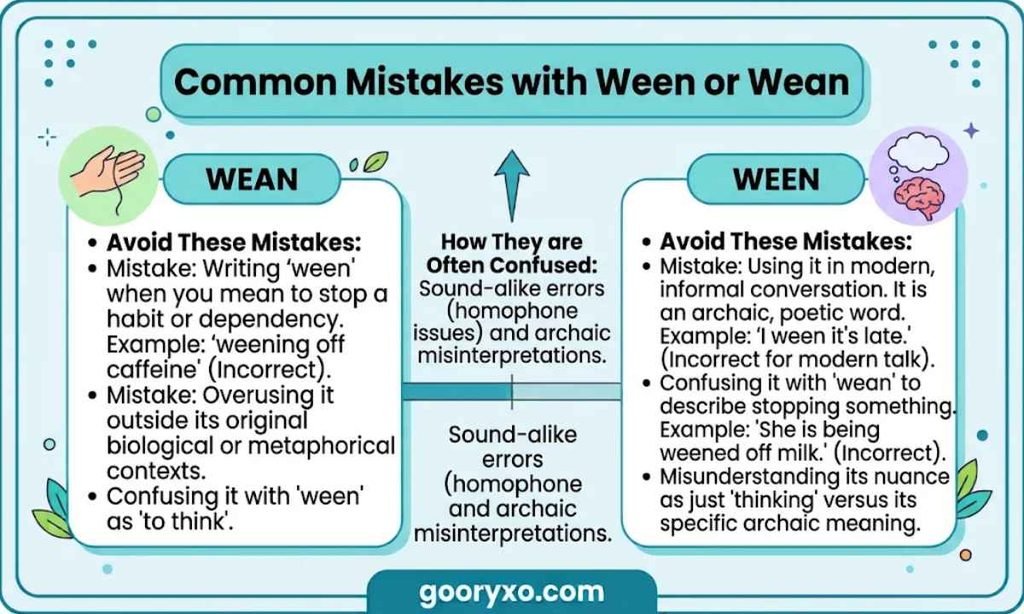
The most common mistake is writing ween where wean belongs, usually in “ween off.” The reverse mistake, using wean to mean “think,” is rarer.
| Incorrect | Correct | Why |
| We need to ween the team off manual reports. | We need to wean the team off manual reports. | The sentence is about ending a habit. |
| Weening a toddler takes patience. | Weaning a toddler takes patience. | The -ing form of wean keeps the “a.” |
| She was weened on old cartoons. | She was weaned on old cartoons. | Early contact uses weaned, not weened. |
| I wean he’ll arrive late. | I think he’ll arrive late. | Wean never means “suppose.” |
| Her enthusiasm began to wean. | Her enthusiasm began to wane. | Wane means to fade. It’s a different word. |
Remember
To lock in ween or wean, try this one: He’s weaning himself away from sugar.
Wean has an “a” for “away,” because weaning takes something away, whether that’s milk, sugar, or a habit. Ween has a double “e” like “seem,” because it’s about how things seem to you.
If you can swap in “gradually stop,” you want wean. If you can swap in “think,” you’ve found the ween meaning, but you’d probably just write “think.”
Ween or Wean in Everyday Examples
In daily life, wean covers parenting, pets, farming, health, and work. Ween shows up only when someone copies old English. These five settings show how ween or wean plays out in practice.
Emails
Wean sounds natural and professional when you describe a slow change.
Hi Dana, we’re planning to wean the team off weekly status calls and move updates to a shared board. Can we try it for a month?
The word suggests a gradual change, not a sudden cut, which makes the message sound softer.
News
News writing uses wean for policy and money topics. Sample headline: “City council votes to wean public buses off diesel.”
Headlines like it because it’s short and carries the idea of a slow change.
See Also Icy or Icey? Correct Spelling, Meaning & Examples
Social Media
On social media, wean often shows up in a light, joking way.
Example: “Day nine of trying to wean myself off doomscrolling. Send snacks.”
Formal Writing
In school and work documents, wean usually appears in policy and health topics. When a doctor needs to be exact about medicine, the usual word is “taper,” which means to lower a dose step by step.
Example: “The report looks at how governments wean economies off fuel subsidies.”
Historical Literature
This is the one place ween belongs, as an old way of saying “I think.” Example: “The captain, I ween, feared the silence more than the storm.”
A modern version would read, “The captain, I think, feared the silence more than the storm.” Unless you’re writing old-style dialogue or quoting, make that swap.
Ween or Wean: Google Trends & Usage Data
Wean is the word people actually use. Ween is mostly looked up for its meaning, as an old word, or as a band. Exact numbers change by country and date.
Want current figures? Compare both words in Google Trends, choose your country and a date range, and the gap shows up fast.
Searches around ween or wean split by intent. Queries about wean usually focus on babies, puppies, solid foods, and medicine. Queries about ween focus on its meaning, its old-fashioned status, and the band.
Two sample searches show the split: a parent typing “how to wean a baby off night feeds,” and a reader of an old novel typing “what does ween mean.”
Popular Countries
The verb wean works the same way in every English-speaking country, so no region handles ween or wean differently. Only the local flavor changes, since Scots and Irish English add the noun for a child.
Search numbers by country move around, so check Trends instead of trusting a fixed list.
- Glasgow: “The weans are playing out the back.”
- Toronto: “We’re going to wean the baby gradually.”
Ween vs Wean Comparison Table
In the ween or wean contrast, wean is the everyday verb (and a regional noun). Ween is an archaic verb for “think” or “suppose.”
Quick contrast: “She weaned the calf in March” versus “She, I ween, would never return.”
| Feature | Wean | Ween |
| Core meaning | Slowly stop, or get used to something new | Think, suppose, expect (archaic) |
| Part of speech | Verb (also a Scots and Irish noun) | Verb |
| Modern use | Everyday | Rare and on purpose |
| Origin | Old English wenian | Old English wēnan |
| Forms | weans, weaned, weaning | weens, weened, weening |
| Easy replacement | Formal: ablactate | think, suppose |
| Typical settings | Parenting, pets, farming, health, work | Old poems, fiction with an old-style voice |
Frequently Asked Questions
Ween or wean: which is right when stopping breastfeeding?
Wean. It’s the standard verb for slowly moving a baby from milk to other foods. The pace is different for every family, so a pediatrician or lactation consultant can help.
Is ween a real word?
Yes. The ween meaning in dictionaries is “to think” or “to suppose,” and it’s archaic. People also often write it by mistake when they mean wean.
Is it “wean off” or “wean from”?
Both are correct. “Wean off” is a bit more casual, and “wean from” sounds slightly more formal.
What does “weaned on” mean?
It means raised with something from an early age. The phrase is neutral, not negative.
Can wean be a noun?
Yes, in Scots and Irish English, where wean means a young child. In standard American or British writing, it’s almost always a verb.
How do you pronounce ween and wean?
They sound the same, /wiːn/, and both rhyme with “green.” That’s why wean vs ween gets mixed up so often in writing.
Ween or wean: which should I use in an essay or business email?
Wean, unless you’re quoting old English. For medicine, “wean off” is common, though “taper” is the exact medical word.
Summary
Ween or wean comes down to meaning. Wean means to move someone away from milk, a medicine, or a habit, while ween is an old verb for “think” that you’ll rarely need.
Pair wean with off, from, or on depending on the meaning. Next time ween or wean trips you up, save ween for old-style writing and give any “ween off” a second look before you publish.

My name is Ashfaq, and I am an English teacher with 5 years of teaching experience, specializing in English grammar. My mission is to make grammar easy to understand through simple explanations, practical examples, and helpful learning resources. At Gooryxo, I aim to help learners improve their grammar, strengthen their writing skills, and use English with confidence.

1 thought on “Ween or Wean: Which Is Correct? Meaning & Examples (2026)”