
Counselor or counsellor? Both are correct: counselor is the American spelling and counsellor is the British one. The meaning is identical, so the only real question is who’s reading.
Below, you’ll see which spelling fits the US, UK, Canada and Australia, why the double L exists, and how counselor or counsellor gets tangled up with councilor and counsel. Every section has examples you can copy into an email or CV.
Counselor or Counsellor – Quick Answer
Use counselor in American English and counsellor in British English. Canada, Australia, New Zealand, Ireland and South Africa follow the British pattern.
Neither side of the counselor or counsellor split is a typo. Dictionaries treat them as one word with two regional spellings, so you’re safe as long as the spelling matches your reader.
Example: A school in Texas hires a counselor, while a school in Leeds hires a counsellor. Same job, same sound.
At a glance:
- Counselor is the American English spelling, and counseling and counseled follow it.
- Counsellor is the British English spelling, also used in Canada, Australia, New Zealand, Ireland and South Africa, and counselling and counselled follow it.
- Both mean a person who gives advice, guidance or therapy.
- Both come from the Latin word consilium, through Old French.
- Neither is the same as councilor or councillor, which means a council member.
Meaning:
A counselor or counsellor is someone trained to give advice, guidance or therapy.
Example: After the layoffs, the company paid for a counsellor to run drop-in sessions for staff.
The role can sit in a school, a clinic, a career center or a summer camp. The setting changes, but the idea of advising someone doesn’t.
Examples:
The spelling changes, but the sentence doesn’t.
- US: Our high school counselor helped me map out my first-year courses.
- UK: Our sixth-form counsellor helped me map out my A-level choices.
In the counselor or counsellor pair, only one letter differs. The rest is vocabulary, like “high school” versus “sixth form.”
What Does Counselor or Counsellor Mean?
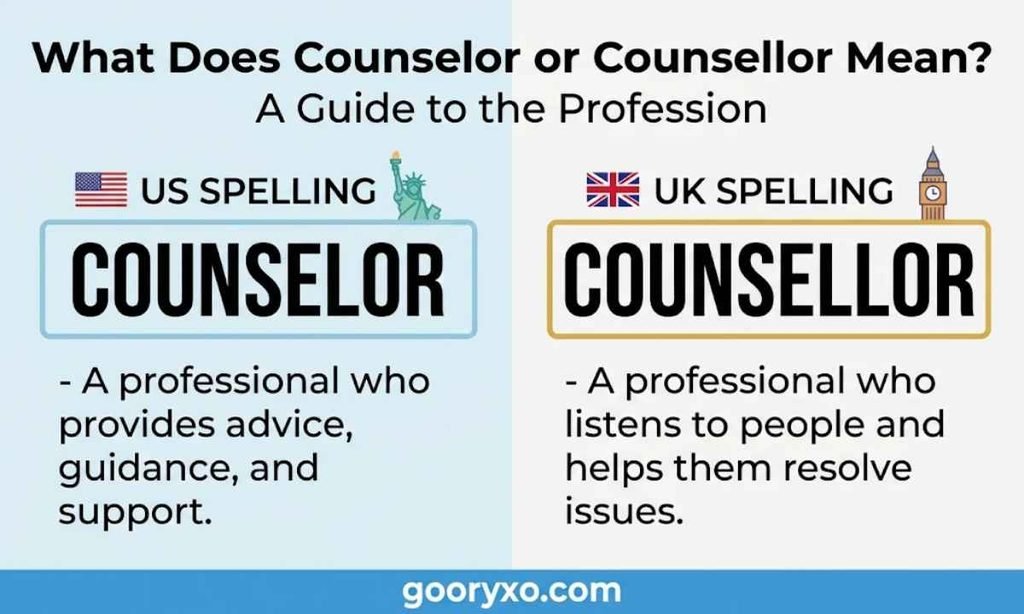
A counselor or counsellor is a person who advises, supports or treats others, usually in a professional setting.
The word stretches across five main senses:
- Personal or mental-health support, such as therapy, grief work or addiction recovery
- Educational and career guidance
- A lawyer, mainly in US usage (counselor-at-law)
- A supervisor at a youth camp, mainly in the US
- A senior diplomatic rank at an embassy
Example: The embassy’s economic counsellor attended the trade briefing.
Context tells you which sense of counselor or counsellor is meant, and the spelling stays the same in each one.
Common Types of Counselors/Counsellors:
The most common types of counselor or counsellor are school, career, mental health, marriage, debt and camp.
| Type | What they usually do |
| School counselor | Supports students with schedules, college plans and well-being |
| Career counselor | Helps people choose or change careers |
| Mental health counselor | Offers talk therapy and emotional support |
| Marriage or relationship counselor | Works with couples on communication and conflict |
| Debt counselor | Helps people budget and plan repayments |
| Camp counselor | Supervises and mentors kids at summer camps |
Example: A debt counselor can help you build a realistic repayment plan.
Swap in counsellor for UK and Commonwealth readers. The jobs are the same.
The Origin of Counselor and Counsellor
Both spellings of counselor or counsellor trace back to the Latin word consilium, which meant advice or discussion.
Old French passed it along as conseil (advice) and conseillier (adviser), and English borrowed counsel and counselor from there in the Middle English period. The spelling split is much younger than the word itself.
Example: Lawyers still say “defense counsel” in the US and “defence counsel” in the UK. That’s the original word for advice, still in use today.
Why Are There Two Spellings?
The counselor or counsellor split exists because British English doubles the final L before an ending like -or or -ing, while American English usually leaves it single.
Example: Add -or to counsel in the UK and you get counsellor. Add it in the US and you get counselor.
British English doubles a single final L even when the last syllable isn’t stressed. American English doubles it only when the last syllable is stressed, as in “compelled.”
Counsel is stressed on its first syllable (COUN-sel), so the American L stays single.
British English:
British English writes counsellor, counselling and counselled, with a double L every time.
It’s the same pattern you see in travelled, labelled and modelled.
Example: She was counselled to take a gap year before university.
American English:
American English writes counselor, counseling and counseled, with a single L.
Example: He’s been counseling teenagers for a decade.
It matches traveled, labeled and modeled. It’s part of a wider American move toward simpler spellings, which Noah Webster’s dictionaries helped start.
British English vs American English Spelling
American English writes counselor, counseling and counseled, while British English writes counsellor, counselling and counselled.
The three forms travel as a set, so spotting one version of counselor or counsellor tells you which type of English a document uses.
Example: If a flyer offers free counselling, you can bet its writer spells the person counsellor, too.
American English
In the counselor or counsellor debate, the US standard is counselor with one L.
Example: Book a visit with the counselor in Room 12.
American organizations follow it in their own names, including the American School Counselor Association and the American Counseling Association.
British English
Counsellor with two Ls is the standard in the UK and in other places that use British or Commonwealth English, including Canada, Australia, New Zealand and Ireland.
The British Association for Counselling and Psychotherapy and the Canadian Counselling and Psychotherapy Association both use the double L.
Canadian style guides from McGill University and the Government of Yukon tell writers to choose counsellor over counselor.
Example: Our Toronto clinic has two counsellors on staff.
Counselor vs Counsellor – Comparison Table
The table below shows the usual counselor or counsellor spelling by country, along with the matching -ing and -ed forms.
| Country | Noun | -ing form | Past tense |
| United States | counselor | counseling | counseled |
| United Kingdom | counsellor | counselling | counselled |
| Canada | counsellor | counselling | counselled |
| Australia | counsellor | counselling | counselled |
| New Zealand | counsellor | counselling | counselled |
| Ireland | counsellor | counselling | counselled |
| South Africa | counsellor | counselling | counselled |
| India and Pakistan | counsellor (usually) | counselling (usually) | counselled (usually) |
Example: A Canadian résumé that lists counselling experience and a US résumé that lists counseling experience are both right.
“Usually” matters here. Individual organizations set their own style rules, and US-written web copy turns up everywhere.
Which Spelling Should You Use?
With counselor or counsellor, the reader’s location decides. Use the spelling they expect, which is normally the one used where they live or where the organization you’re writing to is based.
Example: Applying to a Boston university? Write counselor. Emailing a London clinic? Write counsellor.
Use “Counselor” When:
Choose counselor when your reader is American or the institution itself uses it.
- You’re writing to a US school, university or employer
- Your style guide is APA or Chicago
- You’re filling out US forms or credential applications
- Most of your readers live in the United States
Example: Please forward my transcript to the admissions counselor.
Use “Counsellor” When:
Choose counsellor when you’re writing for the UK or any country that follows British spelling.
- Your readers use British, Canadian, Australian, Irish, New Zealand or South African English
- Your readers are in India or Pakistan, where British-style spelling is the norm
- Your style guide is Oxford, Canadian Press or a British style guide
- The organization’s own website uses the double L
Example: Our counsellor is available Monday to Friday, 9 to 5.
For Global Audiences
For counselor or counsellor, pick the spelling that matches your biggest audience and use it everywhere on the page.
Switching halfway through looks careless, even though neither form is wrong. This article uses American spelling for everyday words and shows both forms of the key word only because it’s teaching the difference.
Example: A global nonprofit can set its style guide to British English and write counsellor on every country page.
Counselor vs Counsellor in Professional Contexts

Job titles, credentials and association names follow the local counselor or counsellor spelling, so copy them exactly as the organization writes them.
Example: The US license title is “licensed professional counselor,” and changing it to counsellor on an American application can cause confusion.
Titles are the one place where you shouldn’t “correct” spelling to fit your own style.
See Also Starring or Staring: Which Is Correct? Meaning & Examples
In Schools
American schools have school and guidance counselors. English schools more often split the work between a school counsellor for well-being and a careers adviser for course choices.
Irish secondary schools use the title guidance counsellor.
Example: A Dublin secondary school posted a vacancy for a guidance counsellor.
In Mental Health
US licensing uses counselor, as in licensed professional counselor. UK and Commonwealth practice uses counsellor, often alongside psychotherapist. Psychologists and therapists do related work, but their training and titles differ.
Rules about who can use the title vary by country and, in the US, by state. Check local requirements before you print it on a business card.
Example: She trained as a counsellor in Manchester before adding psychotherapy training.
In Career Services
It’s career counselor in the US and career counsellor in British-style markets, though some UK services say careers adviser instead.
Example: Book a CV review with a career counsellor at the university careers service.
In Government and Law
In US law, counselor can mean an attorney, as in counselor-at-law. British-style systems use solicitor, barrister or advocate instead, and share the word counsel for a lawyer.
In diplomacy, counselor or counsellor is a senior rank at an embassy.
Example: The judge asked the counselor to approach the bench.
Common Mistakes with Counselor or Counsellor
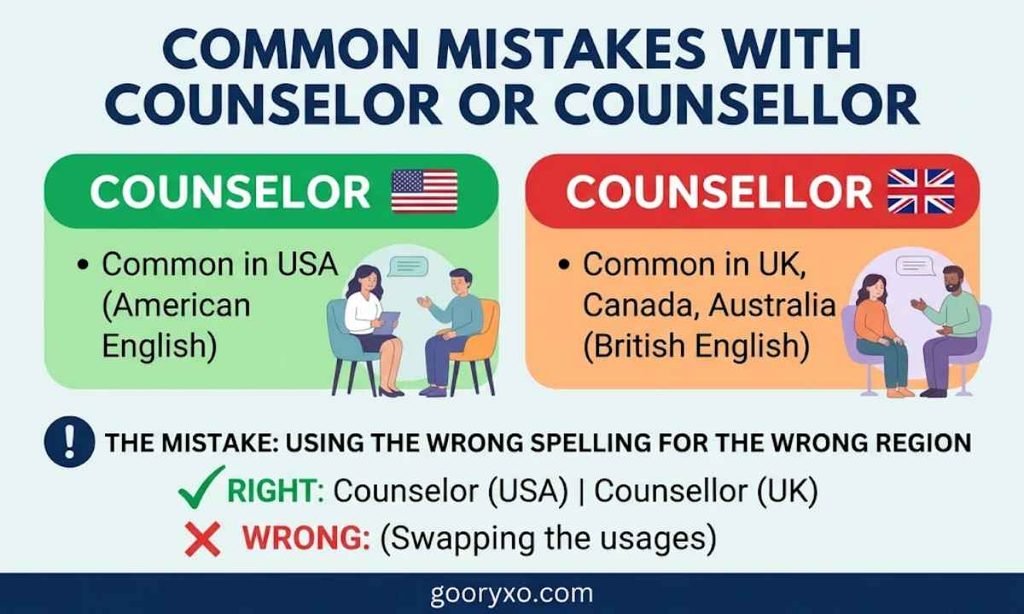
Most errors fall into four groups: calling one spelling wrong, mixing both in one text, ignoring the reader’s location and trusting spell-check blindly.
Example: “The counselor referred me to a counsellor” mixes both spellings in a single sentence.
Mistake 1: Thinking One Is Wrong
Neither side of counselor or counsellor is an error.
“Fixing” a British colleague’s counsellor to counselor only swaps one valid form for another. Save your corrections for real mismatches with the audience.
Example: Don’t “correct” an Australian clinic’s counsellor to counselor.
Mistake 2: Mixing English Styles
Mixing counselor or counsellor in one document is the version readers actually notice. The sneakier version pairs a US noun with a UK -ing form.
Example: Wrong: Our counselor offers free counselling. Right: Our counselor offers free counseling.
Mistake 3: Ignoring Audience Location
A mismatched spelling tells readers you wrote for a different market. It isn’t wrong, just off.
Example: A Manchester practice that advertises “marriage counselor” will look slightly foreign to local readers.
Mistake 4: Using Spell-Check Incorrectly
Spell-check follows its language setting, not your audience, so set the language first.
- Word: Review, then Language, then Set Proofing Language
- Google Docs: File, then Language
- Grammarly: pick American, British, Canadian or Australian English in your settings
Example: With Word set to English (US), counsellor gets a red underline. Switch to English (UK) and it clears.
Counselor or Counsellor in Everyday Examples
Everyday sentences use identical grammar whether you choose counselor or counsellor. Only the number of Ls and the surrounding vocabulary change.
Example: “See the counselor” and “see the counsellor” differ by one letter and nothing else.
In American English
In US writing, the second L disappears from every form.
- The counselor at my daughter’s middle school called about the new schedule.
- After two years of counseling, he felt ready to apply for the job.
- The district sent a grief counselor to the school for the week.
In British English
In UK writing, the L doubles in every form.
- My GP referred me to a counsellor at the local surgery.
- She’s counselling students at a sixth-form college.
- The couple booked six sessions with a relationship counsellor.
In Emails
For counselor or counsellor in emails, match the recipient’s spelling, especially in the subject line, since that’s the first thing they read.
- US: Subject: Meeting with the college counselor, Thursday
- UK: Subject: Request to see the school counsellor
In Job Listings
For counselor or counsellor in a job title, use the local spelling, since that’s what local candidates tend to search for. If the board is international, mention the other spelling once in the description.
Example: Part-time School Counselor (Austin, TX) and Student Well-being Counsellor (Bristol).
Counselor vs Counsellor in SEO Writing
Search engines often treat counselor or counsellor as close variants, but people still search with their own regional spelling, so write for your main market.
Example: A clinic in Calgary that titles a page “anxiety counselling in Calgary” matches how locals type it.
You don’t need two pages for two spellings. One page, one spelling style, and a natural mention of the other form where it helps is enough.
Search Intent Difference
The intent behind counselor or counsellor searches is usually the same, since someone wants help, a job or an answer, but the wording follows the searcher’s home spelling.
Example: A US job seeker types “counselor jobs in Ohio,” while a UK one types “counsellor jobs in Leeds.”
Local searches like “counselor near me” and “counsellor near me” follow the same pattern. Google Trends lets you check it for your own market.
SEO Strategy
Write each page in one spelling style, put that spelling in the title, H1 and URL, and use the other form only where it reads naturally.
- Pick your main market first.
- Use that spelling in the title tag, headings and URL slug (the last part of the web address).
- If you run separate US and UK versions, mark them with hreflang tags (en-us and en-gb), which tell Google which regional version to show.
- Keep internal links and anchor text consistent.
Example: /anxiety-counselling-london for a London clinic, and /anxiety-counseling-austin for an Austin one.
Google Trends & Usage Data
Counselor generally shows higher overall usage, mainly because the US audience is so large, while counsellor leads across the UK and most Commonwealth markets.
Exact numbers move month to month, so this guide skips them. Checking takes a minute: compare counselor or counsellor in Google Trends, set the region to the United States, then switch to the United Kingdom, Canada and Australia.
Example: Search counsellor against counselor with the region set to the UK, then repeat with the US and watch the lines swap places.
“Counselor” dominates in:
The United States, above all.
- US schools, colleges and hospitals
- US-based job boards and publishers
Example: A US job board files openings under counselor, not counsellor.
“Counsellor” dominates in:
The UK, Ireland and most Commonwealth markets, including Australia and New Zealand.
Canadian style guides favor counsellor, though heavy US influence means counselor still turns up in Canadian web copy.
Example: A British therapist directory lists professionals under counsellor, not counselor.
Trend Insight
The counselor or counsellor split follows geography, not correctness, and it hasn’t turned either spelling into a mistake.
Because American sites outnumber everyone else online, generic results for this topic lean toward counselor. Writers in British-style markets should check local results instead.
Example: A Sydney therapist researching keywords should look at Australian results for counsellor, not global ones.
Why the Spelling Difference Matters
The counselor or counsellor choice signals who you’re writing for, and a mismatch can make careful work look careless.
Example: A UK charity page that writes “colour” and “organisation” but “counselor” looks copied from an American draft.
It also affects trust on résumés and forms, and whether local readers and local search find you.
Example:
One mismatched word can undo a polished page.
Picture a British therapist who copies a bio from a US directory. It reads “licensed counselor” in one line and “organised workshops” two lines later.
Most clients won’t consciously notice. The page just feels stitched together.
Counselor vs Counsellor in Academic Writing
For counselor or counsellor in academic work, follow the spelling standard of your institution or target journal: American for APA and Chicago, British for Oxford-style and most UK journals.
Example: A dissertation at a UK university would say counselling throughout, while a US one would say counseling.
If the guidelines don’t say, check the last few papers the journal published.
In American Academic Style
APA and Chicago both default to American spelling, so use counselor, counseling and counseled.
APA points writers to American dictionaries such as Merriam-Webster for spelling questions.
Example: Participants met weekly with a school counselor.
In British Academic Style
UK universities and most Commonwealth journals expect counsellor, counselling and counselled.
Check the author guidelines too. Oxford-style spelling uses -ize endings but still doubles the L, so counsellor and organize can appear together.
Example: Participants attended eight sessions with a trained counsellor.
Related Word Differences
The same L-doubling that separates counselor or counsellor shows up in the verb, the -ing form and the past tense, and in dozens of other words.
Example: Counseled (US) and counselled (UK) share a meaning and a pronunciation.
Similar Examples
If you know one pair, you know the pattern. The table lists the ones worth memorizing.
| American English | British English |
| counselor | counsellor |
| counseling | counselling |
| counseled | counselled |
| traveler | traveller |
| labeled | labelled |
| modeled | modelled |
| fueled | fuelled |
Not every case is clean. Some words go both ways in the US, and “canceled” and “cancelled” both appear, so treat the pattern as a strong tendency rather than a law.
Example: The US headline says “Flight canceled,” the UK one says “Flight cancelled,” and you’ll see both on US sites.
See Also Starring or Staring: Which Is Correct? Meaning & Examples
Counselor vs Councilor vs Counsel: What’s the Difference?
A counselor or counsellor gives advice or therapy, a councilor (councillor in the UK) sits on a council, and counsel means advice or a lawyer.
| Word | US | UK | Meaning |
| Adviser or therapist | counselor | counsellor | Gives advice, guidance or therapy |
| Council member | councilor | councillor | Belongs to a council |
| Advice or lawyer | counsel | counsel | Advice itself, a legal representative, or to advise |
| Assembly | council | council | A governing or advisory group |
They sound alike because two different Latin words ended up sounding the same in English. Counsel comes from consilium (advice), and council comes from concilium (assembly).
Example: The city councillor voted on the budget, and the school counsellor hosted parents’ night.
A quick test: if it involves a vote, it’s council. If it involves advice, it’s counsel. In the UK, some senior barristers are called King’s Counsel.
How Dictionaries Treat the Word
Major dictionaries accept both, labeling one as the American spelling and the other as the British one.
That’s the clearest proof that counselor or counsellor is a regional choice rather than a right-or-wrong one.
Example: Look up counsellor in a UK dictionary and you’ll usually see counselor flagged as the US form beside it.
American dictionaries:
Merriam-Webster and other US dictionaries list counselor as the main spelling and show counsellor as a variant.
Example: A US entry for counselor usually carries counsellor as a variant in the same listing.
British dictionaries:
Oxford, Cambridge and Collins list counsellor as the main spelling and flag the American form.
Example: A UK entry for counsellor typically notes counselor as the US spelling.
Pronunciation Difference
The spelling doesn’t change the sound. Whether you write counselor or counsellor, the word is pronounced the same way, and only regional accents differ.
Americans pronounce the final r, while many British accents don’t. That’s accent, not spelling, and the stress falls on the first syllable either way.
Example: Say “COUN-suh-lur” in the US and “COUN-suh-luh” in much of the UK. The written form doesn’t change for either.
Pronunciation:
Roughly /ˈkaʊnsələr/ in American English and /ˈkaʊnsələ/ in many British accents.
Dictionaries use slightly different symbols, so don’t be surprised if the notation looks different.
Example: The first syllable, coun, rhymes with “town.”
Memory Tricks to Remember the Difference
To remember counselor or counsellor, tie the spelling to the reader’s country, to words you already spell, and to the organization’s own name.
Example: Reader in Denver? Counselor. Reader in Dublin? Counsellor.
Trick 1: Think About Country
Americans trim the word, and almost everyone else keeps the extra L.
Ask where your reader lives first, and the spelling follows.
Example: A student in Chicago asks the counselor, and a student in Glasgow asks the counsellor.
Trick 2: British English Loves Double Letters
If you already write travelled and labelled, write counsellor. It’s the same family.
That one habit also covers counselling and counselled.
Example: Travelled, labelled, counselled: three words, one rule.
Trick 3: Match the Audience
Copy the spelling on the reader’s own website, letterhead or job ad.
An organization’s name is the best cheat sheet you’ll find.
Example: If the clinic’s sign says “counselling,” your email should too.
Counselor vs Counsellor in Formal and Informal Writing
In formal writing, counselor or counsellor should follow a style guide or the recipient’s own spelling. Informal writing is more relaxed but still works best with one spelling.
Example: A cover letter to a UK school says counsellor, while a text to a friend can be as casual as you like.
Formal Writing
Anything official, such as applications, reports, contracts and academic papers, should follow the regional spelling exactly.
Example: Our records show the student met with the school counselor on March 3.
When in doubt, use the form that appears in the organization’s own documents.
Informal Writing
In texts, social posts and casual blogs, either spelling is fine, and nobody’s grading you.
Keep it steady within a single post, though, and let autocorrect follow your keyboard language rather than fight it.
Example: “Finally booked a counsellor. Wish me luck!”
Frequently Asked Questions
Is it counselor or counsellor?
Both are correct. Counselor is the American spelling, and counsellor is the British spelling used across most Commonwealth countries.
Which spelling is more common?
In the counselor or counsellor comparison, counselor is generally more common overall, mainly because of the large US audience. Counsellor leads in the UK, Ireland, Australia and other British-style markets.
Is counsellor wrong in the United States?
No, it’s understood and not an error. Most US schools and employers use counselor, though, so counsellor can look out of place.
Should my website say counselor or counsellor?
Use the spelling your main audience uses and keep it the same across the whole site. If you serve both markets, build separate regional versions and mark them with hreflang tags.
Is counseling spelled with one L or two?
One L in American English (counseling) and two in British English (counselling). The same split applies to counseled and counselled.
What’s the difference between a counselor and a councilor?
A counselor gives advice or therapy, while a councilor is a member of a council. They sound alike but come from different Latin roots.
Can I use both spellings in one article?
Not for the same word in the same article, because mixing looks careless. The exception is when you’re comparing them, as this guide does.
Summary
Counselor or counsellor comes down to geography: counselor in the United States, counsellor in the UK, Canada, Australia and most of the Commonwealth. Both mean the same thing, and neither is a mistake.
Match your reader, keep the spelling steady, and let the other forms follow: counseling and counseled for US readers, counselling and counselled for British-style ones.

My name is Ashfaq, and I am an English teacher with 5 years of teaching experience, specializing in English grammar. My mission is to make grammar easy to understand through simple explanations, practical examples, and helpful learning resources. At Gooryxo, I aim to help learners improve their grammar, strengthen their writing skills, and use English with confidence.

1 thought on “Counselor or Counsellor: Which Is Correct? US vs UK Guide”