
Starring or staring? Starring means playing a main role in a film, show, or play, while staring means looking at something steadily for a long time. One letter changes the meaning completely.
You’ll spot both words in captions, movie posts, and school essays. This guide gives you simple rules, the spelling logic behind each word, and examples you can copy with confidence.
Starring
In the starring or staring pair, starring is the -ing form of the verb “star” (grammar books call it the present participle). It describes someone who plays a main part in a film, TV show, or stage play.
Merriam-Webster lists star as a verb with the forms stars, starred, and starring. You’ll see starring most often in phrases like “a film starring two newcomers” or “a starring role.”
Example: The new thriller, starring two young actors, opens next Friday.
Staring
Staring, the other half of starring or staring, is the -ing form of the verb “stare.” It means looking at someone or something for a long time, often with wide-open eyes.
Example: The toddler sat staring at the ceiling fan for ten minutes.
It’s about attention, not acting. Dictionaries note that the verb often pairs with “at,” as in staring at a screen.
Starring or Staring : Quick Answer
Starring or staring? Use starring for acting and staring for looking. They come from two different verbs, so they never swap places.
Main Difference:
For starring or staring, ask what’s happening in your sentence. Starring is about a role, and staring is about eyes.
- Starring: playing a main part or lead role in a film, show, or play.
- Staring: looking at something steadily and for a long time.
Examples:
Here are three sentences that use starring or staring correctly.
- She’s starring in a new comedy series.
- He sat by the window, staring at the rain.
- I caught myself staring at a poster for a film starring my favorite singer.
The last sentence uses both words, and it shows how common “a film starring someone” is. You don’t need “is” before starring in that pattern.
Starring or Staring : Definitions with Examples
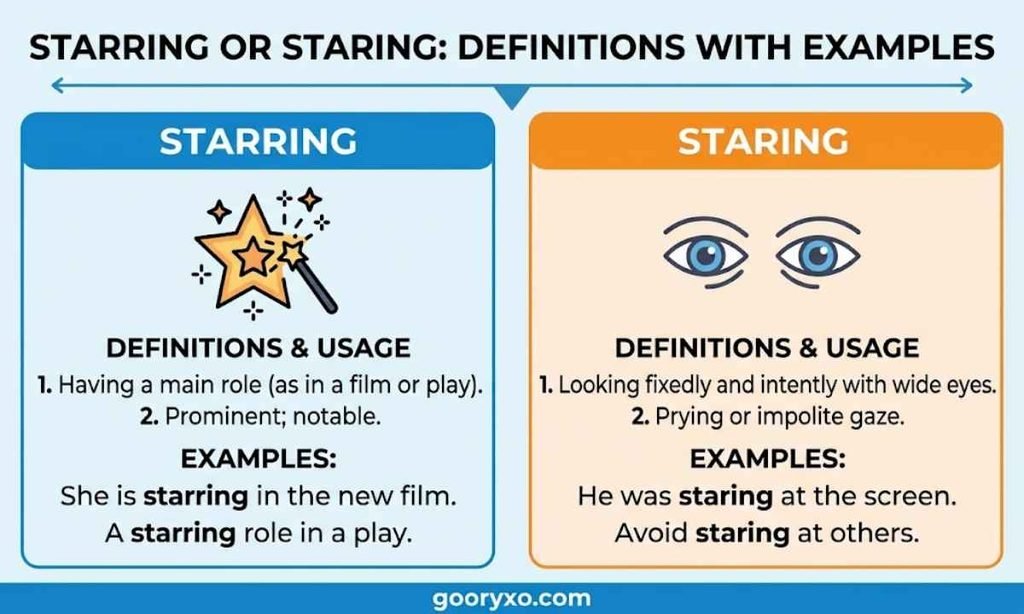
Dictionaries define the verb star as playing a main role, and the verb stare as looking fixedly. Starring or staring are simply the -ing forms of those two verbs.
Starring (Definition)
Starring means being featured in a main part, also called a leading role. Oxford Learner’s Dictionaries shows two patterns: a person stars in something, or a film stars a person.
Several actors can be starring in the same film. The word doesn’t mean only one person carries the whole story.
Examples:
These three sentences show starring in its most common patterns.
- Starring alongside her brother, she made her stage debut.
- The festival opens with a drama starring a talented newcomer.
- Her starring role changed her career.
The second sentence shows the pattern “a drama starring someone.” In the third, starring describes the word “role.”
Staring (Definition)
Staring means looking at something steadily, often because you’re curious, surprised, bored, or lost in thought. You can also use it in a non-literal way, as in staring at a huge pile of work.
Merriam-Webster also lists uses like staring someone up and down, where you look a person over.
Examples:
These three sentences show staring for real looks and for a figure of speech.
- The cat sat staring at the birds outside.
- She could feel someone staring at her across the room.
- The team is staring at a very busy month.
The first two sentences describe real eye contact. The last one isn’t literal, because nobody is really looking at the month.
Simple Meaning
Try a swap test. If you can replace the word with “looking,” you need staring.
If you can replace it with “playing a main part,” you need starring. Those two swaps settle almost every sentence.
What Does “Starring” Mean in Movies and Films?
In movies and TV, starring tells you which actors have the main roles. You’ll see it on posters, trailers, and streaming pages, usually right before the cast names.
On a poster, the starring or staring question settles itself, because only starring fits a cast list. The starring cast is the group named first, and the biggest name usually gets top billing.
The word works in two ways. “A film starring Maya Ortiz” and “Maya Ortiz stars in the film” mean the same thing.
Example: The series, co-starring a veteran stage actor, premieres in spring.
Credit wording such as co-starring, also starring, and guest starring points to a shared or smaller credit. The exact rules vary by production, so don’t treat them as a strict ranking.
The Origin of Starring or Staring

Starring or staring look alike, but they come from different words. One grew out of “star,” the bright object in the sky, and the other comes from Old English starian.
Starring:
Starring comes from the verb star, which grew out of the word “star” for a bright object in the sky. Merriam-Webster says that older word was already in use before the 12th century.
Over time, English used “star” for a person who shines in a field, such as a performer. The verb then came to mean taking the main role.
Example: She starred in school plays long before she appeared on screen.
Staring:
Staring comes from the verb stare, which comes from Old English starian. Merriam-Webster and Dictionary.com both trace it back to that word.
Dictionary.com links it to German starren and to the English words “stark” and “starve.” Etymonline explains the idea behind them: being stiff or fixed, like a gaze that doesn’t move.
Etymonline also says the early meaning didn’t imply rudeness. The phrase “stare someone down” appears in the 1800s.
Example: The two players spent the whole break staring each other down.
Pronunciation: How to Say “Starring” and “Staring” Correctly
Starring sounds like STAR-ing, with the “ar” sound from “star.” Staring sounds like STAIR-ing, with the vowel from “stair.”
For the base words, “star” is /stɑr/ in American English and /stɑː/ in British English. “Stare” is /stɛɚ/ in American English and /stɛə/ in British English.
Adding -ing doesn’t change the vowel, so you can tell starring or staring apart by ear. Wiktionary also notes that “stare” and “stair” sound exactly the same.
Try saying this sentence out loud: She was starring in the school play while her cousin was staring at the stage.
Why Do Both Words Double the “R”?
Only starring doubles the “r.” Staring has just one “r,” because the silent “e” in “stare” drops before -ing.
“Star” is a short word that ends in consonant-vowel-consonant, so English doubles the last letter before -ing. That’s the same pattern you see in “run” becoming “running” and “plan” becoming “planning.”
“Stare” ends in a silent “e,” so the “e” disappears before -ing. That’s the same pattern as “make” becoming “making” and “hope” becoming “hoping.”
| Rule | Starring | Staring |
| Base word | star | stare |
| What happens | double the last letter | drop the silent “e” |
| Result | starring | staring |
| Similar words | running, planning | making, hoping |
Some guides on starring or staring say both words double the “r,” but dictionary spellings show otherwise. If you see two r’s, you’re looking at the acting word.
Star, Starred, Starring and Stare, Stared, Staring: Verb Forms
Star has the forms star, stars, starred, and starring. Stare has the forms stare, stares, stared, and staring.
| Form | Star | Stare |
| Base form | star | stare |
| He, she, or it | stars | stares |
| Past tense | starred | stared |
| -ing form | starring | staring |
Knowing the forms makes starring or staring easier to spot in any tense.
Use “stars in” for something current, “starred in” for something finished, and “will star in” for something coming. “Is starring” works for an ongoing run or a project in progress.
- She stars in the new series.
- He starred in two comedies back in the nineties.
- They’ll star together in next year’s film.
The past forms follow the same logic as the -ing forms. “Starred” doubles the “r,” while “stared” simply adds “d” to the word “stare.”
“Starred” has another meaning too: marked with a star, as in a starred review. That sense has nothing to do with acting.
See Also Performed vs Preformed: Difference, Meaning & Examples
Star In, Star As, Stare At, Stare Into: Prepositions
Use “star in” for a film and “star as” for a character. Use “stare at” for things and “stare into” for space.
The small word after each verb matters, so starring or staring each need the right partner.
You star in a film or show, star as a character, and star opposite another actor. Example: She’ll star as a detective in the sequel, opposite her old co-star.
With stare, “at” works for objects and people. “Into” fits empty space and distance, as in staring into space. You can also stare in disbelief, shock, or amazement.
- Don’t stare at people on the train.
- He stared into the distance and said nothing.
- The crowd stared in amazement as the magician vanished.
Stare also works with “down.” To stare someone down means to look at them so steadily that they look away first.
A common slip is dropping the preposition. “He stared me” is wrong; you need “He stared at me.”
Starring or Staring : Usage Differences
Starring is used for performances, and staring is used for looks and attention. Context decides which one fits, and the two don’t overlap.
Starring appears mostly in entertainment news, but sports writers use it too. Merriam-Webster gives an example of a player who starred at shortstop, meaning he played outstandingly.
Staring belongs to everyday life, and it can describe a real look or a figure of speech. A person can stare at a phone, or a company can stare at a deadline.
Comparison Table:
Here’s how the two words line up side by side.
| Point | Starring | Staring |
| Base verb | star | stare |
| Core meaning | playing a main part | looking fixedly |
| Typical settings | films, TV, theatre, sometimes sports | daily life, body language |
| Spelling rule | double the “r” | drop the silent “e” |
| Sounds like | STAR-ing | STAIR-ing |
| Common patterns | star in, star as | stare at, stare into |
Example: The documentary, starring a retired pilot, shows him staring at the old runway.
UK vs US English: Any Difference?
No. For starring or staring, British and American English spell and use both words the same way. The only small difference is in pronunciation, such as the “r” at the end of “stare.”
In American English you can hear that “r” in stare. In standard British English it’s usually silent, but the spelling stays the same.
- British: “The play stars a young cast from Manchester.”
- American: “The movie stars a young cast from Atlanta.”
Both sentences use the same word, and neither needs any change when it crosses the Atlantic.
Which Word Should You Use?
Use starring when someone plays a main role, and staring when someone looks fixedly. Before you decide on starring or staring, ask yourself whether the sentence is about acting or about eyes.
Use “Starring” When:
You’re talking about a cast, a credit, or a standout performance.
- Announcing the lead actors in a film, series, or play.
- Writing reviews, trailers, or entertainment captions.
- Describing a breakout role or a starring turn.
Example: The streaming platform announced a thriller starring three award winners.
Use “Staring” When:
You’re describing where someone’s eyes are, or what their attention is stuck on.
Example: The student kept staring at the clock.
- Describing a fixed gaze or a long look.
- Writing about body language and reactions.
- Describing a problem you’re facing, like staring at a deadline.
Easy Memory Trick
Think “double R, double spotlight.” Starring has two r’s, like two spotlights on a performer, while staring has one r, like one steady look.
Here’s a second aid for speaking and spelling. “Stare” sounds like “stair,” so picture someone staring at a staircase, and you’ll remember the one-r spelling.
Synonyms for Starring & Staring

Starring has synonyms like featuring, headlining, and leading. Staring has synonyms like gazing, glaring, gawking, and gaping, and each one has a different tone.
Example: The show is headlining a well-known comic actor this season.
Gazing is calm and often long. Glaring is angry, gawking is rude, and gaping suggests surprise with the mouth open.
| Word | Close to | Tone |
| featuring | starring | neutral, descriptive |
| headlining | starring | top billing, big events |
| gazing | staring | calm or dreamy |
| glaring | staring | angry |
| gawking | staring | rude or nosy |
Common Mistakes with Starring or Staring
Most mistakes with starring or staring come from swapping the two words or dropping an “r.” These four patterns cause nearly all of them.
1. Mixing Both Words
Use staring whenever someone’s eyes are involved.
Wrong: “Why is he starring at me?” Right: “Why is he staring at me?”
Starring never goes with “at.”
2. Wrong Context
Don’t use staring for acting.
Wrong: “She’s staring in a new film.” Right: “She’s starring in a new film.”
The same goes for posters and captions. “A comedy staring a famous actor” should be “a comedy starring a famous actor.”
3. Spelling Confusion
Count the r’s. Starring has two, and staring has one.
This also affects the past tense. Wrong: “She stared in three films.” Right: “She starred in three films.”
The reverse mistake happens too: “He starred at the wall” should be “He stared at the wall.”
4. Ignoring Meaning
Most errors happen when you type by sound and don’t reread. Slow down and ask what’s actually happening in the sentence.
Skipping the preposition after stare is another form of this. Wrong: “He stared me for a long time.” Right: “He stared at me for a long time.”
Difference Between Staring and Starring
Starring or staring is easy to separate: staring is about eyes and attention, and starring is about roles and credits. They’re both -ing forms, but they do slightly different grammar jobs.
Staring can name an action, as in “Staring can feel rude.” Starring can describe a role, as in “She won a starring role.”
Both words in one sentence: She kept staring at the screen, because her best friend was starring in the trailer.
If someone’s eyes are involved, use staring. If a credit or a spotlight is involved, use starring.
Real Conversation Examples (Mini Dialogues)
These short chats show how starring or staring comes up in real conversation, and how people fix the slip.
Dialogue 1
- Maya: “Why is Leo staring at his phone?”
- Sam: “He’s waiting for a call back about a play. He might be starring in it.”
Dialogue 2
- Priya: “I just texted my mom that the film is staring Nora Bell.”
- Tom: “You mean starring. It has two r’s because it’s the acting word.”
Dialogue 3
- Daniel: “Stop staring at my screen.”
- Ava: “I’m not! I’m just watching your trailer. Who’s starring in it?”
The first and third chats use both words correctly. The second one shows the most common spelling slip.
See Also Performed vs Preformed: Difference, Meaning & Examples
Starring or Staring in Everyday Examples
Starring or staring shows up in daily life more often than people expect. These four settings show how each word fits.
Daily Life
Daily life uses staring for looks and starring for the occasional performance.
- He lay in bed staring at the ceiling.
- My neighbor is starring in the community theater show.
Social Media
On social media, starring appears in captions and trailers, and staring appears in jokes about screens.
- “New trailer just dropped, starring my favorite actor!”
- “Everyone on this train is staring at a phone.”
School
In school, staring often shows up in stories and essays, while starring shows up in drama and film class.
- The narrator describes a boy staring out of the classroom window.
- Our class watched a short film starring a local student.
Professional Use
At work, starring appears in press releases and staring appears in descriptions of reactions.
- The press release confirms a film starring two award winners.
- She noticed the manager staring at the sales chart.
Starring or Staring : Usage Trends & Popularity
People search for starring or staring mostly to check a spelling in a caption, a post, or an essay. Exact numbers change by country and date, so none are quoted here.
Want current figures? Open Google Trends, compare both terms, and choose your country and time range.
Trend Insight:
Starring is tied to entertainment, so it’s fair to guess its searches rise around big releases. Staring is an everyday word, so it may look steadier. Check the Trends chart to see if that holds in your country.
People who search starring or staring are often writers, students, and social media users. They want a fast answer before they post or submit something.
Comparison Table
Here’s a quick starring or staring table with the details people look up most.
| Aspect | Starring | Staring |
| Base verb | star | stare |
| Past form | starred | stared |
| Pairs with | in, as, opposite | at, into, down |
| Close words | featuring, headlining | gazing, glaring |
| Typical error | used for a look | used for a role |
| Example | A film starring two newcomers | Staring at the sky |
Common User Queries
These are quick answers to the short searches people type around starring or staring.
- “Starring in a movie”: correct. Use “in” after starring.
- “Staring at me”: correct. Use “at” after staring.
- “Starring role”: the main part in a film, show, or play.
- “Co-starring”: appearing alongside the lead.
- “Staring into space”: looking at nothing while lost in thought.
- “Stare down”: to look at someone until they look away.
- “Staring contest”: a game where two people stare until one looks away.
- “Blank stare”: a look with no expression on the face.
- “Starred review”: a review marked with a star, not an acting credit.
- “Stare or stair”: two words that sound the same but mean different things.
Frequently Asked Questions
Starring or staring: which is correct in a movie credit?
Starring. It describes the main actors in a film or show, and staring never refers to acting.
Is it “starring at” or “staring at”?
Staring at. Starring never takes “at,” because it’s about roles and not about looking.
Why does starring have two r’s but staring only one?
The word “star” doubles its last letter before -ing, so it becomes starring. The word “stare” drops its silent “e,” so it becomes staring.
Can staring ever be used for an actor?
No. Staring only describes looking at something. For an actor’s role, you need starring.
What are the past tenses of star and stare?
Star becomes starred, and stare becomes stared. Notice that starred keeps the double “r.”
Starring or staring: are they spelled differently in British English?
No. British and American English spell and use both words the same way. Only the “r” sound at the end of “stare” may be pronounced differently.
Is staring always rude?
Not always. A long, fixed look at a stranger can feel rude, but staring at art, a view, or a screen is usually fine.
Summary
Starring or staring comes down to meaning. Starring is about playing a main role, and staring is about looking at something for a long time.
Next time starring or staring comes up, remember the spelling: starring has two r’s, and staring has one. Use “star in” for roles and “stare at” for looks.

My name is Ashfaq, and I am an English teacher with 5 years of teaching experience, specializing in English grammar. My mission is to make grammar easy to understand through simple explanations, practical examples, and helpful learning resources. At Gooryxo, I aim to help learners improve their grammar, strengthen their writing skills, and use English with confidence.

1 thought on “Starring or Staring: Which Is Correct? Meaning & Examples”