
Personnel or personel? Only “personnel” is correct, and it means the people who work for a company, a government body or the armed forces. The one-n version is a plain spelling mistake.
This guide settles the personnel or personel question through the meaning, the French roots, the pronunciation and the mix-up with “personal.” You’ll leave knowing how to spell personnel without second-guessing yourself.
Personel or Personnel – Quick Answer
Personnel is the correct spelling, with two n’s. “Personel” isn’t an English word, so it counts as an error every time.
Sound is the trap in the personnel or personel debate. Both versions are pronounced the same, so your ear can’t help you, and a fast typist can easily skip the second n. Merriam-Webster, Dictionary.com and other major dictionaries list only the double-n form.
Example: The hospital asked all night-shift personnel to sign in at the front desk.
Meaning:
The personnel meaning is simple: the people employed by an organization, or its whole workforce. In casual office talk it can also stand for the human resources department.
Example: “I’ll send the form to personnel,” she said, meaning the HR office down the hall.
Strictly speaking, it names a group. For one individual, most writers reach for “employee” or “staff member” instead.
Examples:
Here are three sentences that settle personnel or personel in practice, plus one that gets it wrong. Read them aloud once and the pattern sticks.
- Example 1: The airline trains its ground personnel every spring.
- Example 2: Only authorized personnel may enter the server room.
- Example 3: Our personnel policy was rewritten last quarter.
- Example 4 (wrong): The personel list is on the shared drive.
The last line is the odd one out because it drops an n. Everything else is the same word doing its normal job: naming the people on the payroll.
Pronunciation:
Say it per-suh-NEL, with the stress on the last syllable. In American English the sounds are roughly /pɝ.səˈnɛl/.
Sound can’t settle personnel or personel, since both versions are pronounced alike. The final-syllable stress does separate it from “personal,” which leans on the first syllable (PER-suh-nul).
Example: “Per-suh-NEL” for the staff roster, “PER-suh-nul” for a private note.
The Origin of Personnel

The personnel or personel question starts in French, where the word began as an adjective meaning “personal.” English borrowed it as a noun around the 1830s.
French took it from Late Latin personalis, the same source that gave us the English word “personal.” That makes the two words close relatives, which linguists call doublets.
Military French also used it in contrast with matériel, which means equipment. One word covered the people, and the other covered the gear.
Example: A logistics report might count personnel (soldiers, medics) in one column and matériel (trucks, tents) in another.
Why Double “n”?
The personnel or personel puzzle exists because English kept the French spelling, and the French form carries two n’s. Nobody simplified it afterward.
Example: Spell it out loud: p-e-r-s-o-n-n-e-l. Nine letters, with the double n right in the middle.
That’s why the ending feels heavier than the one in “personal.” It isn’t random. It’s just an old, borrowed spelling that nobody shortened.
British English vs American English Spelling
There’s no difference. British and American English both spell it personnel, so you won’t find a color-versus-colour split here.
A writer in Leeds and a writer in Los Angeles face the same personnel or personel choice, and the answer is the same on both sides of the Atlantic. Canada and Australia follow suit. Only the vowel sounds shift a little in speech.
Example: A recruiter in Manchester and one in Austin would both label the folder “Personnel Records.”
Key Point:
The personnel or personel choice isn’t a regional matter. You don’t need to adjust it for UK or US readers.
A global company can put “personnel” in its shared style guide and skip the usual list of regional exceptions.
Example: One handbook, two offices, zero spelling edits when it moves from London to Chicago.
Comparison Table
On personnel or personel, every major variety of English lands on the same form, as the table shows.
| Variety | Correct spelling | Stress | Example |
| American English | personnel | per-suh-NEL | Security personnel checked every badge. |
| British English | personnel | per-suh-NEL | All personnel must sign the register. |
| Canadian and Australian English | personnel | per-suh-NEL | The mine employs four hundred personnel. |
Which Spelling Should You Use?
Use personnel, every time. English has no accepted alternative for this word.
If you’re stuck on personnel or personel, the choice answers itself: one is in the dictionary and the other isn’t. Pick the dictionary version in emails, résumés, contracts and anything else with your name on it.
Example: A cover letter that says “I supervised fifteen personnel” reads as polished. “Fifteen personel” gets a raised eyebrow.
Simple Answer:
For personnel or personel, the rule is short: write personnel whenever you mean staff, employees or crew.
Example: “The festival hired extra personnel for the weekend.” Swap in “staff” and the sentence still works, which makes a handy quick test.
Use “personnel” in:
Use it anywhere you’re talking about the people who work somewhere. These are the places it turns up most:
- Job postings and employee handbooks
- HR policies and internal memos
- Emails to teams or departments
- Military, security and emergency-service reports
- Government forms and official notices
Example: A door sign that reads “Authorized personnel only” follows the same rule.
Never use:
When weighing personnel or personel, never use “personel,” “personell” or “personnal” for the staff word. None of them is standard English.
Example: Wrong: “Ask personell about leave forms.” Right: “Ask personnel about leave forms.” The fix takes two seconds.
See Also Tons or Tonnes: Difference Meaning Conversion & Correct Usage
Common Mistakes with Personnel
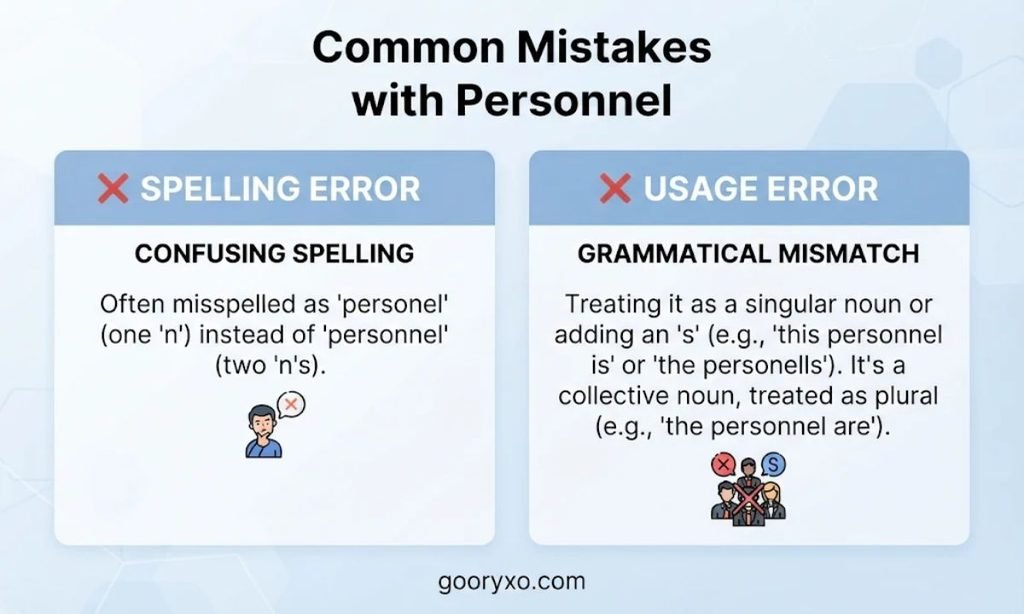
Mistakes around personnel or personel fall into four buckets: a dropped n, an extra l, an -al ending, or a mix-up with “personal.” Each one is easy to fix once you can spot it.
Mistake 1:
Dropping an n turns personnel into “personel,” the classic typo behind every personnel or personel search. It happens because the missing letter doesn’t change how the word sounds.
Example: Wrong: “The personel desk opens at nine.” Right: “The personnel desk opens at nine.”
Before you hit send, count two n’s between the o and the e.
Mistake 2:
Adding a second l gives you “personell.” The word ends in a single l.
Norwegian does spell it that way, which shows the form isn’t random. In English, though, it’s still wrong.
Example: Wrong: “Personell training starts Monday.” Right: “Personnel training starts Monday.”
Mistake 3:
Swapping the ending to -al gives you “personnal.” It’s a blend of “personal” and “personnel,” and it belongs to neither.
Example: Wrong: “Personnal benefits are listed on page two.” Right: “Personnel benefits are listed on page two,” if you mean staff benefits.
Mistake 4:
Using “personal” where “personnel” belongs, or the other way around, is the hardest slip to catch. Both are real words, so a spell checker stays quiet.
Example: “All personal must badge in” reads like a sign about private feelings. It should say personnel.
Other Common Misspellings of Personnel
A few foreign-language forms also sneak into English writing. “Personnelle” is the French feminine adjective, and “personeel” is the Dutch word for staff.
Neither works in English. If one of them lands in your draft, replace it with the plain double-n spelling.
Example: “Personeel handbook” becomes “personnel handbook.”
Easy Memory Trick for Spelling Personnel
To get personnel or personel right every time, break it into three chunks: per + son + nel. Say the chunks as you type and the double n practically writes itself.
Example: Typing “per-son-nel” in your head before a job post goes live is faster than fixing the typo later.
Here’s a second trick. Personnel is a noun, and the word “noun” has two n’s as well. Personal, the adjective, gets by with one.
Personnel vs Personal (Important Difference)

Personnel is a noun for a group of employees, while personal is an adjective meaning private or individual. They share a Latin root but do different jobs in a sentence.
Example: “Our personnel took personal days after the launch.” Both words show up, and neither can trade places with the other.
The stress is different, too. Personnel lands on the last syllable and personal on the first, so a listener rarely mixes them up. Writing is where the trouble starts.
Key Difference:
Look at what the word does in the sentence. If you could replace it with “staff,” you want personnel. If “private” or “own” fits, you want personal.
| Word | Part of speech | Meaning | Example |
| Personnel | Noun | Employees or staff | The personnel were briefed at noon. |
| Personal | Adjective | Private or individual | She kept a personal diary. |
Examples:
Pairs help here, so each one below puts the two words side by side. Notice how the sentence falls apart if you swap them.
- Example 1: Personnel records are stored in HR. Personal records are kept at home.
- Example 2: The company asked personnel to avoid sharing personal passwords.
- Example 3: A personnel issue involves staff. A personal issue involves someone’s private life.
Personnel File vs Personal File
A personnel file belongs to your employer, while a personal file is one you keep yourself. Both phrases are correct, which is why they trip people up.
Example: Your signed offer letter sits in your personnel file at work. Your tax receipts sit in your personal file at home.
The same split shows up in “personnel matter” and “personal matter.” A dispute between two coworkers could be called either one. It depends on whether you mean the staffing side or the private side.
Personnel in Everyday Examples
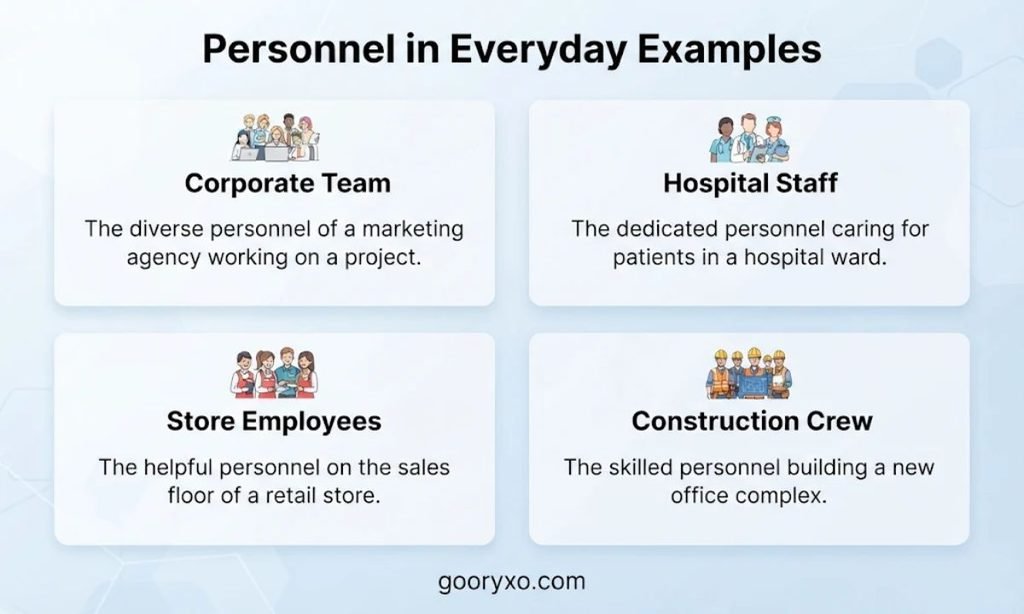
In daily writing, personnel appears wherever a team, a crew or a staff is mentioned. You’ll meet it on door signs, memos and news reports.
The examples below show where the personnel or personel question comes up most, sorted by setting, so you can borrow the phrasing that fits your own situation.
In Business:
In business, personnel usually refers to employees as a group, often when talking about hiring, costs or training. Terms like “HR personnel” and “support personnel” are common in staffing plans.
Example: Retail personnel receive a discount on every purchase.
Managers use it in plans and budgets, though “staff” and “team” sound warmer in everyday conversation.
In Military:
In military writing, personnel means the people serving, as opposed to the equipment they use.
Example: Medical personnel were flown in before the supplies arrived.
You’ll also see it in phrases like “military personnel,” “service personnel” and “security personnel.”
In Emails:
In emails, personnel suits notices that go out to a whole group. For a friendlier note, “team” or “everyone” often works better.
Example: Subject: Reminder for all personnel: fire drill at 10:30 a.m.
Check the subject line twice. The personnel or personel slip is hard to miss in bold type at the top of a message.
See Also Tons or Tonnes: Difference Meaning Conversion & Correct Usage
In Formal Writing:
In formal writing, personnel carries a neutral, official tone, which is why policies, contracts and reports lean on it.
Example: “Personnel management involves recruiting, training and retaining qualified staff.”
Is Personnel Singular or Plural?
Personnel usually takes a plural verb, though it can take a singular one when you mean staffing as a whole. Plural is the safer choice in most business writing.
Example: “All personnel are required to attend,” and with a number, “Twelve personnel were reassigned.”
Both patterns turn up in print. If a sentence sounds awkward either way, rewrite it with “staff” or “employees” and the problem disappears.
Personnel – Usage & Trends
In the personnel or personel contest, personnel is still the only standard spelling, and the one-n form only appears as a mistake. Linguix’s misspelling data backs that up.
Its records show “personel” as the most frequent wrong version, followed by “personell.” Keep in mind these percentages come from corrections logged by that tool’s users, not from the entire internet.
| Misspelling | Share of recorded errors |
| personel | 22.47% |
| personell | 13.59% |
| personnelle | 6.66% |
| personnal | 3.33% |
| personeel | 2.77% |
Workplace language has also shifted. Many companies now say “human resources” instead of “personnel department,” yet personnel lives on in military, security and government writing.
Key Insight:
The bigger risk isn’t the personel typo, it’s swapping personal and personnel. Spell checkers can’t flag it, since both are valid words.
Example: “Authorized personal only” passes a spell check and is still wrong.
Comparison Table: Personnel vs Personel
On personnel or personel, the verdict is simple: personnel is the standard English word, and personel is a misspelling. The table lays the differences out side by side.
| Feature | Personnel | Personel |
| Status in English | Standard spelling | Misspelling |
| Meaning | Employees or staff | None in English |
| Dictionary listing | Listed in major dictionaries | Not listed |
| Spell checker | Passes | Flagged |
| Example | The personnel meeting starts at ten. | The personel meeting starts at ten. |
“None in English” is the key phrase. Turkish does use “personel” for staff, and Indonesian and Polish have similar forms, which explains why the spelling feels familiar to some writers.
Personnel in Professional Contexts
Professionally, the personnel or personel choice signals care, since personnel appears in HR documents, business contracts and government notices.
A misspelled word in a policy or a proposal can make a reader doubt the rest of the page. Getting personnel right costs nothing and protects your credibility.
In HR (Human Resources):
In HR, personnel shows up in terms like personnel records, personnel policy and personnel management. Many departments have since renamed themselves “human resources,” but the older terms stuck around in paperwork.
Example: “Personnel records must be kept confidential and stored securely.”
In Business:
In business, personnel appears in hiring plans, payroll reports and contracts. “Key personnel” is a common contract phrase naming the people a client expects to see on a project.
Example: “The proposal lists three key personnel who will lead the implementation.”
In Government:
In government, personnel covers civil servants, administrative staff and security teams. The United States even has an agency called the Office of Personnel Management that handles federal workforce matters.
Example: “Administrative personnel will process the applications by Friday.”
Frequently Asked Questions
Is it personnel or personel?
It’s personnel. The word has two n’s, and “personel” is a misspelling.
If you’re ever unsure, picture the word split in three parts, per-son-nel, and type it back piece by piece.
Is personnel or personel the correct spelling in British English?
Personnel is correct in British English, just as it is in American English. The spelling doesn’t change by region, so “personel” is wrong on both sides of the Atlantic.
What does personnel mean?
Personnel means the people who work for an organization. It can also refer to the HR department in casual speech.
How do you pronounce personnel?
Say per-suh-NEL, with the stress on the last syllable. “Personal” puts the stress on the first syllable instead.
Is personnel singular or plural?
It’s usually treated as plural: “The personnel are ready.” A singular verb can appear when you mean staffing as a whole, but plural is the safer option.
What is the difference between personnel and personal?
Personnel is a noun meaning employees, and personal is an adjective meaning private. If “staff” fits the sentence, use personnel.
Is personel ever correct?
Not in English. In the personnel or personel debate, Turkish uses “personel” for staff, but in English writing it’s always an error.
Summary
Personnel or personel? The answer is personnel, with two n’s. It means the staff or employees of an organization, and the one-n version is only a typo.
The personnel or personel answer is the same in British and American English. Keep the stress on the last syllable, remember the personnel file, and let “personal” handle everything private.

My name is Ashfaq, and I am an English teacher with 5 years of teaching experience, specializing in English grammar. My mission is to make grammar easy to understand through simple explanations, practical examples, and helpful learning resources. At Gooryxo, I aim to help learners improve their grammar, strengthen their writing skills, and use English with confidence.

1 thought on “Personnel or Personel: Which Is Correct? Meaning & Examples”