
Tons or tonnes? Write “tonnes” for the metric unit of 1,000 kilograms, and “tons” for the American short ton of 2,000 pounds (about 907 kg). The UK, Europe, Australia and most scientific writing go with tonnes, the SI-accepted metric unit.
With tons or tonnes, the two words sound identical, but the weights differ by roughly 10%, and that gap matters on a cargo invoice or a climate report. This guide covers meaning, origin, conversions, regional habits and common slip-ups, including how tonnes translate into maunds for readers in Pakistan.
Tons or Tonnes – Quick Answer
Use “tonnes” when the figure is in kilograms and “tons” when it’s in pounds. That one test settles most tons or tonnes questions, and the rest of this article deals with the exceptions.
Example: A port notice in Karachi listing 12,000 tonnes of wheat means 12 million kilograms. A grain elevator in Texas reporting 12,000 tons is moving about 10.9 million kilograms. Same number, very different pile.
Quick facts:
- 1 tonne (t), also called a metric ton, is 1,000 kg, or about 2,204.62 lb.
- 1 short ton (US ton) is 2,000 lb, or about 907.18 kg.
- 1 long ton (old British ton) is 2,240 lb, or about 1,016.05 kg.
Simple Difference:
A tonne is exactly 1,000 kg, or about 2,204.6 pounds. A US ton is 2,000 pounds, or about 907.2 kg, which makes the tonne roughly 10% heavier.
Example: Two suppliers each promise 20 units of gravel. The one in Lahore means 20 tonnes (20,000 kg), while the one in Houston means 20 tons (about 18,144 kg). Nearly two tonnes quietly disappear in translation.
Examples:
The sentence pattern for tons or tonnes is identical. Only the unit behind the word changes.
- Example 1: The bridge is posted for a 40-ton limit. (An American road sign, so short tons.)
- Example 2: The recycling plant processed 3,500 tonnes of cardboard in March.
- Example 3: The exporter shipped 800 metric tons of rice to Dubai. (That’s the same weight as 800 tonnes.)
The Origin of Tons or Tonnes

Both halves of tons or tonnes grew out of “tun,” an Old English word for a big wine cask. English held on to “ton” for its pound-based units, while the metric system borrowed the French spelling, “tonne.”
Merchants had a practical reason to care about casks. A ship that held 200 tuns of wine could carry 200 tuns’ worth of cargo, and that was how freight fees and port taxes were worked out.
Origin of “Ton”
“Ton” and “tun” started out as spelling variants of one word. Ships were rated by how many wine tuns they could hold, and that capacity figure became “tunnage,” then “tonnage.”
Over the centuries “ton” drifted from a measure of space to a measure of weight. Britain’s long ton settled at 2,240 pounds, and the United States later chose a 2,000-pound short ton.
Example: Look at the word “tonnage” in a modern port report. It still carries the cask idea, because gross tonnage measures the inside volume of a ship, not its weight.
Origin of “Tonne”
“Tonne” is the French spelling, and it stuck on purpose. France built its metric system in the 1790s around the kilogram, so a thousand of them naturally became the tonne.
Keeping the French form made the unit harder to confuse with the pound-based ton. The International Bureau of Weights and Measures (BIPM) lists the tonne, symbol t, as a unit accepted for use with the SI, the international system of units.
Example: Say both words out loud and you get the same sound, /tʌn/. Nobody can hear which one you mean, which is exactly why writers need to be explicit on the page.
Tons vs Tonnes – Meaning Explained

“Ton” is a family of pound-based units, while “tonne” is a single fixed unit equal to 1,000 kilograms. The definition, not the spelling, is what causes the tons or tonnes mix-ups.
What Does “Tons” Mean?
“Ton” has three working meanings: the US short ton (2,000 lb), the British long ton (2,240 lb), and the informal “a lot.” Which one you’re looking at depends on where and when the sentence was written.
Example: “The old footbridge is posted for 10 tons.” In the US that’s roughly 9,072 kg.
In American writing it’s nearly always the short ton. Older trade papers sometimes say “net ton” (a short ton) or “gross ton” (a long ton), which are just other names for the same two weights.
Types of Tons
Three units sit behind the tons or tonnes confusion, and the metric tonne belongs in the comparison even though it’s spelled differently.
| Unit | Pounds | Kilograms | Where you’ll meet it |
| Short ton (US ton, net ton) | 2,000 | 907.18 | United States, some Canadian trade |
| Long ton (imperial ton, gross ton) | 2,240 | 1,016.05 | Older British texts, historic shipping records |
| Tonne (metric ton) | 2,204.62 | 1,000 | Most of the world, science, international trade |
The long ton is the awkward one. It’s spelled like the American unit but weighs more than a tonne, so “10 long tons of steel bar” is about 10,160 kg, a little over 10 tonnes.
Examples:
Short ton, long ton and informal “ton” all read the same on the page. Context is your only clue.
- Example 1: The freight car holds 100 tons of coal. (US short tons, about 90.7 tonnes.)
- Example 2: A Victorian ship’s register lists her at 1,800 tons. (Probably long tons, or a tonnage measure.)
- Example 3: She’s got tons of patience. (No weight involved at all.)
What Does “Tonnes” Mean?
In the tons or tonnes pairing, a tonne is a metric unit of mass equal to 1,000 kilograms, and it is the unit most countries use for large loads and international trade. You’ll also see it written as “metric ton” or “metric tonne.”
Example: “The mine produced 4,500 tonnes of copper ore last quarter.” A reader in Chile, India or Canada hears 4.5 million kilograms.
US government publications generally write “metric ton” where everyone else writes “tonne.” It’s the same unit with a different name tag.
See Also Channel vs Chanel: Which Spelling Is Correct?
Metric Definition:
One tonne equals 1,000 kg, which is also one megagram (Mg) and about 2,204.62 pounds. That figure never changes, unlike the pound-based tons, which differed by country and era. Strictly speaking, a tonne measures mass, but everyday writing treats mass and weight as the same thing.
Example: A small hatchback that weighs 1,200 kg weighs 1.2 tonnes. Park five of them on a trailer and you’ve loaded roughly six tonnes.
Examples:
Tonnes show up wherever numbers get large and need to be compared across borders.
- Example 1: The refinery loads about 6,000 tonnes of diesel a day.
- Example 2: Farmers in the district harvested 90,000 tonnes of sugarcane.
- Example 3: The new cargo crane is rated to lift 45 tonnes.
Abbreviations: t, MT, tn, LT
When you shorten tons or tonnes, use “t” for tonnes in scientific and engineering writing, “tn” or “ton” for short tons, and “LT” for long tons. Trade paperwork often uses “MT” for metric ton, and capital letters matter there.
A capital M with a lowercase t (“Mt”) means megatonne, which is a million tonnes. Lowercase “mt” is unclear, so spell it out if there’s any doubt.
Example: “Output reached 12 Mt” is twelve million tonnes. “Output reached 12 MT” on a shipping document means twelve metric tons, a million times less.
British English vs American English Usage
Americans say “ton” for 2,000 lb and “metric ton” for 1,000 kg, while British English says “tonne” for the metric unit. So the tons or tonnes split is less about spelling and more about which measurement system a country actually runs on.
Main Rule:
For tons or tonnes, follow the measurement system your reader lives in, and name the unit whenever the number matters. For a US audience “metric ton” is clear, and for most other readers “tonne” is.
Example: A US trade paper might write that a mill ships 5,000 metric tons a week. A British paper covering the same mill says 5,000 tonnes a week. The facts match and the words don’t.
Comparison Table
Here’s how tons or tonnes usage breaks down by region.
| Region | Usual wording | Notes |
| United States | ton (2,000 lb), “metric ton” for 1,000 kg | Short ton is the everyday unit |
| United Kingdom | tonne | “Ton” stays in older texts and casual speech |
| Ireland, Australia, New Zealand | tonne | Metric for trade and industry |
| Canada | tonne | Short tons still appear in trade tied to the US |
| Continental Europe | tonne (and local equivalents) | Metric throughout |
| Pakistan, India | tonne | Pakistan’s markets also still talk in maunds |
| International science | tonne (t) | Standard in climate and engineering reports |
The UK is the one that trips people up. Road signs there show weight limits with a “t” for tonnes, yet many older people still say “ton” out of habit.
See Also Channel vs Chanel: Which Spelling Is Correct?
Which One Should You Use?
Choosing between tons or tonnes is simple: pick “tonnes” for kilograms and international readers, and “tons” for pounds and American readers. If your audience is mixed, give the metric figure and put the other in brackets.
Use “Tons” When:
- Your readers are mainly in the United States.
- You’re quoting a source that reports short tons.
- The figure is based on pounds.
- You mean “a lot,” as in “tons of emails.”
Example: A US lumber yard advertising “2 tons of mulch” is selling 4,000 pounds, which is about 1,814 kg.
Use “Tonnes” When:
- The figure is in kilograms.
- You’re writing for an international or scientific audience.
- The document is a report, contract or standard that uses metric throughout.
- You’re covering freight, mining or emissions outside the US.
Example: “The tanker can carry 80,000 tonnes of crude” is the safest phrasing for a worldwide readership.
Simple Rule:
For tons or tonnes, pounds point to “ton” and kilograms point to “tonne.” Whenever the weight actually matters, add the conversion in brackets so nobody has to guess.
Example: “The shipment weighs 5,000 tons (about 4,536 tonnes).” One short line removes all ambiguity.
What Do Style Guides Say?
American newsroom and government style generally writes “metric ton” for the 1,000 kg unit. British and international publications generally write “tonne.”
Whichever house style you follow for tons or tonnes, being consistent inside one document matters more than the choice itself. Check your own guide, then stick to it from the first line to the last.
Example: An article that says “3 tonnes” in the second paragraph and “3 metric tons” in the sixth will look careless even though both are right.
Common Mistakes with Tons or Tonnes

The three biggest tons or tonnes errors are treating the units as identical, mixing systems in one document, and assuming “tonne” is a typo. Each one is easy to avoid once you’ve seen it.
Mistake 1
Many writers treat tons or tonnes as the same weight. The 10% gap sounds small until the numbers get big.
Example: A cargo of 40,000 short tons is about 36,287 tonnes. Call it 40,000 tonnes by mistake and you’ve invented 3,713 tonnes of cargo.
Mistake 2
Using “tons” in a metric scientific or technical report is a common slip. Readers will assume you mean tonnes and may not notice the error, which can spoil the data.
Example: “Emissions fell by 4 million tons” in a document that otherwise uses kilograms and litres should read “4 million tonnes.”
Mistake 3
Writers often forget who’s reading. A reader in Lagos or Lahore sees “tons” and may think of a long ton or just “a lot.”
Example: A British engineer writing to a US client should say “8 tonnes (about 8.8 US tons)” rather than just “8 tons.”
Mistake 4
Some people treat “tonne” as a misspelling and change it to “ton.” It isn’t a typo, and it isn’t only a British quirk. It’s the international name for the metric unit.
Saying “metric tonne” repeats itself a little, but everyone understands it and it does no harm.
Example: A proofreader who changes “6 tonnes of cement” to “6 tons of cement” has just swapped 6,000 kg for about 5,443 kg.
Tons or Tonnes in Everyday Examples
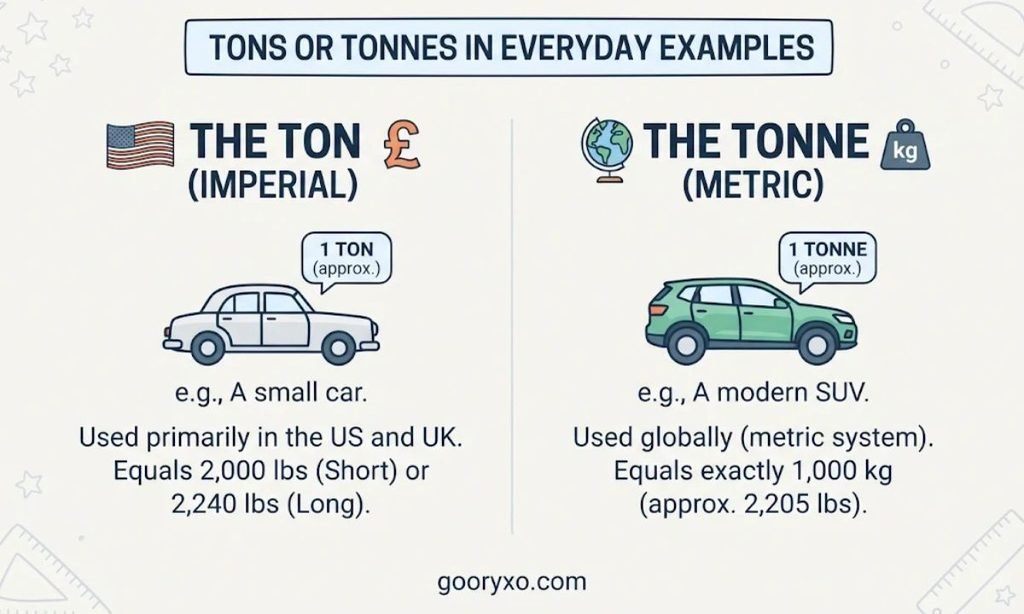
In daily life, “tons” turns up in American trucking, home projects and casual talk, while “tonnes” turns up in freight, mining and climate reporting. With tons or tonnes, the industry usually tells you which one fits.
Construction
On a building site, tons or tonnes depends on the country. Builders outside the US order bulk materials in tonnes, while American contractors order them in tons or cubic yards.
Example: A UK builder orders 6 tonnes of sharp sand for a patio base. A contractor in Ohio orders 7 tons of crushed stone for a driveway. Seven short tons is about 6.4 tonnes, so the two orders are close.
Shipping
For tons or tonnes at sea, global freight is priced and tracked in tonnes, and ship capacity is quoted as deadweight tonnage. The biggest iron-ore carriers can load around 400,000 tonnes.
Example: “The port handled 2.4 million tonnes of container cargo this year” is how most international ports report their yearly volume.
News Reports
In headlines, tons or tonnes follows the outlet’s home country. Headlines lean toward “tonnes” for disasters, seizures and production figures, and on “tons” for American stories. Watch the outlet’s country before you convert.
Example: A British headline about police seizing 3 tonnes of illegal tobacco refers to 3,000 kg. An American story about 3 tons would be about 2,722 kg.
Social Media
On social media nearly everything is informal, so “tons” mostly means “a lot.” People rarely check the unit because no one is weighing anything.
Example: “Got tons of laundry waiting” is a mood, not a measurement.
Tons or Tonnes – Google Trends & Usage Data
Search habits for tons or tonnes follow the measurement system, not the dictionary. Readers in metric countries look up “tonne,” while many Americans look up “ton” and “metric ton.”
You can check this yourself in a minute. Open Google Trends, compare “tonne” and “ton,” then switch the region between the US, the UK, India and Australia. The split is usually clear straight away.
Key Insight:
For tons or tonnes, wherever the metric system is the legal standard, “tonne” tends to win. In the US the picture is mixed because “ton” and “metric ton” share the field.
Example: A cross-border seller who runs ads for “metric ton” in the US and “tonne” in the UK is just matching how local buyers actually type.
Comparison Table: Tons vs Tonnes
In the tons or tonnes comparison, a tonne sits between the short ton and the long ton in weight. The table lays out all three at a glance.
| Feature | Short ton (US) | Long ton (imperial) | Tonne (metric) |
| Pounds | 2,000 | 2,240 | 2,204.62 |
| Kilograms | 907.18 | 1,016.05 | 1,000 |
| Symbol | tn | LT | t |
| Based on | Pounds | Pounds | Kilograms |
| Typical home | United States | Historic Britain | Most of the world |
| Common in science | No | No | Yes |
Example: Put a short ton, a tonne and a long ton on the same scale and the readings climb in that order: 907 kg, 1,000 kg, 1,016 kg. The tonne is about 10% heavier than the short ton and about 1.6% lighter than the long ton.
Tons to Tonnes Conversion (Formula + Quick Table)
Converting tons or tonnes is simple arithmetic. To convert short tons to tonnes, multiply by 0.9072. To go the other way, multiply tonnes by 1.1023.
For long tons, multiply by 1.0160 to get tonnes, and multiply tonnes by 0.9842 to get long tons.
Example: Twelve short tons × 0.9072 is about 10.89 tonnes. Going back, 250 tonnes × 1.1023 is about 275.58 short tons.
| Tonnes | Short tons | Long tons |
| 1 | 1.102 | 0.984 |
| 5 | 5.512 | 4.921 |
| 10 | 11.023 | 9.842 |
| 50 | 55.116 | 49.210 |
| 100 | 110.231 | 98.421 |
A quick mental shortcut: to estimate short tons from tonnes, add about 10%. To estimate tonnes from short tons, take off about 9%. It’s not exact, but it’s close enough for a first check.
Why the Metric Tonne Matters Internationally
In the tons or tonnes debate, the metric tonne gives buyers, sellers and regulators in different countries one weight everyone reads the same way. That removes a whole class of invoice disputes.
Global crude steel output runs just under 1.9 billion tonnes a year, and no one trading at that scale wants to argue over which ton they meant. Contracts, customs paperwork and shipping manifests all work more smoothly when the unit is fixed.
Example: A Pakistani exporter quotes 500 tonnes of cotton yarn to a buyer in Italy. Both sides read exactly 500,000 kg, with no conversion table needed.
Tons vs Tonnes in Pakistan (Maunds Conversion)
In Pakistan, tons or tonnes questions get a local twist. Industrial and commercial markets quote bulk goods in tonnes, but many traders still think in maunds. One maund is 40 seers, or about 37.32 kg, so one tonne is roughly 26.8 maunds.
| Tonnes | Maunds (approx.) |
| 1 | 26.79 |
| 5 | 133.96 |
| 10 | 267.92 |
Example: A buyer ordering 8 tonnes of scrap iron is buying about 214 maunds. Ask a dealer for “200 maunds” instead, and you’d get around 7.5 tonnes.
Some dealers round the figure to make mental math easier, and you’ll hear numbers like 25 or 27 maunds per tonne in practice. For anything that carries a price tag, confirm the exact conversion in writing before the deal closes.
Tons vs Tonnes in Environmental Reports
For tons or tonnes in climate work, reports use tonnes so that figures from different countries can be added up without conversions. Even US agencies tend to write “metric tons” in these reports to mean the same thing.
Example: Global fossil-fuel and industrial CO₂ emissions have been estimated at around 37 billion tonnes a year in recent assessments by the Global Carbon Project. Switch that to short tons and the number grows by about 10%, which is why climate reports don’t do it.
You’ll also see “tCO₂e,” which means tonnes of carbon dioxide equivalent. It lets a report turn methane and other gases into one number that can be compared.
Tons as Informal English
“Tons of” is an everyday way to say “a lot of,” and it has nothing to do with weight. It works with countable and uncountable nouns alike, and it’s the one place where tons or tonnes stops mattering.
British English also uses “tonnes of” in the same casual way, so the informal sense isn’t limited to the word “tons.”
Examples:
Informal use is flexible. You can use it with nouns, or even as an adverb.
- Example 1: I’ve got tons of emails to clear before lunch.
- Example 2: He felt tons better after a night’s sleep.
- Example 3: They spent tonnes of money on that kitchen. (Common in British English.)
Simple Trick to Remember the Difference
A handy way to settle tons or tonnes is to remember that the longer spelling is heavier. “Tonne” (2,204 lb) outweighs the American “ton” (2,000 lb). The one catch is the old British long ton, which is heavier still.
Easy Memory Rule
For tons or tonnes, link “tonne” with kilograms and “ton” with pounds. If you can keep that pair in your head, you can get the right word almost every time.
Example: A recipe that says 2 kg of flour and a bag that says 5 lb of flour use the same split. Kilograms and tonnes belong together, and pounds and tons do too.
Quick Reminder
Before choosing tons or tonnes, check the unit on the number. If it’s kilograms, write tonnes, and if it’s pounds, write tons.
Example: “4,000 kg of fertiliser” becomes “4 tonnes of fertiliser.” “8,000 lb of fertiliser” becomes “4 tons of fertiliser.”
Related Terms: Tonnage, Kilotonne, Megatonne, Deadweight Tonnage
Several terms built around tons or tonnes show up in news and shipping, and they don’t all measure weight. Knowing which ones do, and which don’t, saves a lot of confusion.
| Term | What it means |
| Tonnage | A ship’s capacity or a port’s total cargo handled, depending on context |
| Kilotonne (kt) | 1,000 tonnes |
| Megatonne (Mt) | 1 million tonnes |
| Gigatonne (Gt) | 1 billion tonnes |
| Deadweight tonnage (DWT) | How much cargo, fuel and supplies a ship can carry, in tonnes |
| Gross tonnage (GT) | A measure of a ship’s inside volume, not a weight |
| Displacement tonnage | The weight of the water a floating ship pushes aside, in tonnes |
| Ton of TNT | A unit of energy, fixed at 4.184 gigajoules |
| Ton of refrigeration | A cooling rate of 12,000 BTU per hour (about 3.5 kW) |
Example: A report saying a bulk carrier has 180,000 DWT means it can carry about 180,000 tonnes of load. A bomb described as “one kiloton” is measuring explosive energy, not the weight of the device.
Frequently Asked Questions
Is it tons or tonnes?
Tons or tonnes are both correct, and the right one depends on the unit. Use “tonnes” for the metric 1,000 kg unit and “tons” for the US short ton of 2,000 pounds.
Is a tonne heavier than a ton?
A tonne is about 10% heavier than a US short ton, but about 1.6% lighter than a British long ton. So the answer depends on which “ton” you mean.
Is a metric ton the same as a tonne?
Yes, they’re two names for the same 1,000 kg unit. “Tonne” is the international spelling and “metric ton” is the usual US phrase.
Which spelling should I use in American English?
Write “ton” for 2,000 pounds and “metric ton” for 1,000 kg. “Tonne” is understood and fine in scientific or international writing aimed at US readers.
Does the UK say ton or tonne?
British English uses “tonne” for the metric unit in trade, law and science. “Ton” stays in older texts and casual speech.
How many kilograms are in a ton?
A US short ton is 907.18 kg, a British long ton is 1,016.05 kg, and a metric tonne is exactly 1,000 kg. Which one you need depends on the source of the number.
Does “tons of” refer to weight?
No. In casual English “tons of” simply means “a lot of,” and it has no connection to any weight system.
Summary
Tons or tonnes comes down to the unit behind the number. A tonne is exactly 1,000 kg, a US short ton is 2,000 pounds, and a British long ton is 2,240 pounds.
Choose tonnes for metric and international writing, and tons for pound-based or American contexts. When the weight matters, show both figures so tons or tonnes never turns into a costly guess.

My name is Ashfaq, and I am an English teacher with 5 years of teaching experience, specializing in English grammar. My mission is to make grammar easy to understand through simple explanations, practical examples, and helpful learning resources. At Gooryxo, I aim to help learners improve their grammar, strengthen their writing skills, and use English with confidence.

1 thought on “Tons or Tonnes: Difference Meaning Conversion & Correct Usage”